

This document is a PhilosophersNotes summary by Brian Johnson of Don Miguel Ruiz’s *The Four Agreements*, a book rooted in ancient Toltec wisdom that offers four practical principles for breaking free from the limiting social conditioning — or “domestication” — that shapes human behavior from childhood through systems of reward and punishment. The first agreement, “Be Impeccable with Your Word,” calls for speaking with integrity, avoiding self-judgment, gossip, and blame, and honoring only commitments one truly intends to keep. The second, “Don’t Take Anything Personally,” teaches that other people’s actions and words are reflections of their own inner world, not yours, freeing one from unnecessary hurt and emotional reaction. The third, “Don’t Make Assumptions,” urges asking questions and seeking clarity rather than inventing narratives that lead to misunderstanding and unnecessary drama. The fourth, “Always Do Your Best,” acknowledges that one’s best will vary from moment to moment but insists on consistent effort as the foundation that makes the other three agreements sustainable habits. The note also emphasizes that personal freedom begins with awareness, that we are ultimately our own greatest obstacle, that breaking old patterns requires patience and gradual step-by-step effort, and that mastery comes through repetition — connecting Ruiz’s teachings to parallel wisdom from Aristotle, Stoic philosophers, and modern thinkers.

TM
PhilosophersNotes
More Wisdom in Less Time
Brian Johnson’s
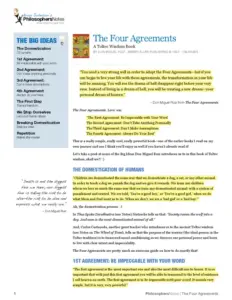
“You need a very strong will in order to adopt the Four Agreements—but if you
can begin to live your life with these agreements, the transformation in your life
will be amazing. You will see the drama of hell disappear right before your very
eyes. Instead of living in a dream of hell, you will be creating a new dream—your
personal dream of heaven.”
~ Don Miguel Ruiz from The Four Agreements
The Four Agreements. Love ‘em:
“The First Agreement: Be Impeccable with Your Word
The Second Agreement: Don’t Take Anything Personally
The Third Agreement: Don’t Make Assumptions
The Fourth Agreement: Always Do Your Best”
This is a really simple, really cool, really powerful book—one of the earlier books I read on my
own journey and one I think you’ll enjoy as well if you haven’t already read it!
Let’s take a peek at some of the Big Ideas Don Miguel Ruiz introduces us to in this book of Toltec
wisdom, shall we?! :)
THE DOMESTICATION OF HUMANS
“Children are domesticated the same way that we domesticate a dog, a cat, or any other animal.
In order to teach a dog we punish the dog and we give it rewards. We train our children
whom we love so much the same way that we train any domesticated animal: with a system of
punishment and reward. We are told, ‘You’re a good boy,’ or ‘You’re a good girl,’ when we do
what Mom and Dad want us to do. When we don’t, we are a ‘bad girl’ or a ‘bad boy.’”
Ah, the domestication process. :)
In Thus Spoke Zarathustra (see Notes) Nietzsche tells us that: “Society tames the wolf into a
dog. And man is the most domesticated animal of all.”
And, Carlos Castaneda, another great teacher who introduces us to the ancient Toltec wisdom
(see Notes on The Wheel of Time), tells us that the purpose of the warrior (the ideal person in the
Toltec tradition) is to transcend social conditioning as we discover our personal power and learn
to live with clear intent and impeccability.
The Four Agreements are pretty much an awesome guide on how to do exactly that!
1ST AGREEMENT: BE IMPECCABLE WITH YOUR WORD
“The first agreement is the most important one and also the most difficult one to honor. It is so
important that with just this first agreement you will be able to transcend to the level of existence
I call heaven on earth. The first agreement is to be impeccable with your word. It sounds very
simple, but it is very, very powerful.”
The Four Agreements
A Toltec Wisdom Book
BY DON MIGUEL RUIZ · AMBER-ALLEN PUBLISHING © 1997 · 138 PAGES
THE BIG IDEAS
The Domestication
Of humans.
1st Agreement:
Be impeccable with your word.
2nd Agreement:
Don’t take anything personally.
3rd Agreement:
Don’t make assumptions.
4th Agreement:
Always do your best.
The First Step
Toward freedom.
We Stop Ourselves
Let’s not blame others.
Breaking Domestication
Step-by-step.
Repetition
Makes the master.
1
PhilosophersNotes | The Four Agreements
“Death is not the biggest
fear we have; our biggest
fear is taking the risk to be
alive—the risk to be alive and
express what we really are.”
~ Don Miguel Ruiz

Being impeccable with our word. This is big.
First, let’s look at how Ruiz defines the word impeccability: “Impeccability means ‘without sin.’
Impeccable comes from the Latin pecatus, which means ‘sin.’ The im in impeccable means
‘without,’ so impeccable means ‘without sin.’ Religions talk about sin and sinners, but let’s
understand what it really means to sin. A sin is anything that you do which goes against yourself.
Everything you feel or believe or say that goes against yourself is a sin. You go against yourself
when you judge or blame yourself for anything. Being without sin is exactly the opposite. Being
impeccable is not going against yourself. When you are impeccable, you take responsibility for
your actions, but you do not judge or blame yourself.”
Brilliant.
So when we’re impeccable, we don’t use our word against ourselves indulging in guilt or shame.
We also don’t use our word against others
in blaming, criticizing or gossiping. We also honor our
commitments and only make commitments we intend to follow through on.
How’re you doing on those fronts?
In The Diamond Cutter (see Notes), Geshe Michael Roach talks about the fact that in Tibet
they don’t even have a word for “guilt.” As he says: “There’s no word in Tibetan for ‘guilty.’ The
closest thing is ‘intelligent regret that decides to do things differently.’”
Geshe Roach also describes blame/criticism/complaining/etc. as “useless talk.” It depletes us of
energy and wires our brains in ways we don’t wanna be wired. So, uh, let’s get impeccable with
our word and stop all blame and criticism—of ourselves and others; and, while we’re at it, let’s
get rid of all the complaining and gossip as well! :)
Now, let’s address being impeccable with our word as it relates to commitments.
Do you honor your commitments? When you say you’re going to do something, do you *really*
intend to follow through and then DO you? Or, do you kinda say “Yes” to every request because
you think you need to and you figure you can always flake later? We’ve all said “Yes” too often
when a polite “No” would’ve been more appropriate but let’s practice honoring our word and the
commitments we make, shall we?!
(While we’re on the subject of sin, did you know that, according to Wikipedia: “in the biblical
Hebrew, the generic word for sin is het. It means to err, to miss the mark. It does not mean to
do evil.” Paulo Coelho (see Notes) talks about the fact that to sin, from this perspective, is kinda
like an archer missing the bulls-eye. Cool, eh?)
2ND AGREEMENT: DON’T TAKE ANYTHING PERSONALLY
“Whatever happens around you, don’t take it personally… if I see you on the street and say,
‘Hey, you are so stupid,’ without knowing you, it’s not about you; it’s about me. If you take it
personally, then perhaps you believe you are stupid. Maybe you think to yourself, ‘How does he
know? Is he clairvoyant, or can everybody see how stupid I am?’”
This is another theme that all the great teachers come back to again and again and again (and
again :).
How about some Marcus Aurelius, Seneca and Deepak Chopra?
Marcus Aurelius (see Notes on Meditations) reminds us not to worry about the opinion of other
people who don’t even have a good opinion of themselves! He tells us: “The approval of such
men, who do not even stand well in their own eyes, has no value for him.”
And Seneca (see Notes on Letters from a Stoic) reminds us that the world is so inconsistent in
its opinions we should just be done with it. He says: “Away with the world’s opinion of you, it’s
2
PhilosophersNotes | The Four Agreements
“When you make it a strong
habit not to take anything
personally, you avoid many
upsets in your life. Your
anger, jealousy, and envy
will disappear, and even
your sadness will simply
disappear if you don’t take
things personally.”
~ Don Miguel Ruiz
“Write this agreement on
paper, and put it on your
refrigerator to remind you
all the time: Don’t take
anything personally.”
~ Don Miguel Ruiz

always unsettled and divided.”
While Ervin Seale (see Notes on Take Off from Within) reminds us: “There is one recurring,
persistent, perennial, and dogging personal problem which, more than any other, steals the
force and peace of people and ruins projects and enterprises and careers. It is the habit of
feeling hurt because of what others do or do not do and what they say or do not say.”
Deepak Chopra (see Notes on The Spontaneous Fulfillment of Desire) has a mantra I’ve said
thousands of times:
I’m totally independent of the good or bad opinion of others.
I’m totally independent of the good or bad opinion of others.
I’m totally independent of the good or bad opinion of others.
I’m totally independent of the good or bad opinion of others.
I’m totally independent of the good or bad opinion of others.
Why is this such a big deal?
Because, as Don Miguel Ruiz says: “Nothing other people do is because of you. It is because
of themselves.”
Let’s think about it. Imagine interacting with the same person in two different situations.
First: the person had an AWESOME day—they got a great night of sleep, won the lottery and
every other thing that could’ve possibly gone well for them unfolded. They’re feelin’ great. How
do you think they’re gonna treat us? Probably pretty well, eh?
Now, same person. This time, they got a really bad night of sleep, lost their job, got in a car
accident, didn’t eat all day long and every other annoying thing that could’ve happened,
happened. Not in such a good mood. How do you think they’re gonna treat us now? Prolly no
where near as well as when they’re rested, happy and all that jazz, eh?
The important thing to note here is that WE were exactly the same in both situations. But if we
base our opinion of ourselves on how someone else treats us, we’re in trouble.
Again, as Ruiz says: “Nothing other people do is because of you. It is because of themselves.”
3RD AGREEMENT: DON’T MAKE ASSUMPTIONS
“We have the tendency to make assumptions about everything. The problem with making
assumptions is that we believe they are the truth. We could swear they are real. We make
assumptions about what others are doing or thinking—we take it personally—then we blame
them and react by sending emotional poison with our word. That is why when we make
assumptions, we’re asking for problems. We make an assumption, we misunderstand, we take it
personally, and we end up creating a whole big drama for nothing.”
Well, there ya go!
The third agreement: Don’t make assumptions.
Are you making any assumptions about what someone’s thinking or doing? Can you see how
the drama factor can go down
*dramatically* (pun intended) if we just have the courage to ask
what’s up?
As Ruiz says: “The way to keep yourself from making assumptions is to ask questions. Make sure
the communication is clear. If you don’t understand, ask. Have the courage to ask questions until
you are as clear as you can be.”
So… Let’s identify where we’re making some assumptions and have the courage to ask ‘em what’s
up and get out of the drama of assumption-ville, shall we?!? :)
3
PhilosophersNotes | The Four Agreements
“When you transform
your whole dream, magic
just happens in your life.
What you need comes to
you easily because spirit
moves freely through
you. This is the mastery
of intent, the mastery of
spirit, the mastery of love,
the mastery of gratitude,
and the mastery of life.
This is the goal of the
Toltec. This is the path to
personal freedom.”
~ Don Miguel Ruiz