ACT 4 of The Crucible By Arthur Miller

ACT 4 of The Crucible By Arthur Miller

Act 4 of Arthur Miller's The Crucible unfolds in a Salem jail, where the tension surrounding the witch trials reaches its peak. Key characters, including John Proctor, Elizabeth Proctor, and Reverend Hale, grapple with themes of integrity, guilt, and societal pressure. As Proctor faces execution, the moral dilemmas of truth and sacrifice come to the forefront, revealing the devastating impact of hysteria on the community. This act serves as a critical examination of the consequences of fear and the struggle for personal redemption. Ideal for students studying American literature or exploring themes of justice and morality.

Key Points

  • Explores the moral dilemmas faced by John Proctor as he contemplates confessing to witchcraft.
  • Highlights the societal pressures and hysteria that drive the Salem witch trials.
  • Features key characters like Elizabeth Proctor and Reverend Hale in pivotal roles.
  • Examines themes of integrity, sacrifice, and the quest for redemption in a repressive society.
82
/ 8
1
The Crucible
By Arthur Miller
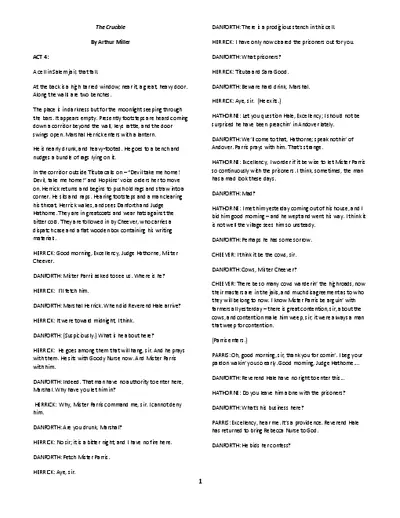
ACT 4:
A cell in Salem jail, that fall.
At the back is a high barred window; near it, a great, heavy door.
Along the walls are two benches.
The place is in darkness but for the moonlight seeping through
the bars. It appears empty. Presently footsteps are heard coming
down a corridor beyond the wall, keys rattle, and the door
swings open. Marshal Herrick enters with a lantern.
He is nearly drunk, and heavy-footed. He goes to a bench and
nudges a bundle of rags lying on it.
In the corridor outside Tituba calls on “Devil take me home!
Devil, take me home!” and Hopkins’ voice orders her to move
on. Herrick returns and begins to push old rags and straw into a
corner. He sits and naps. Hearing footsteps and a man clearing
his throat, Herrick wakes, and sees Danforth and Judge
Hathorne. They are in greatcoats and wear hats against the
bitter cold. They are followed in by Cheever, who carries a
dispatch case and a flat wooden box containing his writing
materials.
HERRICK: Good morning, Excellency, Judge Hathorne, Mister
Cheever.
DANFORTH: Mister Parris asked to see us. Where is he?
HERRICK: I‘ll fetch him.
DANFORTH: Marshal Herrick. When did Reverend Hale arrive?
HERRICK: It were toward midnight, I think.
DANFORTH: (Suspiciously.) What is he about here?
HERRICK: He goes among them that will hang, sir. And he prays
with them. He sits with Goody Nurse now. And Mister Parris
with him.
DANFORTH: Indeed. That man have no authority to enter here,
Marshal. Why have you let him in?
HERRICK: Why, Mister Parris command me, sir. I cannot deny
him.
DANFORTH: Are you drunk, Marshal?
HERRICK: No sir; it is a bitter night, and I have no fire here.
DANFORTH: Fetch Mister Parris.
HERRICK: Aye, sir.
DANFORTH: There is a prodigious stench in this cell.
HERRICK: I have only now cleared the prisoners out for you.
DANFORTH: What prisoners?
HERRICK: Tituba and Sara Good.
DANFORTH: Beware hard drink, Marshal.
HERRICK: Aye, sir. (He exits.)
HATHORNE: Let you question Hale, Excellency; I should not be
surprised he have been preachin‘ in Andover lately.
DANFORTH: We‘ll come to that, Hathorne; speak nothin‘ of
Andover. Parris prays with him. That‘s strange.
HATHORNE: Excellency, I wonder if it be wise to let Mister Parris
so continuously with the prisoners. I think, sometimes, the man
has a mad look these days.
DANFORTH: Mad?
HATHORNE: I met him yesterday coming out of his house, and I
bid him good morning and he wept and went his way. I think it
is not well the village sees him so unsteady.
DANFORTH: Perhaps he has some sorrow.
CHEEVER: I think it be the cows, sir.
DANFORTH: Cows, Mister Cheever?
CHEEVER: There be so many cows wanderin’ the highroads, now
their masters are in the jails, and much disagreement as to who
they will belong to now. I know Mister Parris be arguin’ with
farmers all yesterday there is great contention, sir, about the
cows, and contention make him weep, sir; it were always a man
that weep for contention.
(Parris enters.)
PARRIS: Oh, good morning, sir, thank you for comin‘. I beg your
pardon wakin‘ you so early. Good morning, Judge Hathorne….
DANFORTH: Reverend Hale have no right to enter this
HATHORNE: Do you leave him alone with the prisoners?
DANFORTH: What‘s his business here?
PARRIS: Excellency, hear me. It’s a providence. Reverend Hale
has returned to bring Rebecca Nurse to God.
DANFORTH: He bids her confess?
2
PARRIS: Hear me. Rebecca have not given me a word this three
months since she came. Now she sits with him, and her sister
and Martha Corey and two or three others, and he pleads with
them confess their crimes and save their lives.
DANFORTH: Whythis is indeed a providence. And they soften,
they soften?
PARRIS: Not yet, not yet. But I thought to summon you, sir, that
we might not think on whether it be not wise to I had thought
to put a question, sir, and I hope you will not
DANFORTH: Mister Parris, be plain, what troubles you?
PARRIS: There is news, sir, that the court, the court must reckon
with. My niece, sir, my niece I believe she has vanished.
DANFORTH: Vanished!
PARRIS: I had thought to advise you of it earlier in the week,
but…
DANFORTH: Why?how long is she gone?
PARRIS: This be the third night. She and Mercy Lewis are both
gone.
DANFORTH: I will send a party for them. Where may they be?
PARRIS: Excellency, I think they be aboard a ship. My daughter
tells me how she hears them speakin‘ of ships last week, and
tonight I discover my… my strongbox is broken into.
HATHORNE: She have robbed you?
PARRIS: Thirty-one pound is gone. I am penniless.
DANFORTH: Mister Parris, you are a brainless man!
PARRIS: Excellency, it profit nothing you should blame me. I
cannot think they would run off except they fear to keep in
Salem anymore. Mark it, sir, Abigail had close knowledge of the
town, and since the news of Andover has broken here
DANFORTH: Andover is remedied. The court returns there on
Friday, and will resume examinations.
PARRIS: I am sure of it, sir. But the rumor here speaks rebellion
in Andover, and it…
DANFORTH: There is no rebellion in Andover!
PARRIS: I tell you what is spoken here, sir. Andover have thrown
out the court, they say, and will have no part of witchcraft.
There be a faction here feeding on that news, and I tell you true,
sir, I fear there will be riot here.
HATHORNE: Riot!Why, at every execution I have seen naught
but high satisfaction in the town.
PARRIS: Judge Hathorneit were another sort that hanged till
now. Rebecca Nurse is no Bridget that lived three year with
Bishop before she married him. John Proctor is not Isaac Ward
that drank his family to ruin. (To Danforth.) I would to God it
were not so, Excellency, but these people have great weight yet
in the town. Let Rebecca stand upon the gibbet and send up
some righteous prayer, and I feel she‘ll wake a vengeance on
you.
HATHORNE: Excellency, she is a condemned witch.
DANFORTH: Pray you
HATHORNE: The court have
DANFORTH: How do you propose that, Mister Parris?
PARRIS: Excellency… I would postpone these hangin‘s for a time.
DANFORTH: There will be no postponement.
PARRIS: Now Mister Hale‘s returned, there is hope, I think—for if
he bring even one of these to God, that confession surely damns
the others in the public eye, and none may doubt any more that
they are all linked to Hell. This way, unconfessed and claiming
innocence, doubts are multiplied, and honest people will weep
for them, and our good purpose is lost in their tears. It cannot be
forgot, sir, that when I summoned the congregation for John
Proctor‘s excommunication, there were hardly thirty people
come to hear it. That speak a discontent, I think, and…
DANFORTH: There will be no postponement. Now, sir, which of
the condemned, in your opinion, may be brought to God? I will,
myself, strive with him ‘till dawn.
PARRIS: There is not sufficient time till dawn.
DANFORTH: I shall to my utmost. Which of them do you have
hope for?
PARRIS: Excellency… a dagger…
DANFORTH: What do you say?
PARRIS: Tonight, when I open my door to leave my housea
dagger clattered to the ground. You cannot hang this sort. There
is danger for me. I dare not step out at night!
(Hale enters, exhausted.)
HERRICK: Reverend Hale, sir.
DANFORTH: Accept my congratulations, Reverend Hale; we are
gladdened to see you returned to your good work.
3
HALE: You must pardon them. They will not budge.
DANFORTH: You misunderstand me, sir; I cannot pardon these
when twelve are already hanged for the same crime. It is not
just.
PARRIS: Rebecca will not confess?
HALE: The sun will rise in a few minutes. Excellency, I must have
more time.
DANFORTH: Now hear me, and beguile yourselves no more. I will
not receive a single plea for pardon or postponement. Them that
will not confess will hang. Twelve are already executed; the
names of these seven are given out, and the village expects to
see them die this morning. Postponement, now, speaks a
floundering on my part; reprieve or pardon must cast doubt
upon the guilt of them that died till now. While I speak God’s
law, I will not crack its voice with whimpering. If retaliation is
your fear, know this I should hang ten thousand that dared to
rise against the law, and an ocean of salt tears could not melt
the resolution of the statutes. Now draw yourselves up like men
and help me, as you are bound by Heaven to do. Have you
spoken with them all, Mister Hale?
HALE: All … all but Proctor. He is in the dungeon.
DANFORTH: (To Herrick.) What‘s Proctor‘s way now, Marshal?
HERRICK: He sits like some great bird; you‘d not know he lived
except he will take food from time to time.
DANFORTH: His wife… his wife must be well on with child now.
HERRICK: She is, sir.
DANFORTH: What think you, Mister Parris?You have closer
knowledge of this man; might her presence soften him?
PARRIS: It is possible, sirhe have not laid eyes on her these
three months. I should summon her.
DANFORTH: Is she yet adamant? Has he struck at you again,
Marshal?
HERRICK: He cannot, sir, he is chained to the wall.
DANFORTH: Fetch Goody Proctor to me. Then let you bring him
up.
HERRICK: Aye, sir. (Herrick exits.)
HALE: Excellency, if you postpone a week, and publish to the
town that you are striving for their confessions, that speak
mercy on your part, not faltering.
DANFORTH: Mister Hale, as God have not empowered me like
Joshua to stop this sun from rising, so I cannot withhold from
them the perfection of their punishment.
HALE: If you think God wills you to raise rebellion, Mister
Danforth, you are mistaken.
DANFORTH: You have heard rebellion spoken in the town?
HALE: Excellency, there are orphans wandering from house to
house; abandoned cattle bellow on the highroads, the stink of
rotting crops hangs everywhere, and no man knows when the
harlots‘ cry will end his life—and you wonder yet if rebellion‘s
spoke? Better yet you should marvel how they do not burn your
province!
DANFORTH: Mister Hale, have you preached in Andover this
month?
HALE: Thank God they have no need of me in Andover.
DANFORTH: You baffle me, sir. Why have you returned here?
HALE: Why, it is all simple. I come to do the Devil‘s work. I come
to counsel Christians they should belie themselves. There is
blood on my head! Can you not see the blood on my head?
DANFORTH: Mister Hale.
PARRIS: Hush!
(Elizabeth enters.)
DANFORTH: Remove her chains, Marshal.
HERRICK: Aye, sir.
DANFORTH: Goody Proctor. I hope you are hearty?
ELIZABETH: I am … I am yet six month before my time.
DANFORTH: Pray, be at your ease, we come not for your life.
We… Mister Hale, will you speak with the woman?
HALE: Goody Proctor, your husband is marked to hang this
morning.
ELIZABETH: I have heard it.
HALE: You know, do you not, that I have no connection with the
court? I come of my own, Goody Proctor. I would save your
husband‘s life, for if he is taken I count myself his murderer. Do
you understand me?
ELIZABETH: What do you want of me?
HALE: Goody Proctor, I have gone this three month like our Lord
into the wilderness. I have sought a Christian way, for
damnation‘s doubled on a minister who counsels men to lie.
/ 8
End of Document
82
You May Also Like

FAQs of ACT 4 of The Crucible By Arthur Miller

What is the significance of John Proctor's character in Act 4?
John Proctor's character in Act 4 represents the struggle between personal integrity and societal pressure. As he faces execution, Proctor grapples with the decision to confess to witchcraft, which he knows to be a lie. His internal conflict highlights the themes of honor and redemption, as he ultimately chooses to maintain his truth rather than live in deceit. This choice underscores the broader commentary on the consequences of mass hysteria and the importance of individual conscience.
How does Elizabeth Proctor influence John in Act 4?
Elizabeth Proctor plays a crucial role in Act 4 by providing emotional support and urging John to consider his choices carefully. Her presence reminds John of the life they built together and the future of their children. Elizabeth's unwavering strength and love serve as a catalyst for John's ultimate decision, emphasizing the personal stakes involved in the witch trials. Her character embodies resilience and compassion, contrasting sharply with the fear and paranoia that dominate Salem.
What themes are explored in Act 4 of The Crucible?
Act 4 of The Crucible delves into several profound themes, including the conflict between truth and deception, the nature of justice, and the impact of societal hysteria. The act illustrates how fear can lead to the erosion of moral values and the destruction of community bonds. Additionally, it examines the idea of personal sacrifice for the greater good, as characters like John Proctor confront their own beliefs and the consequences of their actions. These themes resonate with contemporary issues of integrity and social responsibility.
What role does Reverend Hale play in Act 4?
Reverend Hale's role in Act 4 is significant as he returns to Salem with a sense of remorse and a desire to save the condemned. Initially a fervent supporter of the witch trials, Hale undergoes a transformation and now advocates for mercy and truth. His character represents the conflict between blind faith and moral awakening, as he seeks to persuade the accused to confess in order to save their lives. Hale's evolution highlights the dangers of fanaticism and the importance of questioning authority.


Related of ACT 4 of The Crucible By Arthur Miller