
AP Computer Science Unit 2 Review (Edhesive) Exam Questions and Answers, Exams of Computer Science

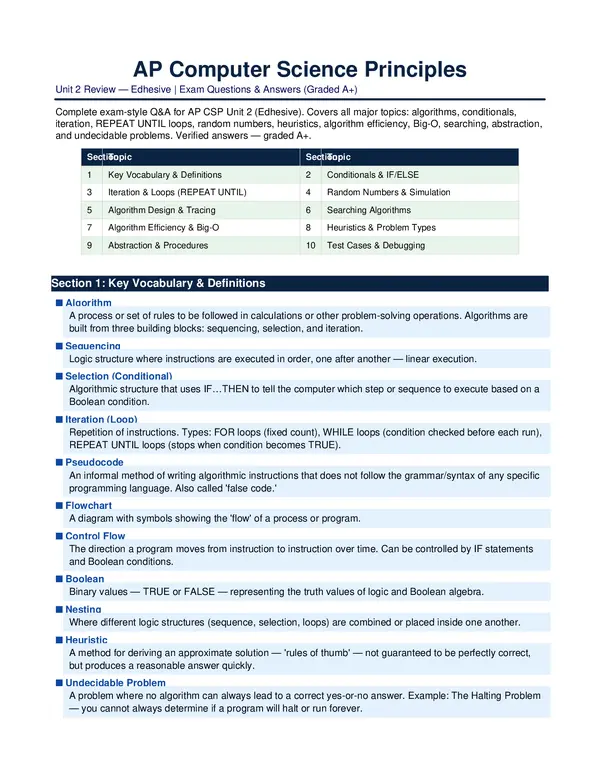
AP Computer Science Principles
Unit 2 Review — Edhesive | Exam Questions & Answers (Graded A+)
Complete exam-style Q&A for AP CSP Unit 2 (Edhesive). Covers all major topics: algorithms, conditionals,
iteration, REPEAT UNTIL loops, random numbers, heuristics, algorithm efficiency, Big-O, searching, abstraction,
and undecidable problems. Verified answers — graded A+.
SectionTopic SectionTopic
1 Key Vocabulary & Definitions 2 Conditionals & IF/ELSE
3 Iteration & Loops (REPEAT UNTIL) 4 Random Numbers & Simulation
5 Algorithm Design & Tracing 6 Searching Algorithms
7 Algorithm Efficiency & Big-O 8 Heuristics & Problem Types
9 Abstraction & Procedures 10 Test Cases & Debugging
Section 1: Key Vocabulary & Definitions
■ Algorithm
A process or set of rules to be followed in calculations or other problem-solving operations. Algorithms are
built from three building blocks: sequencing, selection, and iteration.
■ Sequencing
Logic structure where instructions are executed in order, one after another — linear execution.
■ Selection (Conditional)
Algorithmic structure that uses IF…THEN to tell the computer which step or sequence to execute based on a
Boolean condition.
■ Iteration (Loop)
Repetition of instructions. Types: FOR loops (fixed count), WHILE loops (condition checked before each run),
REPEAT UNTIL loops (stops when condition becomes TRUE).
■ Pseudocode
An informal method of writing algorithmic instructions that does not follow the grammar/syntax of any specific
programming language. Also called 'false code.'
■ Flowchart
A diagram with symbols showing the 'flow' of a process or program.
■ Control Flow
The direction a program moves from instruction to instruction over time. Can be controlled by IF statements
and Boolean conditions.
■ Boolean
Binary values — TRUE or FALSE — representing the truth values of logic and Boolean algebra.
■ Nesting
Where different logic structures (sequence, selection, loops) are combined or placed inside one another.
■ Heuristic
A method for deriving an approximate solution — 'rules of thumb' — not guaranteed to be perfectly correct,
but produces a reasonable answer quickly.
■ Undecidable Problem
A problem where no algorithm can always lead to a correct yes-or-no answer. Example: The Halting Problem
— you cannot always determine if a program will halt or run forever.

■ Halting Problem
There cannot be a program that will always determine which programs will halt (exit) and which will run forever
(infinite loop). This is a classic undecidable problem.
■ Scalability
How well an algorithm performs at increasingly larger input sizes.
■ Big-O Notation
A mathematical concept used to determine how well algorithms scale. Classifies performance: O(1) constant,
O(log n) logarithmic, O(n) linear, O(n²) quadratic, O(2■) exponential.
■ Sequential Search (Linear Search)
Looking through a list one item at a time until a match is found. O(n) — less efficient.
■ Binary Search
Divides the search interval in half each time (requires sorted data). Logarithmic behavior — doubling the input
only requires one extra step. O(log n).
■ Abstraction
Hiding complex details and providing a simpler interface. In programming: procedures/functions that can be
reused without restating detailed steps each time.
■ Procedure (Function)
A named collection of steps in an algorithm that can be reused anytime without restating the detailed
procedures. A key form of abstraction.
■ Brute Force
Trial-and-error method used to decode data (e.g., passwords). O(2■) — exponential — not practical for large
inputs.
Section 2: Conditionals & IF/ELSE — Exam Questions
Q: What will be the output of the following program if the user input number is -5? number ← INPUT()
DISPLAY(number * 3)
✔ –15 (The program multiplies the input –5 by 3.)
Q: Consider the following code. What will be output if n = 0? IF (n > 0) { DISPLAY('The number is
positive.') } ELSE { DISPLAY('The number is not positive.') }
✔ 'The number is not positive.' — 0 is not greater than 0, so the ELSE branch executes.
Q: A travel organisation's program displays the price of a trip to London based on applicants. IF
(Applicants < 50) { DISPLAY('The price is $300!') } ELSE IF (Applicants < 100) { DISPLAY('The price is
$250!') } ELSE { DISPLAY('The price is $200!') } If the number of applicants is 60, what is displayed?
✔ 'The price of the trip is $250!' — 60 ≥ 50 and 60 < 100, so the second branch runs.
Q: An IF/ELSE IF/ELSE chain vs. nested IF statements — what is the key difference?
✔ IF/ELSE IF/ELSE checks conditions in order and executes only the FIRST matching branch. Nested IFs
check every condition independently and may execute multiple branches.
Q: What is a one-way selection vs. a two-way selection?
✔ One-way selection: IF (condition) { … } — only executes if TRUE, does nothing otherwise. Two-way
selection: IF/ELSE — executes one block if TRUE, another block if FALSE.
Section 3: Iteration & Loops (REPEAT UNTIL)
Q: What are the three types of loops in AP CSP pseudocode?
✔ 1) REPEAT n TIMES { … } — runs exactly n times.
2) REPEAT UNTIL (condition) { … } — repeats UNTIL condition is TRUE (stops when TRUE).

3) FOR EACH item IN list { … } — iterates over each element of a list.
Q: Which of the following best describes the result of running this program? number ← RANDOM(1, 6)
REPEAT UNTIL (number > 100) { number ← number * 2 } IF (number = 128) { DISPLAY(true) } ELSE {
DISPLAY(false) }
✔ If number starts as 1, 2, or 4, then the program will display TRUE.
• Starting at 1: 1→2→4→8→16→32→64→128 ✔
• Starting at 2: 2→4→8→16→32→64→128 ✔
• Starting at 4: 4→8→16→32→64→128 ✔
• Starting at 3: 3→6→12→24→48→96→192 ✗ (192 ≠ 128)
• Starting at 5 or 6: also skip 128.
Q: A program has been developed to compute the sum of all elements with a value > 10 in a list. Which
statement best describes how iteration is used?
✔ The program will iterate (loop) through each element of the list, check if the element is greater than 10, and
add it to a running total if so. Iteration allows this check to be performed on every element without writing
separate code for each one.
Q: Consider two equivalent code segments that display the first 12 positive even integers. Segment A
uses 12 separate DISPLAY statements. Segment B uses a loop. Which of the following is NOT an
advantage of Segment B over Segment A?
✔ Segment B will execute in less time than Segment A.
(Both segments produce the same output in roughly the same execution time — the advantage of Segment B
is readability and maintainability, not speed.)
Q: When is a REPEAT UNTIL loop preferred over a REPEAT n TIMES loop?
✔ When it is unknown how many times the loop will need to iterate — usually when we are waiting for an
event to occur (e.g., 'repeat until the user enters a valid password').
Q: A study of beech trees shows 40% may be susceptible to a disease. A program counts susceptible
trees in a forest of k trees. Which condition replaces <MISSING CONDITION>? total ← 1 ; REPEAT k
TIMES { IF () { total ← total + 1 } } DISPLAY(total) — Select TWO answers.
✔ ✔ RANDOM(1, 10) ≤ 4 (40% probability — 4 out of 10)
✔ RANDOM(1, 100) ≤ 40 (40% probability — 40 out of 100)
Both correctly simulate a 40% chance for each tree.
Section 4: Random Numbers & Simulation
Q: What does RANDOM(a, b) return in AP CSP pseudocode?
✔ A random integer from a to b, inclusive. Each integer in the range has an equal probability of being selected.
Q: How do you simulate rolling a 6-sided die in pseudocode?
✔ result ← RANDOM(1, 6) — returns 1, 2, 3, 4, 5, or 6 with equal probability.
Q: A string 'Value' has 5 characters (indices 1–5). The code below generates a random number: String
word = new String('Value') int random = (int)(Math.random() * word.length() + 1) What is the range of
numbers that could be printed?
✔ 1 to 5. (Math.random() * 5 gives [0.0, 5.0), casting to int gives 0–4, +1 gives 1–5.)
Q: Why are random number generators used in simulations?
✔ To model real-world uncertainty and probability. Random values allow programs to simulate unpredictable
events (weather, disease spread, dice rolls) without requiring actual randomness.
Section 5: Algorithm Design & Tracing