AP Physics C Electricity and Magnetism Study Guide

AP Physics C Electricity and Magnetism Study Guide

AP Physics C Electricity and Magnetism focuses on key concepts in electricity and magnetism, essential for AP exam preparation. This study guide covers topics such as electric fields, magnetic fields, capacitance, and circuit analysis. It includes detailed explanations of Coulomb's Law, Gauss's Law, and Faraday's Law, along with practical applications and problem-solving strategies. Designed for students preparing for the AP Physics C exam, it provides a comprehensive overview of the curriculum and essential formulas. The guide also features practice problems and solutions to reinforce understanding and application of concepts.

Key Points

  • Explains Coulomb's Law and its applications in electric fields.
  • Covers Gauss's Law for calculating electric flux through surfaces.
  • Discusses magnetic fields generated by currents and their effects.
  • Includes detailed sections on capacitance and energy storage in capacitors.
  • Provides practice problems aligned with AP Physics C exam standards.

96
/ 63
AP PHYSICS C: ELECTRICITY +
MAGNETISM
From Simple Studies, https://simplestudies.edublogs.org & @simplestudies4 on Instagram
Table of Contents:
1. Electricity
1. Chapter 21 - The Electric Field I: Discrete Charge Distributions
2. Chapter 22 - The Electric Field II: Continuous Charge Distributions
3. Chapter 23 - Electric Potential
4. Chapter 24 - Electrostatic Energy and Capacitance
5. Chapter 25 - Electric Current and Direct-Current Circuits
2. Magnetism
1. Chapter 26 - The Magnetic Field
2. Chapter 27 - Sources of the Magnetic Field
3. Chapter 28 - Magnetic Induction
4. Chapter 29 - Alternating Current Circuits
5. Chapter 30 - Maxwell's Equations and Electromagnetic Waves
3. Appendix
Electricity
Chapter 21 - The Electric Field I: Discrete Charge
Distributions
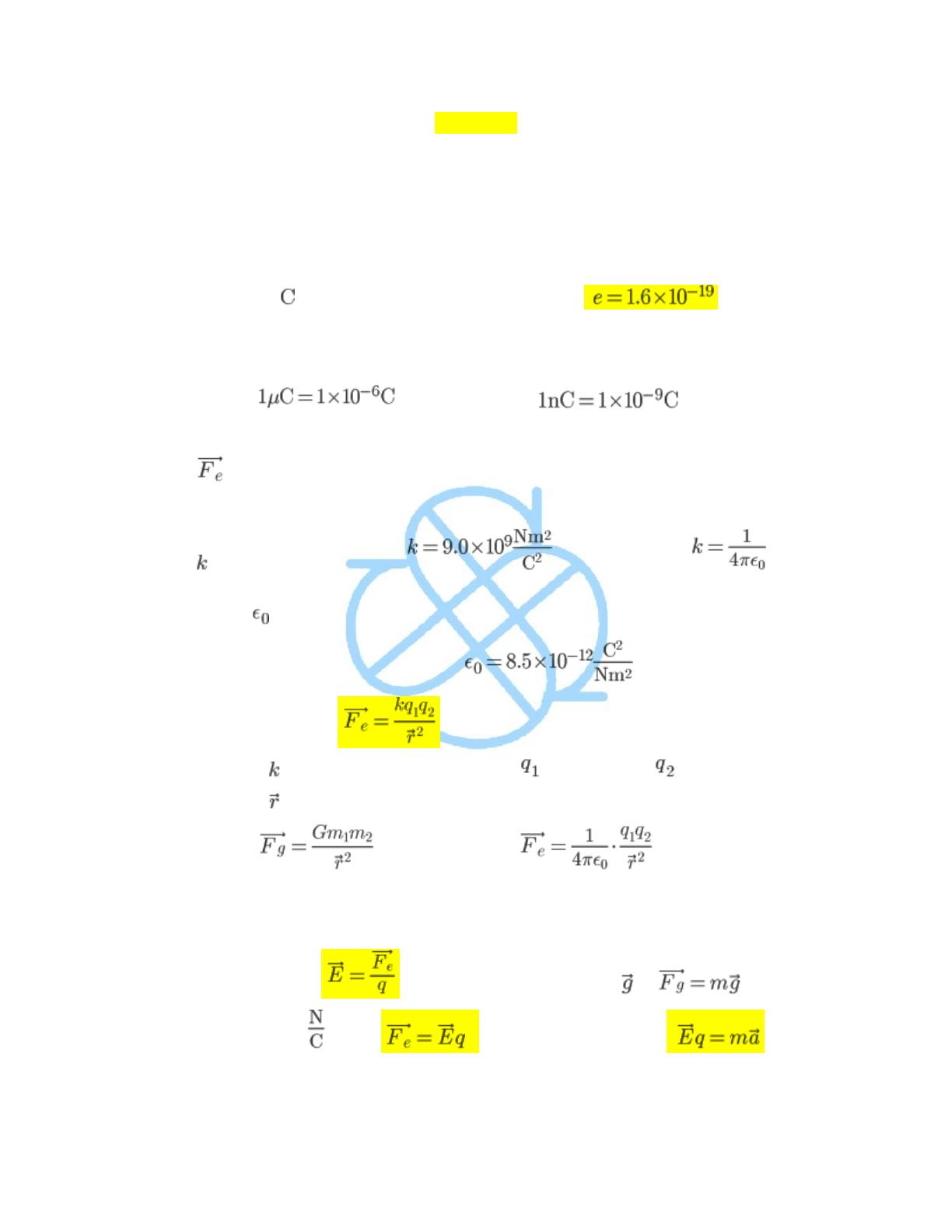
Coulomb ( ) - SI unit of charge [elemental charge, , is the
smallest unit of charge (i.e. - proton or electron) and it indicates that CHARGE IS
QUANTIZED]. More commonly used units are the microcoulomb
( ) or nanocoulomb ( )
Law of Charges: opposite charges attract & like charges repel
= electric force (electromagnetic analog of gravity - force exerted from one
charged particle on another)
= electrostatic constant ( ). Alternate form:
o = The permittivity of vacuum. How easily the electric force can go
through a certain substance. in a vacuum.
Coulomb's Law - (i.e.- the electric force is the electrostatic
constant ( ) times the product of charge 1 ( ) and charge 2 ( ) divided by the
distance ( ) between the two charges). Same form as the Gravity formula.
( ). Expanded form: .
o Applies to POINT CHARGES. Uniformly charged spherical objects
behave like point charges from their surface.
Field Strength ( ) - electromagnetic analog of in
. Measured in . Thus, . For point masses. Thus:
Electric field diagrams - Lines representing the direction of the electric
force acting on a positively charged particle are placed at that
location. Near the source, the field lines are closer, meaning that the force
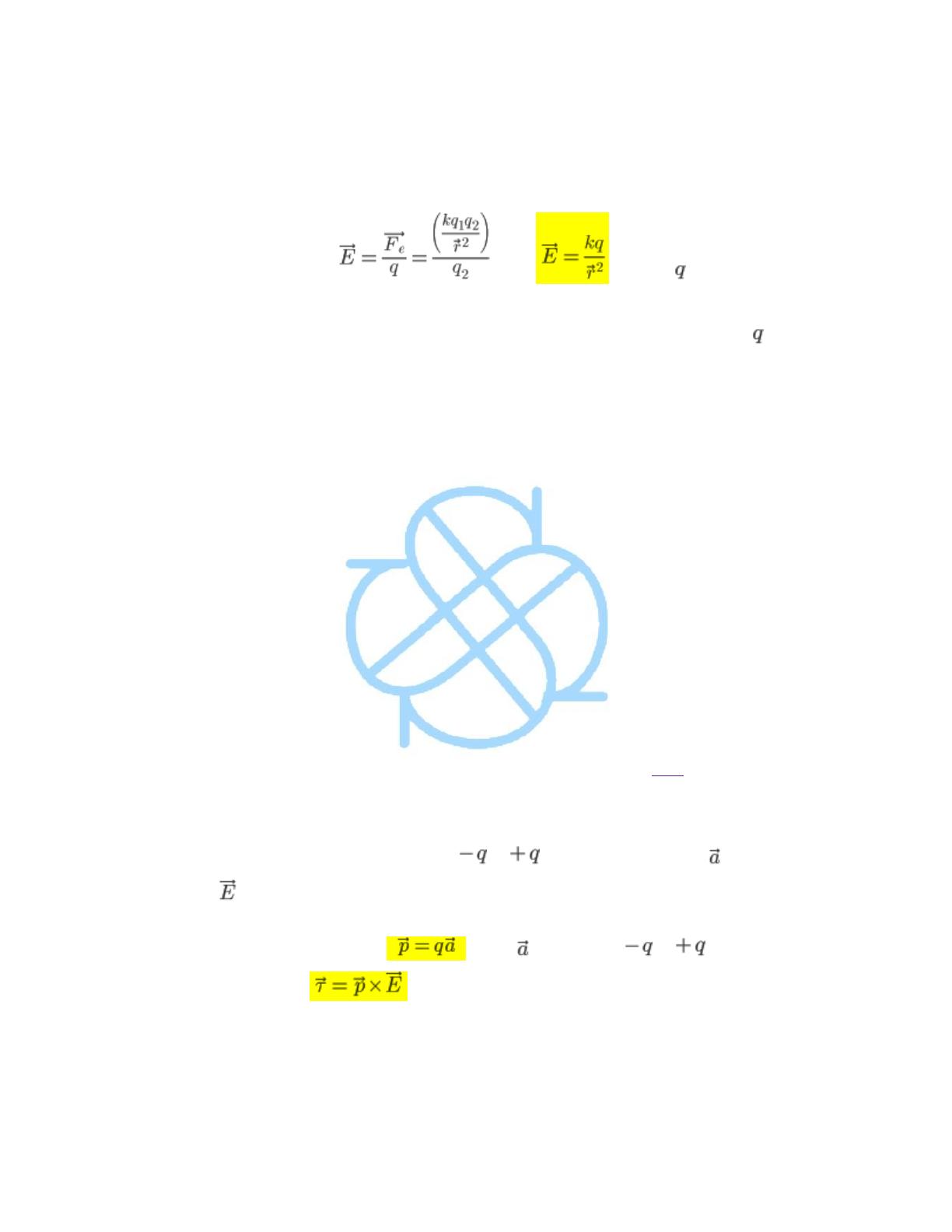
is stronger. Since , then (where is the
charge of the source of the field, not of the positively charged particle at
that location). This is the electric field around a point charge with charge
. Generally, field lines point from positive to negative. Field lines can
never cross; they only interact to create new, averaged, field lines.
o Dipoles - A dipole is the force tangent to the curved
lines. Remember, it's the direction of the force, not necessarily
where it will spread out. Uneven charges will cause the arrows to
lean towards the larger charge.
o Two like charges - an uncharged spot exists in the center: any test
charge will remain stationary if placed in the direct center as the
forces exerted by the two charges are equal and opposite.
o Uniform Field Strength - This occurs between two parallel and
oppositely charged plates. Field lines are parallel so thus the field
strength stays constant. For a sample problem, click here.
Electric Dipole Moment -charges & separated by distance . In
an field, dipole experiences torque:
o Dipole Moment - where points from to . Thus
torque:
Chapter 22 - The Electric Field II: Continuous Charge
Distributions
/ 63
End of Document
96
You May Also Like

FAQs of AP Physics C Electricity and Magnetism Study Guide

What are the main topics covered in AP Physics C Electricity and Magnetism?
AP Physics C Electricity and Magnetism covers essential topics such as electric fields, magnetic fields, capacitance, and circuit analysis. Key concepts include Coulomb's Law, which describes the force between charged particles, and Gauss's Law, which relates electric flux to charge. The study guide also explores Faraday's Law of electromagnetic induction, detailing how changing magnetic fields can induce electric currents. Each topic is supported by practical examples and problem-solving strategies to help students grasp complex concepts.
How does Coulomb's Law apply to electric fields?
Coulomb's Law defines the electrostatic force between two point charges, stating that the force is proportional to the product of the charges and inversely proportional to the square of the distance between them. This law is fundamental in determining electric fields generated by point charges. The electric field can be calculated using the formula E = k * |q| / r², where E is the electric field strength, k is Coulomb's constant, q is the charge, and r is the distance from the charge. Understanding this relationship is crucial for solving problems related to electric forces and fields.
What is Gauss's Law and how is it used?
Gauss's Law states that the total electric flux through a closed surface is proportional to the enclosed electric charge. It is mathematically expressed as Φ = ∮ E · dA = Q_enc / ε₀, where Φ is the electric flux, E is the electric field, dA is the differential area, Q_enc is the enclosed charge, and ε₀ is the permittivity of free space. This law is particularly useful for calculating electric fields in situations with high symmetry, such as spherical or cylindrical charge distributions. By applying Gauss's Law, students can simplify complex electric field calculations.
What role does Faraday's Law play in electromagnetic induction?
Faraday's Law of electromagnetic induction states that a change in magnetic flux through a circuit induces an electromotive force (EMF) in the circuit. This principle is foundational for understanding how generators and transformers work. The law can be expressed mathematically as EMF = -dΦ/dt, where dΦ is the change in magnetic flux and dt is the change in time. The negative sign indicates that the induced EMF opposes the change in flux, a concept known as Lenz's Law. This relationship is critical for students studying the principles of electricity and magnetism.

Related of AP Physics C Electricity and Magnetism Study Guide