

This document is a Bible study lesson handout covering the Book of Genesis and Yahweh’s covenants, presenting a structured overview of Genesis divided into two major sections — the Creation and Early World History (covering the events of Creation, the Fall, the Flood, and the scattering of nations) and the Age of the Patriarchs (Abraham, Isaac, Jacob, and Joseph) — alongside detailed handouts examining Genesis Chapter 1 through multiple lenses, including Hebrew word analysis, the Framework Hypothesis developed by scholar Meredith Kline, and six different theories of Creation ranging from the Literal Interpretation to the Mythical View, with the Catholic Church’s Magisterium guidelines on what must be believed about Creation also included; the document further provides a comprehensive chart of Yahweh’s eight covenants from Adam to Jesus, detailing each covenant’s promises, signs, and scriptural references, and concludes with a theological distinction between conditional covenants — which carry blessings for obedience and curses for disobedience — and non-conditional covenants, supported by extensive biblical cross-references throughout.

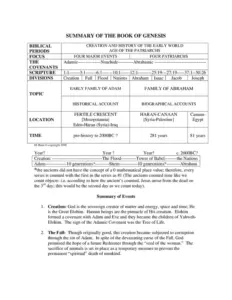
SUMMARY OF THE BOOK OF GENESIS
BIBLICAL
PERIODS
CREATION AND HISTORY OF THE EARLY WORLD
AGE OF THE PATRIARCHS
FOCUS
FOUR MAJOR EVENTS FOUR PATRIARCHS
THE
COVENANTS
Adamic---------------Noachide----------Abrahamic ----------------------------------
SCRIPTURE
1:1-------3:1-------6:1-------10:1------12:1---------25:19---27:19-----37:1--50:26
DIVISIONS
Creation Fall Flood Nations Abraham Isaac Jacob Joseph
EARLY FAMILY OF ADAM
FAMILY OF ABRAHAM
TOPIC
HISTORICAL ACCOUNT
BIOGRAPHICAL ACCOUNTS
LOCATION
FERTILE CRESCENT
[Mesopotamia]
Eden-Haran (Syria)-Iraq
HARAN-CANAAN
[Syria-Palestine]
Canaan-
Egypt
TIME
pre-history to 2000BC ?
281 years
81 years
M. Hunt © copyright 1998
Year? Year ? Year? c. 2000BC?
Creation: ---------------------------------The Flood----------Tower of Babel--------the Nations
Adam--------------10 generations*---------Shem------------10 generations*---------Abraham
*the ancients did not have the concept of a 0 mathematical place value; therefore, every
series is counted with the first in the series as #1 (The ancients counted time like we
count objects: i.e. according to how the ancient’s counted, Jesus arose from the dead on
the 3
rd
day; this would be the second day as we count today).
Summary of Events
1. Creation: God is the sovereign creator of matter and energy, space and time; He
is the Great Elohim. Human beings are the pinnacle of His creation. Elohim
formed a covenant with Adam and Eve and they became the children of Yahweh-
Elohim. The sign of the Adamic Covenant was the Tree of Life.
2. The Fall: Though originally good, this creation became subjected to corruption
through the sin of Adam. In spite of the devastating curse of the Fall, God
promised the hope of a future Redeemer through the “seed of the woman.” The
sacrifice of animals is set in place as a temporary measure to prevent the
permanent “spiritual” death of mankind.

3. The Flood: As humanity multiplied, sin also multiplied until God destroyed the
human race with the exception of Noah and his family. After the Flood, God
made a covenant with Noah and all Creation. The sign of the Noahide covenant
was the rainbow. The covenant and the line of the “promised seed” continued
with Noah’s righteous son Shem. The Flood became the prophetic promise of new
life in Christ and the forgiveness of original sin through baptism into the family of
God.
4. The Nations: Though we are all children of Adam through Noah, God
fragmented the single culture and language of the post-flood world and scattered
the people over the face of the earth. According to Scripture, all the nations of the
earth are descendants of the 3 sons of Noah.
Summary of the Importance of the Family of Abraham in Genesis
Abrahamic Covenant: God initiated His covenant with Abram when he was living
in Ur of the Chaldeans in Mesopotamia. God promised a 3-fold blessing of land,
descendants, and a world-wide blessing if Abram would have faith and be obedient to
God. Abram’s faith and obedience resulted in the ratification of a 3-fold covenant and
his name was changed to Abraham. This covenant was renewed with Abraham’s
descendants Isaac, Jacob (Israel), and Joseph. The covenant sign was the rite of
circumcision and the hope of the “promised seed” continued through Abraham’s
righteous son Isaac and Isaac’s son Jacob/Israel, father of the twelve tribes of Israel.
Handout 2: Genesis chapter 1
Genesis 1:1-5: The First “Day.” The significant Hebrew words that we will be
discussing are in brackets; “formless-void” is underlined to indicate the Hebrew word in
brackets represents both English words; the second word in the English text (the) is in
parenthesis because it is not present in the Hebrew text.
1:1 In (the) beginning God [Elohim] created heaven and earth. 2 Now the earth was a
formless void [toho wa bohu], there was darkness over the deep, with a divine wind
[ruah] sweeping [rahap] over the waters. 3 God said, ‘Let there be light,’ and there was
light. 4 God saw that light was good, and God divided light from darkness. 5 God called
the light ‘day’ and the darkness he called ‘night.’ Evening came and morning came: the
first day.
THE FRAMEWORK HYPOTHESIS
In this view of Creation, for the first 3 days God creates time, space, and life. In the next
set of 3 days, God fills the first 3 days with that which will rule or govern:
Realms Created Filled With Rulers
TIME [light from darkness]
Genesis 1: 3-5
SUN, MOON, STARS, PLANETS
Genesis 1: 14-19
SPACE [heaven and the seas]
Genesis 1: 6-10
FISH, BIRDS
Genesis 1: 20-23
LAND/ LIFE [dry land and vegetation]
Genesis 1: 11-13
BEASTS AND MAN
Genesis 1: 24-31
[this view of Creation is known as the “framework hypothesis.” It was developed by Biblical scholar
Meredith Kline]
Another way to look at the Creation event is in the formation of a two-part division of
three empty resources which become useful reservoirs of activity/life.
Unfilled Resource/ Empty space Filled Useful Reservoir
1. Cosmos of light and darkness (Gen
1:3:5)
1. Lights of sun, moon, stars, planets(Gen
1:14-19)
2. Sky/ water (Gen 1:6-8) 2. Birds, fish (Gen 1:20-23)
3. Dry land/ vegetation (Gen 1:9-13) 3. Land creatures and man (Gen 1:24-31)
Adapted from a chart by Bruce Waltke, Genesis, page 57
Repetitions in the Genesis Prologue1:1-2:4a (3 or more times in Hebrew text)
Word/ phrase Number of repetitions and verses
1. “God said” Eleven times: 1:3, 6, 9, 11, 14, 20, 24, 26,
28, 29
2. “___ was good” Seven times: 1:4, 10, 12, 18, 21, 25, 31 =
(very good)
3. “Evening and morning came …” Six times: 1:5, 8, 13, 19, 23, 31
4. “to divide” (“separate) Five times: 1:4, 6, 7, 14, 18
5. “created” Seven times: 1:1, 21, 27 (3 times), 2:3, 4a
6. Commands (i.e. “let the/ let us…”) 2 x 7 times (14): 1:3, 6 (twice), 9 (twice),
11, 14 (twice), 15, 20, 22, 24, 26 (twice).
7. “the seventh day” Three times: 2:2 (twice), 3
8. God’s “work” of Creation Three times: 2:2 (twice), 3
© Copyright www.AgapeBibleStudy.com z