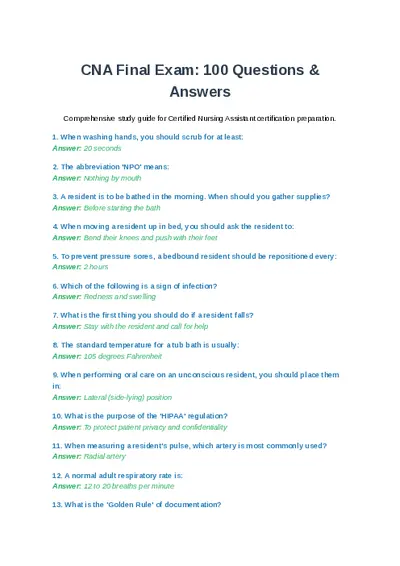
This document is a comprehensive study guide designed for individuals preparing for the Certified Nursing Assistant (CNA) certification exam. It contains 100 questions and answers that cover essential topics relevant to the CNA role, including patient care, safety protocols, and infection control. The guide is structured in a straightforward format, making it easy for readers to navigate through various subjects. Key areas include handwashing techniques, patient positioning, and emergency response procedures. This resource is ideal for nursing students and professionals seeking to enhance their knowledge and skills in the healthcare field. The document serves as a valuable tool for exam preparation, ensuring that candidates are well-equipped to succeed in their certification tests.

/ 7

CNA Final Exam: 100 Questions &
Answers
Comprehensive study guide for Certified Nursing Assistant certification preparation.
1. When washing hands, you should scrub for at least:
Answer: 20 seconds
2. The abbreviation 'NPO' means:
Answer: Nothing by mouth
3. A resident is to be bathed in the morning. When should you gather supplies?
Answer: Before starting the bath
4. When moving a resident up in bed, you should ask the resident to:
Answer: Bend their knees and push with their feet
5. To prevent pressure sores, a bedbound resident should be repositioned every:
Answer: 2 hours
6. Which of the following is a sign of infection?
Answer: Redness and swelling
7. What is the first thing you should do if a resident falls?
Answer: Stay with the resident and call for help
8. The standard temperature for a tub bath is usually:
Answer: 105 degrees Fahrenheit
9. When performing oral care on an unconscious resident, you should place them
in:
Answer: Lateral (side-lying) position
10. What is the purpose of the 'HIPAA' regulation?
Answer: To protect patient privacy and confidentiality
11. When measuring a resident's pulse, which artery is most commonly used?
Answer: Radial artery
12. A normal adult respiratory rate is:
Answer: 12 to 20 breaths per minute
13. What is the 'Golden Rule' of documentation?

Answer: If it wasn't documented, it wasn't done
14. How should you clean a female resident's perineal area?
Answer: Front to back
15. A resident is choking and cannot speak. What should you do?
Answer: Perform abdominal thrusts (Heimlich maneuver)
16. When transferring a resident with a weak left side, you should place the
wheelchair on the resident's:
Answer: Strong (right) side
17. What is the first sign of a pressure ulcer?
Answer: Reddened skin that doesn't blanch
18. A resident's blood pressure is 150/95. This is considered:
Answer: Hypertension
19. When logrolling a resident, how many staff members are usually required?
Answer: At least two
20. The term 'Dyspnea' means:
Answer: Difficulty breathing
21. Which of the following is an example of objective data?
Answer: A resident's temperature of 101 degrees
22. What is the most effective way to prevent the spread of infection?
Answer: Handwashing
23. When assisting a resident with a walker, you should walk:
Answer: Slightly behind and to the resident's weaker side
24. A resident who is 'ambulatory' can:
Answer: Walk
25. In what order should personal protective equipment (PPE) be removed?
Answer: Gloves, Goggles/Shield, Gown, Mask
26. How many milliliters (mL) are in one ounce (oz)?
Answer: 30 mL
27. When shaving a resident's face with a safety razor, you should shave:
Answer: In the direction of hair growth
28. What should you do if a resident refuses to take a bath?
Answer: Respect the refusal and report it to the nurse

29. A 'Prone' position means the resident is lying:
Answer: On their stomach
30. Which type of fire extinguisher is used for electrical fires?
Answer: Class C
31. What does 'PRN' mean?
Answer: As needed
32. How often should catheter care be performed?
Answer: At least once per shift or after every bowel movement
33. Where should a resident's drainage bag be placed?
Answer: Below the level of the bladder
34. What is the normal range for body temperature taken orally?
Answer: 97.6 to 99.6 degrees Fahrenheit
35. A 'stoma' is an opening for:
Answer: A colostomy or ileostomy
36. What is 'Aphasia'?
Answer: Inability to speak or understand speech
37. A resident is complaining of chest pain. You should:
Answer: Immediately notify the nurse
38. The 'Heimlich maneuver' is used for:
Answer: Clearing an obstructed airway
39. What is the best way to communicate with a hearing-impaired resident?
Answer: Face the resident and speak clearly and slowly
40. When should gloves be changed?
Answer: When they become soiled or when moving between tasks/residents
41. What is 'Edema'?
Answer: Swelling caused by excess fluid in tissues
42. How should a CNA identify a resident?
Answer: Check the resident's identification band
43. What is the first step in using a fire extinguisher?
Answer: Pull the pin
44. A 'Foley' is a type of:
Answer: Indwelling urinary catheter
Loading document...
/ 7
Upload to Download
Every 3 documents you upload earns 1 download credit.
You have uploaded 0 documents. Upload 3 more to earn a download.
Upload Documents
End of Document
412
Report this document
Why are you reporting this content?
Embed document
* The code will be updated based on your changes.
Upload to Print
Every 3 documents you upload earns 1 print/download credit.
You have uploaded 0 documents. Upload 3 more to earn a credit.
Upload Documents