Cognitive Assessment Toolkit for Medicare Wellness Visits

Cognitive Assessment Toolkit for Medicare Wellness Visits

The Cognitive Assessment Toolkit provides healthcare professionals with essential tools to detect cognitive impairment during Medicare Annual Wellness Visits. It includes validated assessment methods like the General Practitioner Assessment of Cognition (GPCOG), Mini-Cog, and Memory Impairment Screen (MIS). Designed for use by non-physician staff, these tools can be administered quickly, enhancing early detection of dementia. This toolkit is crucial for primary care providers aiming to improve patient outcomes through timely cognitive evaluations. It is particularly useful for clinicians working with older adults who may exhibit signs of cognitive decline.

Key Points

  • Includes validated cognitive assessment tools like GPCOG and Mini-Cog.
  • Designed for quick administration by non-physician staff in primary care.
  • Enhances early detection of dementia during Medicare Annual Wellness Visits.
  • Provides a structured approach to evaluate cognitive impairment effectively.
161
/ 26
COGNITIVE
ASSESSMENT TOOLKIT
A guide to detect cognitive impairment quickly and efficiently
during the Medicare Annual Wellness Visit
800.272.3900
|
alz.org
Overview ...............................................................................................................................................................3
Medicare Annual Wellness Visit Algorithm for Assessment of Cognition ..........................................................4
General Practitioner Assessment of Cognition (GPCOG) .....................................................................................5
Memory Impairment Screen (MIS) .......................................................................................................................7
Mini-Cog
TM
.............................................................................................................................................................9
Short Form of the Informant Questionnaire on Cognitive Decline in the Elderly (Short IQCODE) ....................11
Eight-item Informant Interview to Differentiate Aging and Dementia (AD8) ...................................................14
Alzheimer’s Association Recommendations for Operationalizing the Detection of Cognitive
Impairment During the Medical Annual Wellness Visit in a Primary Care Setting ..........................................17
TABLE OF CONTENTS
800.272.3900
|
alz.org
The Alzheimer’s Association – dedicated to fueling the advancement of early detection and diagnosis of
dementia – has developed an easy-to-implement process to assess cognition during the Medicare Annual
Wellness Visit. Developed by a group of clinical dementia experts, the recommended process outlined on
page 4 allows you to efficiently identify patients with probable cognitive impairment while giving you the
flexibility to choose a cognitive assessment tool that works best for you and your patients.
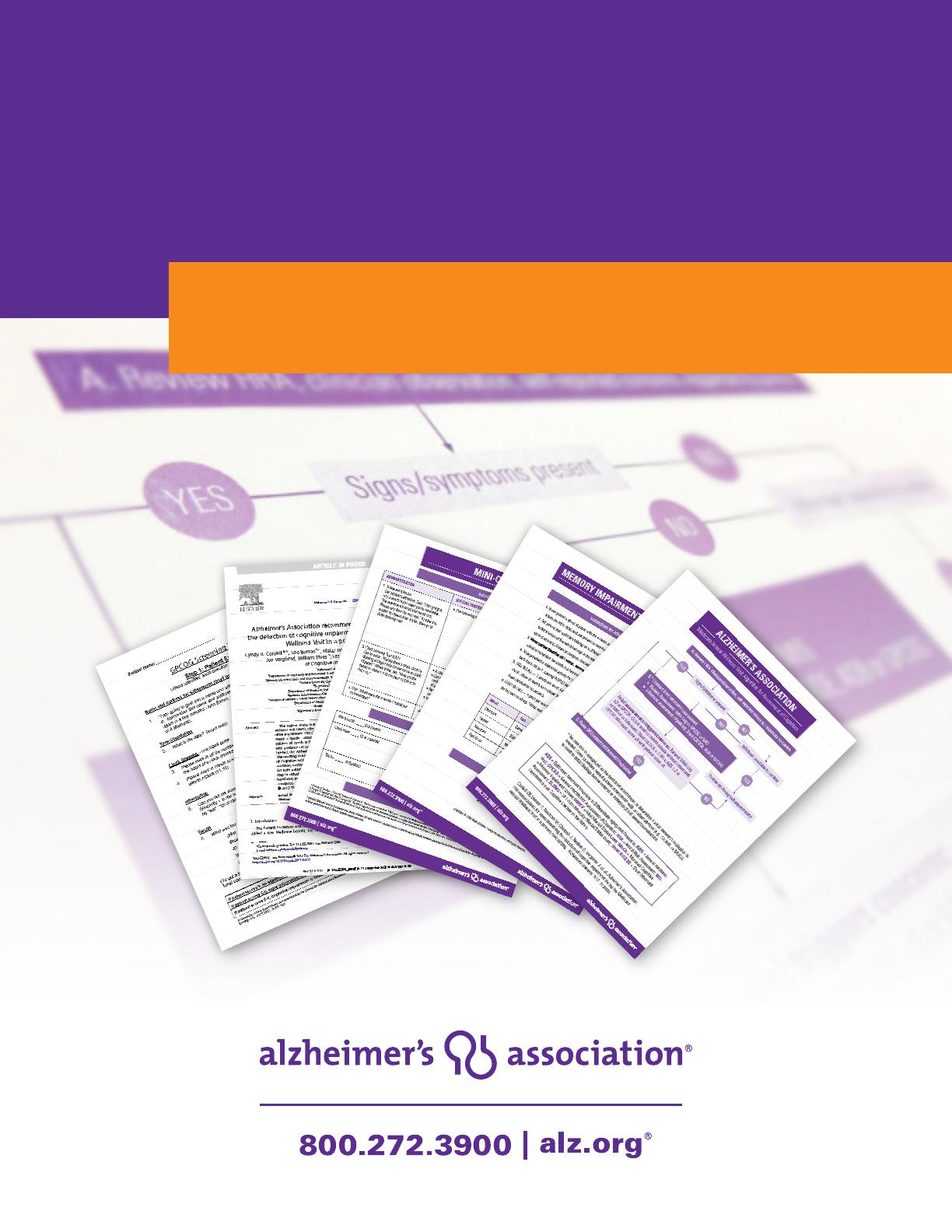
This Cognitive Assessment Toolkit contains:
The Medicare Annual Wellness Visit Algorithm for Assessment of Cognition, incorporating patient
history, clinician observations, and concerns expressed by the patient, family or caregiver
Three validated patient assessment tools: the General Practitioner Assessment of Cognition (GPCOG),
the Memory Impairment Screen (MIS) and the Mini-Cog
TM
. All tools:
Can be administered in 5 minutes or less
Are equal to or superior to the Mini-Mental State Exam (MMSE) for detecting dementia
Are easily administered by medical staff members who are not physicians
Are relatively free from educational, language and/or cultural bias
Three validated informant assessment of patient tools: the Short Form of the Informant Questionnaire
on Cognitive Decline in the Elderly (Short IQCODE), the Eight-item Informant Interview to Differentiate
Aging and Dementia (AD8) and the GPCOG
The “Alzheimer’s Association Recommendations for Operationalizing the Detection of Cognitive
Impairment During the Medical Annual Wellness Visit in a Primary Care Setting,”as published in the
journal Alzheimer’s and Dementia.
For more information on the detection, diagnosis and treatment of Alzheimer’s disease, as well as direct
access to patient and caregiver resources, please visit our Health Care Professionals and Alzheimer’s center
at alz.org/hcps.
OVERVIEW
/ 26
End of Document
161
You May Also Like

FAQs of Cognitive Assessment Toolkit for Medicare Wellness Visits

What are the key tools included in the Cognitive Assessment Toolkit?
The Cognitive Assessment Toolkit includes several key tools designed for quick and effective cognitive evaluation. These tools are the General Practitioner Assessment of Cognition (GPCOG), the Mini-Cog, and the Memory Impairment Screen (MIS). Each tool is validated for use in primary care settings and can be administered in under five minutes, making them ideal for busy clinicians. The toolkit aims to facilitate early detection of cognitive impairment, which is crucial for timely intervention and management.
How does the GPCOG assess cognitive function?
The GPCOG assesses cognitive function through a structured approach that includes both patient and informant components. The patient section involves recalling a name and address, time orientation, and a clock-drawing task. The informant section asks questions about the patient's cognitive changes compared to their functioning five to ten years ago. This dual approach helps to provide a comprehensive view of the patient's cognitive status, making it easier for healthcare providers to identify potential impairments.
What is the purpose of the Cognitive Assessment Toolkit?
The purpose of the Cognitive Assessment Toolkit is to assist healthcare providers in detecting cognitive impairment during Medicare Annual Wellness Visits. By utilizing validated assessment tools, clinicians can identify patients who may need further evaluation for dementia or mild cognitive impairment. This proactive approach aims to improve patient outcomes by facilitating early diagnosis and intervention, which can significantly enhance the quality of life for affected individuals and their families.
How can the Mini-Cog be administered in a clinical setting?
The Mini-Cog can be administered in a clinical setting by following a simple three-step process. First, the clinician asks the patient to remember and repeat three words. Next, the patient is asked to draw a clock, which assesses their executive function and visuospatial skills. Finally, the clinician prompts the patient to recall the three words after a brief distraction. This quick assessment allows for efficient screening of cognitive impairment, making it suitable for busy primary care environments.
What are the benefits of using the Memory Impairment Screen (MIS)?
The Memory Impairment Screen (MIS) offers several benefits for assessing cognitive function. It is a verbal memory test that requires no writing or drawing, making it accessible for patients with motor impairments. The MIS evaluates both free recall and cued recall, providing a comprehensive assessment of memory capabilities. With a maximum score of eight, the MIS helps clinicians quickly determine whether a patient may have cognitive impairment, facilitating timely referrals for further evaluation.

Related of Cognitive Assessment Toolkit for Medicare Wellness Visits