Disability, Space, Architecture

Disability, Space, Architecture

Disability rights admins advocacy surrounding how cities and public spaces are built

Key Points

  • Explores the relationship between disability and urban design, emphasizing inclusivity in architecture.
  • Features contributions from multiple disciplines, including anthropology and health studies, to broaden the discourse on disability.
  • Challenges traditional design practices by framing disability as an opportunity for innovative architectural thinking.
  • Edited by Jos Boys, a prominent figure in disability studies and architecture, enhancing the credibility of the collection.
254
/ 343
DISABILITY, SPACE, ARCHITECTURE
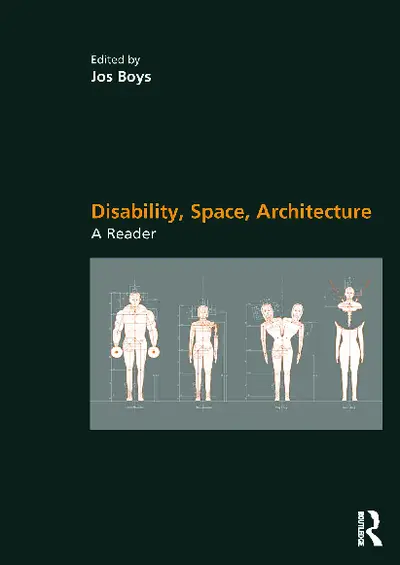
Disability, Space, Architecture: A Reader takes a groundbreaking approach to exploring the
interconnections between disability, architecture and cities. The contributions come from
architecture, geography, anthropology, health studies, English language and literature,
rhetoric and composition, art history, disability studies and disability arts and cover
personal, theoretical and innovative ideas and work.
Richer approaches to disability – beyond regulation and design guidance – remain
fragmented and difficult to find for architectural and built environment students, educators
and professionals. By bringing together in one place some seminal texts and projects, as well as
newly commissioned writings, readers can engage with disability in unexpected and exciting
ways that can vibrantly inform their understandings of architecture and urban design.
Most crucially, Disability, Space, Architecture: A Reader opens up not just disability but also
ability – dis/ability – as a means of refusing the normalisation of only particular kinds of
bodies in the design of built space. It reveals how our everyday social attitudes and practices
about people, objects and spaces can be better understood through the lens of disability,
and it suggests how thinking differently about dis/ability can enable innovative and new
kinds of critical and creative architectural and urban design education and practice.
Jos Boys trained in architecture and has worked as a journalist, researcher, academic and
community-based practitioner. As a non-disabled person she is particularly interested in
how architects and other built environment professionals can act creatively and responsively
as designers and policy-makers without misrepresenting or marginalising disabled people.
Her previous book, Doing Disability Differently: An Alternative Handbook on Architecture,
Dis/ability and Designing for Everyday Life, grew out of a series of collaborations between
disabled artists and architects, through a group she co-founded called Architecture-Inside
Out. Previously Jos has written extensively about feminism and architecture. She was co-
founder of Matrix, a feminist architectural design and research practice, and has been a
member of the TakingPlace art and architecture collective.
‘This diverse collection of essays proposes creative and critical ways of engaging in
disability studies within the field of architecture. From rethinking technologies and
design practices to reframing dis/ability across the theoretical and historical discourses
of architecture, it challenges dominant assumptions about the embodied occupation
of designed environments. Instead of simply framing disability as a problem to be
solved by way of regulations and universal spatial solutions, embodied dis/abilities
are explored as opportunities rather than impediments to design thinking and socio-
spatial awareness.’
— Dr Hélène Frichot, KTH (Royal Institute of Technology), Sweden
Disability, Space, Architecture: A Reader is a critical and thought provoking collection
of essays broadening the potential of dis/ability studies for designers, educators
and academics. Seeking to radically relocate disability front and center within
architectural discourse, the Reader positions disability as a transformative place to
design and educate from. For the built environment to become more responsive
and inclusive, we must not only acknowledge but also conceptualize differently
the relationship between heterogeneous bodies and space as far more complex and
intersectional, providing a trove of under examined spatial potential.’
— Lori A. Brown, Professor, School of Architecture, Syracuse University, USA
/ 343
End of Document
254
You May Also Like

FAQs of Disability, Space, Architecture

What themes are explored in Disability, Space, Architecture: A Reader?
Disability, Space, Architecture: A Reader delves into themes of inclusivity, the intersection of disability with architectural design, and the social attitudes that shape our built environments. The essays challenge the notion of disability as merely a problem to be solved, instead presenting it as a critical lens through which to understand and innovate architectural practices. The collection emphasizes the need for a more nuanced understanding of how diverse bodies interact with space, advocating for designs that are responsive to the complexities of human experience.
Who is the editor of Disability, Space, Architecture: A Reader?
The editor of Disability, Space, Architecture: A Reader is Jos Boys, a trained architect and advocate for inclusive design. Boys has a rich background in journalism, research, and community-based practice, focusing on how built environment professionals can engage with disability without marginalizing disabled voices. Her previous work, Doing Disability Differently, laid the groundwork for this collection, showcasing her commitment to integrating disability studies into architectural discourse.
How does this reader propose to change architectural practices?
The reader proposes to change architectural practices by positioning disability as a transformative element in design and education. It encourages architects and designers to rethink their approaches, moving away from standard regulations and towards a more inclusive understanding of diverse bodies. By framing disability as an opportunity for creative solutions, the essays advocate for a shift in how built environments are conceptualized, aiming for designs that are not only functional but also socially aware and responsive.
What is the significance of the contributions from various disciplines in this collection?
The significance of contributions from various disciplines lies in their ability to enrich the discourse on disability and architecture. By incorporating perspectives from anthropology, geography, and health studies, the reader presents a multifaceted view of how disability intersects with urban design. This interdisciplinary approach fosters a deeper understanding of the complexities involved in creating inclusive spaces, encouraging architects and educators to draw from a broader range of ideas and practices in their work.


Related of Disability, Space, Architecture