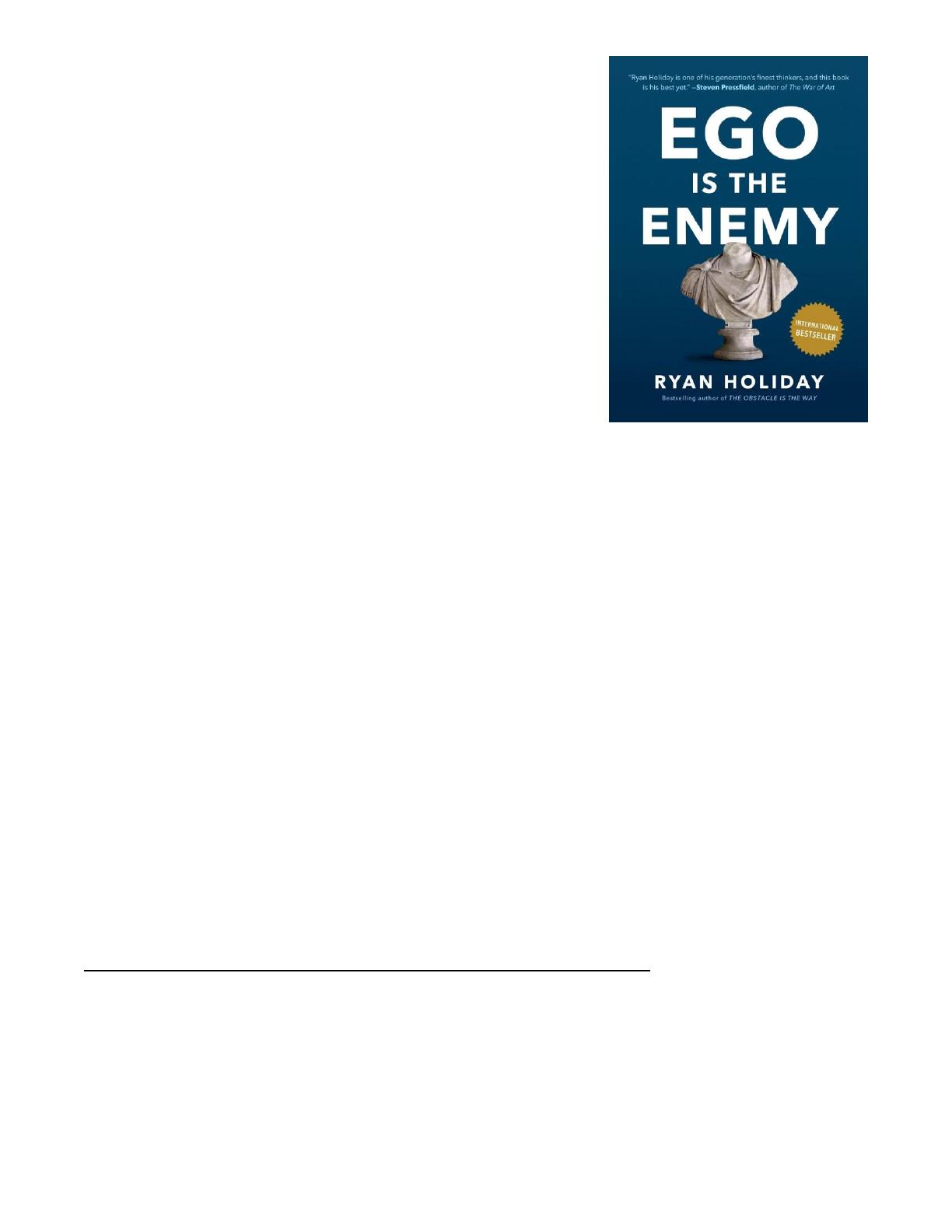
Ego Is The Enemy by Ryan Holiday explores the detrimental effects of ego on personal and professional success. The book is divided into three sections: Aspire, Success, and Failure, each illustrating how ego can hinder growth and happiness. Holiday emphasizes the importance of humility in aspirations, graciousness in success, and resilience in the face of failure. This resource is ideal for individuals seeking self-improvement and a deeper understanding of how ego influences behavior and decision-making. Readers will find practical insights and real-life examples that encourage continuous learning and self-reflection.

Key Points

  • Explores the concept of ego and its negative impact on personal growth and relationships.
  • Divided into three sections: Aspire, Success, and Failure, each addressing ego's role in these phases.
  • Includes real-life examples of individuals who succeeded by overcoming their egos.
  • Emphasizes the importance of humility, continuous learning, and resilience in achieving true success.
newtopiccyclegrowin
9 pages
newtopiccyclegrowin
9 pages
243
/ 9
Ego Is The Enemy by Ryan Holiday
Book Notes/Summary by Corey Jacobsen, Elk101.com
These are the notes I took, and the quotes that stood out to me, as I read
Ryans book, Ego Is the Enemy.
I will start out by saying that, for the most part, I try really hard to apply
humility to all areas of my life (family, work, church, friends, hunting,
etc.). These efforts are a daily battle though, and this book helped me
recognize several areas where I have slacked and need to do better.
Each one of us has the ability to improve in this area, and we also have
the ability to neglect the efforts needed to stay on top of ego and pride.
One of the examples Ryan uses in the book was that our ego is like a
floor. A floor needs to be swept continually, as dirt and dust are
continually building up. We sweep one day, and we need to sweep it
again the next day. Our egos are similar.just because we do it once or
once in a while doesnt mean it stays clean forever.
Ego (pride, arrogance, whatever you want to call it) is at the center of almost every detail of drama. From issues
at work, in our marriage and family, and within our endeavors in hunting, ego works as a wedge to separate us
from true happiness. When what we want becomes a greater desire than what we want for those around us,
ego has become the enemy.
I first listened to the audiobook of Ego Is the Enemy on Audible on a roadtrip a month or two ago. About halfway
through the audiobook, I found myself thinking about all the people I knew who struggled with ego, and
assessing how ego was causing them to act in certain ways. It was like an alder branch slapping me alongside my
face as I realized it was ego in me that was causing me to focus on the weaknesses and shortcomings of others. I
listened to the rest of the audiobook with more of an open mind on how I needed to work on my own ego.
Then, a few weeks later, I ordered the hardcopy of the book and read it again, this time focusing on what I could
apply to my own ego. It was life-changing. I took notes, and highlighted multiple pages in the book as I read it for
the second time.
I hope these book notes and quotes will resonate with you in a way that will pique your interest and inspire you
to evaluate how ego is affecting you in your life. If you feel so inclined, I would highly recommend picking up a
copy of the book or listening to the audiobook as well. In no way am I affiliated with the book or with Ryan
Holiday I am just simply passing along a resource that I feel has been a great help to me in my life.
My notes are written in standard font, and quotes from the book are italicized (and sometimes bold if they
really stood out to me).
Book Notes and Quotes from Ego Is the Enemy by Ryan Holiday
After the Intro, the book is broken into 3 sections: Aspire, Success, Failure. In all that we do, we are either
aspiring to do (or become) something, achieving success, or going through some challenge, trial, or failure. In all
three aspects, Ego is the Enemy!
Ryan categorizes these three aspects as: ambition, achievement, and adversityIn short, this book will help us
be: humble in our aspirations, gracious in our success, and resilient in our failures.
If you struggle with ego or any of the associated symptoms of ego and pride you need to read this book. If
you don’t struggle with ego, you need to read this book twice… Once to recognize how ego affects all of us,

and then again to see what you can do to make needed changes to reduce ego in your life (see quote #4 &
#5 below)
Sometimes, we dont even recognize what ego is or how it might be affecting us. Ryan defines ego by saying,
The ego we see most commonly goes by a more casual definition, an unhealthy belief in our own
importance. Arrogance. Self-centered ambition. That's the definition this book will use. It's that petulant
child inside every person, the one that chooses getting his or her way over anything or anyone else. The
need to be better than, more than, recognized for, far past any reasonable utility - that's ego. It's the
sense of superiority and certainty that exceeds the bounds of confidence and talent.”
One of the comments he makes on ego really resonated with me:
Ego is stolen. Confidence is earned. It's the difference between potent and poisonous.
Introduction
Ego is the type of storytelling in which eventually your talent becomes your identity and your
accomplishments become your worth.
To be successful: Goals must be put and kept higher than a desire for recognition. If you are wanting to be
something or somebody, ego is setting your course. If you are wanting to do something, you will be far more
successful and far better able to keep ego at bay. Plus, by doing something, you will naturally become
someone. The opposite is not true
While the history books are filled with tales of obsessive, visionary geniuses who remade the world in
their image with sheer, almost irrational force, I found that if you go looking you'll find that history is
also made by individuals who fought their egos at every turn, who eschewed the spotlight, and who put
their higher goals above their desire for recognition.”
QUOTE #4 - Perhaps you've always thought of yourself as a pretty balanced person. But for people with
ambitions, talents, drives, and potential to fulfill, ego comes with the territory. Precisely what makes us
so promising as thinkers, doers, creative and entrepreneurs, what drives us to the top of those fields,
makes us vulnerable to this darker side of the psyche.
QUOTE #5 - We think something else is to blame for our problems, most often, other people. We are, as
the poet Lucretius put it a few thousand years ago, the proverbial "sick man ignorant of the cause of his
malady." Especially for successful people who can't see what ego prevents them from doing because all
they can see is what they've already done.
Aspire
As I read the book, I think I felt the most resonation with this section. Even if we are successful or we are
failing I think we are all still aspiring and working towards something greater. Because of that, I feel that the
info in this section applies to the other sections as well.
Ryan mentions that as we are working toward a goal, it is Poise, Not Pose that will get us there.
United States military officer William Sherman, during the Civil War, was a great man. One of
Sherman's biographers summarized the man in this way: "among men who rise to fame in leadership
two types are recognizable, those who are born with a believe in themselves and those in whom it is a
slow growth dependent on actual achievement. To the man of the last type their own success is a
constant surprise, and it's fruits the more delicious, yet to be tested cautiously with the hunting sense of
doubt whether it is not all a dream. In that out lies true modesty, not the shim of insincere self-
depreciation, but the modesty of "moderation", in the Greek sense. It is poise, not pose."
I mentioned it in the Intro section, but it is far more important and effective to focus on doing something
rather than trying to be something. Ryan said, “To be or to do – life is a constant roll call.”
It's about the doing, not the recognition. In this course, it is not "who do I want to be in life?", But "what
is it that I want to accomplish in life?"
Ryan uses several real-life examples of people who have succeeded by keeping Ego at bay, as well as several
real-life examples of people who have crashed and burned due to their egos. One of my favorite stories he
shared was of the lead-guitarist for the band Metallica, Kirk Hammett. (I blame Dirk for introducing me to
Metallica back in high school)
In a nutshell, Kirk Hammett had only been playing guitar for a few years (he was 19). The previous guitarist for
Metallica, Dave Mustaine, was fired by the band, and they called Hammett to see if he wanted to come audition.
He sold a few items to be able to afford the plane ticket from California to New York, and was hired on the spot.
It would be easy to sit back and think, Ive arrived in this situation, but Kirk knew better. He signed up for
guitar lessons from legendary guitar teacher, Joe Satriani.
"That was the point Kirk wanted to learn what he didn't know, to firm up his understanding of the
fundamentals so that he might continue exploring this new genre of music you know had a chance to
pursue."
In other words, despite joining his dream group and quite literally turning professional, Kirk insisted that
he needed more instruction that he was still a student.
The power of being a student is not just that it is an extended period of instruction, it also places the
ego and ambition in someone else's hands.
The pretense of knowledge is our most dangerous place, because it prevents us from getting any
better.
I love that last quote.I think we sometimes feel like we know enough and stop yearning to learn more. To be
truly successful, we must remain forever a student!
“You cannot get better if you’re convinced you are the best.”
Frank Shamrock, the great UFC fighter, has a system he uses for training new fighters. He calls it the plus,
minus, equal system.
He said, Each fighter, to become great, needs to have someone better that they can learn from,
someone lesser they can teach, and someone equal that they can challenge themselves against.”
You will not find the answers if you're too conceited and self-assured to ask the questions. You
cannot get better if you're convinced you are the best.
Similar to the concept of doing rather than being, Ryan points out the importance of doing things with
PURPOSE, not PASSION.
Purpose de-emphasizes the I. Purpose is about pursuing something outside yourself as opposed to
pleasuring yourself. (self-promotion, recognition, etc.)
/ 9
End of Document
243

FAQs

What are the main themes of Ego Is The Enemy?
Ego Is The Enemy focuses on the themes of humility, self-awareness, and resilience. Ryan Holiday argues that ego can be a significant barrier to personal and professional success. The book illustrates how ego manifests in various aspects of life, including aspirations, achievements, and failures. By emphasizing the need for humility and continuous learning, Holiday encourages readers to confront their egos and strive for personal growth.
How does Ryan Holiday define ego in the book?
Ryan Holiday defines ego as an unhealthy belief in one's own importance, characterized by arrogance and self-centered ambition. He describes it as the part of us that seeks recognition and superiority, often at the expense of others. This definition sets the stage for understanding how ego can lead to negative outcomes in both personal and professional contexts. Holiday contrasts ego with confidence, highlighting that true confidence is earned through effort and humility.
What practical advice does Holiday offer for managing ego?
Holiday offers several practical strategies for managing ego, including the importance of remaining a lifelong learner. He emphasizes that true success comes from focusing on doing rather than being, and encourages readers to pursue goals with purpose rather than seeking recognition. Additionally, he suggests surrounding oneself with mentors and peers who can provide constructive feedback, helping to keep ego in check and promote continuous improvement.
What examples does Holiday use to illustrate the impact of ego?
In Ego Is The Enemy, Holiday uses various real-life examples to illustrate the impact of ego on success and failure. He discusses figures like Kirk Hammett of Metallica, who continued to seek improvement despite achieving fame, and Frank Shamrock, a UFC fighter who emphasizes the importance of learning from others. These examples serve to highlight how successful individuals manage their egos and remain committed to personal growth.
How does the book address the relationship between success and ego?
The book addresses the relationship between success and ego by illustrating how achieving success can often inflate one's ego, making it harder to maintain that success. Holiday argues that many successful individuals struggle with their egos, leading to complacency and a lack of growth. He stresses the importance of humility and continuous effort, suggesting that true success is not just about reaching a pinnacle but about sustaining that success through hard work and self-awareness.
What does Holiday suggest about failure and ego?
Holiday suggests that failure is often exacerbated by ego, which can prevent individuals from learning from their mistakes. He emphasizes that a healthy attitude towards failure involves humility and resilience, allowing one to reassess goals and strategies. The book encourages readers to view failures as opportunities for growth rather than as threats to their identity, advocating for a mindset that prioritizes learning and self-improvement.

