
The Energy and Matter Lab 5 Heating Curve worksheet focuses on analyzing how temperature changes as a substance (often water) absorbs heat, demonstrating transitions between solid, liquid, and gas phases. Students typically plot temperature versus time/heat input, identifying phases, melting/boiling points, and increasing kinetic vs. potential energy.

1/3/08 1
EXPERIMENT 5 Chemistry 100 Laboratory
ENERGY IN CHEMICAL REACTIONS
PART I INTRODUCTION
Purpose: To determine the heat of a chemical reaction
1. What is a calorie?
A Calorie is a unit of heat. It is the amount of heat needed to raise the temperature of 1 gram water 1 degree
Celsius. You will actually measure the calories of a food product and compare this to the calories on the
container. Food Calories usually have an upper case C. 1 Calorie = 1000 calories. Today you will measure
calories and then convert them to Calories.
2. How are heat and temperature different?
Temperature is the average amount of kinetic energy contained in the molecules of a substance. It is
measured with a thermometer and the units are degrees Celsius. Heat is the total amount of energy in a
sample of substance. It is measured indirectly and the units are calories.
3. How is heat measured?
To measure calories in food, for example, the food is burned in a combustion chamber. The heat from the
combustion reaction of the food is used to raise the temperature of a sample of water. Knowing the mass of the
water and the temperature change of the water the heat gained by the water can be calculated using the
following equation:
M X C X ΔT = Heat change in the water (q)
M is the mass of the water. Δ T is the final temperature of the water – the initial temperature of the water (Δ T
means change in temperature). C is a constant called specific heat. It tells how a particular substance absorbs
heat. All substances absorb heat differently. It takes one calorie of heat to raise the temperature of one gram
water one degree Celsius. C for water is 1 cal/g
o
C.
PART II PROCEDURE
Procedure and Observations and Data:
A. How much energy is in a peanut
1. Measure the mass of the apparatus which is a stickpin that is attached to a cork
2. Place 1/2 of a peanut on the apparatus and find the mass. Be careful. Do not let the pin go into your finger.
Your instructor will show you how to do this safely.
3. Put exactly 25 ml of water in a 100 ml beaker . Measure and record the temperature of the water.
4. Light the peanut on fire with a match and once the nut is lit, quickly hold the beaker of water over the nut. The
goal is to get as much heat into the water as possible (Is it possible to get all of the heat into the water?)
5. Do not let the water boil! Blow out the flame before this happens.
6. After the nut has burned, make sure the water is mixed so that the hot water is evenly dispersed in the beaker,
and measure the temperature of the water and record
7. Record the mass of the apparatus and nut after it was burned. Be sure to pick up any crumbs that fell off of the
pin.
8. Repeat this experiment until you have burned 3 nuts.
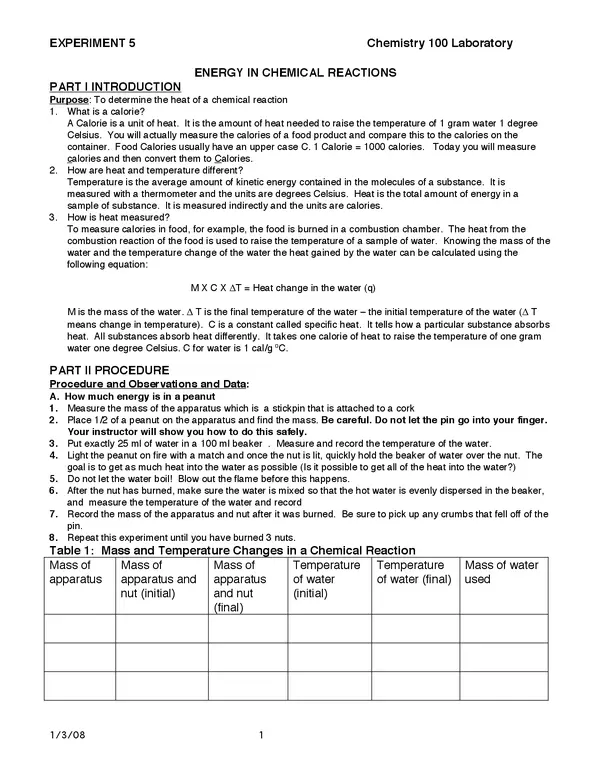
Table 1: Mass and Temperature Changes in a Chemical Reaction
Mass of
apparatus
Mass of
apparatus and
nut (initial)
Mass of
apparatus
and nut
(final)
Temperature
of water
(initial)
Temperature
of water (final)
Mass of water
used

1/3/08 2
Chem. 100 Lab Report Date ______________
Name ______________________________________
Lab Section __________________ Initials________
EXPERIMENT 5
ENERGY IN CHEMICAL REACTIONS
Part III Calculations (do this for each nut)
Show all of the calculations for one nut in your lab book but show the results of all calculations in a table
in your book
1. What is the initial mass of the nut?
2. What is the final mass of the nut ?
3. What is the change in mass of the nut?
4. What is the change in temperature of the water?
5. What is the heat gain of the water in calories ?
6. What is the heat gain of the water in Calories ?
7. What is the experimental heat loss of the nut in Calories?
8. What is the heat loss per gam of the nut?
9. What is the average heat loss per gram of the nut?
10. What is the theoretical heat loss per gram of the nut in Calories? (from the average)

1/3/08 3
11. What is the efficiency of this experiment? (from the average)
Table 2: Calculating Heat Changes in a Chemical Reaction
Initial
mass
of nut
Final
mas
s of
nut
Change
in mass
of nut
Change
in temp.
of water
Heat
gain
of
water
cal.
Heat
gain
of
water
Cal.
Experiment
al heat loss
of nut in
Cal.
Experiment
al heat loss
per gram of
nut in Cal.
Ave.
heat
loss
of
nut
Theo.
heat
loss
of nut
%
Eff.
Questions
1. How could you make it so that more of the heat from the burning nut goes into the water
2. The mass of the nut went down and the temperature of the water went up. Did you change matter into
energy? Make sure you explain your answer with evidence.
3. What happened to the matter of the nut that was burned?
4. How did the energy get into the nut in the first place?