
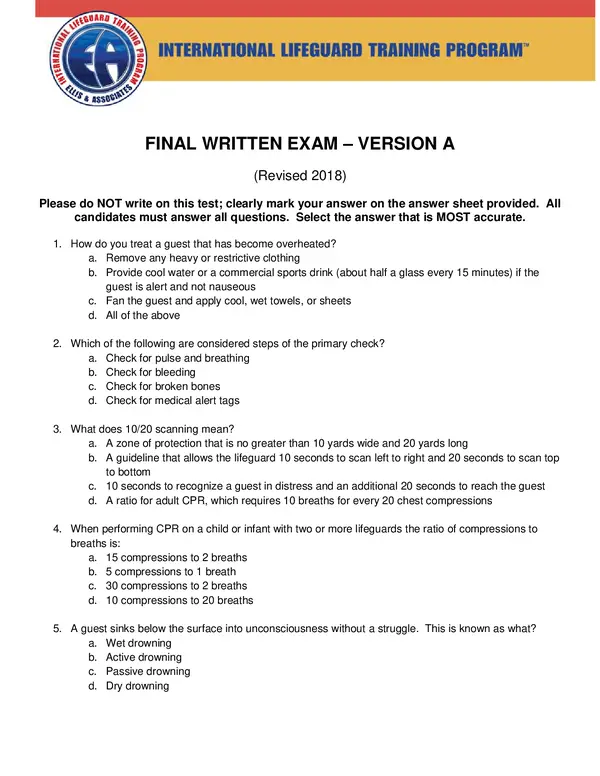
The Ellis & Associates International Lifeguard Training Program (ILTP®) final written exam is a comprehensive test designed to evaluate a lifeguard candidate’s knowledge of rescue procedures, emergency care, and professional responsibilities.

FINAL WRITTEN EXAM – VERSION A
(Revised 2018)
Please do NOT write on this test; clearly mark your answer on the answer sheet provided. All
candidates must answer all questions. Select the answer that is MOST accurate.
1. How do you treat a guest that has become overheated?
a. Remove any heavy or restrictive clothing
b. Provide cool water or a commercial sports drink (about half a glass every 15 minutes) if the
guest is alert and not nauseous
c. Fan the guest and apply cool, wet towels, or sheets
d. All of the above
2. Which of the following are considered steps of the primary check?
a. Check for pulse and breathing
b. Check for bleeding
c. Check for broken bones
d. Check for medical alert tags
3. What does 10/20 scanning mean?
a. A zone of protection that is no greater than 10 yards wide and 20 yards long
b. A guideline that allows the lifeguard 10 seconds to scan left to right and 20 seconds to scan top
to bottom
c. 10 seconds to recognize a guest in distress and an additional 20 seconds to reach the guest
d. A ratio for adult CPR, which requires 10 breaths for every 20 chest compressions
4. When performing CPR on a child or infant with two or more lifeguards the ratio of compressions to
breaths is:
a. 15 compressions to 2 breaths
b. 5 compressions to 1 breath
c. 30 compressions to 2 breaths
d. 10 compressions to 20 breaths
5. A guest sinks below the surface into unconsciousness without a struggle. This is known as what?
a. Wet drowning
b. Active drowning
c. Passive drowning
d. Dry drowning

6. What is an example of an “assist”?
a. Extending a rescue tube to a guest and pulling them to the side of the pool while maintaining
10/20 Protection
b. Entering the water to help another lifeguard with a rescue
c. Performing a secondary check while another lifeguard conducts a primary check
d. Calming down a family member while lifeguards perform CPR
7. A lifeguard in the water signaling with a raised, clenched fist is requesting:
a. A break
b. A lifeguard to “watch my zone”
c. Assistance from another lifeguard
d. To stop dispatch on the slide
8. When a lifeguard provides breaths for a non-breathing guest, that lifeguard is performing:
a. Abdominal thrusts
b. Cardiopulmonary Resuscitation or CPR
c. Rescue breathing
d. A spontaneous breath check
9. When using a resuscitation mask, the most common problem rescuers face is:
a. Counting the number of seconds between breaths
b. Maintaining a proper seal and open airway
c. Finding a secondary guard to assist
d. All of the above
10. What is the correct ratio for rescue breathing on a child?
a. One rescue breath every 5 seconds
b. One rescue breath every 3 seconds
c. Two rescue breaths every 15 seconds
d. Two rescue breaths every 30 seconds
11. What is the proper response for an adult guest who is conscious, standing, grasping at his throat and
unable to talk or breathe?
a. Get the guest to lie down and then perform chest thrusts until the object is removed or the guest
becomes unconscious
b. Provide 5 back blows, followed by 5 chest thrusts repeatedly until the object is removed
c. Encourage the guest to continue coughing until the object is removed or the guest becomes
unconscious
d. Perform the Heimlich maneuver until the object is removed or the guest becomes unconscious

12. Identify the INCORRECT treatment for burns:
a. Remove any jewelry or smoldering clothing
b. Activate your EAP to summon EMS personnel for chemical burns, electrical burns, or thermal
burns
c. Apply warm water
d. If the burn is from a wet chemical, flush it with a large, continuous flow of water. If the chemical
is a dry powder, brush the powder from the skin before flushing
13. For a conscious, choking infant who is unable to cry or breathe, you should:
a. Perform abdominal thrusts until the object is removed or the infant becomes unconscious
b. Lay the infant down and then perform chest thrusts until the object is removed
c. Encourage the infant to continue coughing until the object is removed or the infant becomes
unconscious
d. Provide 5 back blows, followed by 5 chest thrusts repeatedly until the object is removed or the
infant becomes unconscious
14. When performing chest compressions on an infant, the proper placement for your fingers or thumbs is:
a. Just above the nipple line
b. Directly on the nipple line
c. Just below the xiphoid process
d. Just below the nipple line
15. When using a Bag Valve Mask (BVM), it is important to:
a. Squeeze the bag hard enough to get all of the air out of the bag
b. Squeeze the bag just enough to see visible chest rise
c. Provide one breath every 10 seconds
d. Provide two breaths every 30 seconds
16. A guest in distress is facing away from you, struggling on the surface of the water, you should use the:
a. Rear hug rescue
b. Front drive rescue
c. Vise grip rescue
d. Squeeze play rescue
17. For a guest in distress who is beneath the surface of the water but still within arm’s reach, you should
use the:
a. Rear hug rescue
b. Deep water rescue
c. Duck pluck rescue
d. Front drive rescue