Important Equations for AS Physics 9702 by Faisal Jaffer

Important Equations for AS Physics 9702 by Faisal Jaffer

Important Equations for AS Physics 9702 by Faisal Jaffer provides a comprehensive overview of essential physics formulas and concepts for AS level students. Covering topics such as motion, force, energy, electric charge, and waves, this resource is ideal for students preparing for their examinations. Key equations include those related to Newton's laws of motion, electric field intensity, and wave behavior. This guide serves as a valuable tool for mastering the principles of physics and excelling in the AS Physics curriculum.

Key Points

  • Covers key physics equations for AS level topics including motion and energy.
  • Includes detailed explanations of Newton's laws of motion and their applications.
  • Explains electric charge concepts and Ohm's law for circuit analysis.
  • Discusses wave properties, including frequency, wavelength, and wave speed.
62
/ 9
1
Important Equations for AS Physics - 9702 Prepared by Faisal Jaffer, Nov 2011
Important Equations in Physics (AS)
Unit 1: Quantities and their measurements (topics 1 and 2 from AS syllabus)
1
System of units
M.K.S system
,
C.G.S. system,
F.P.S. system and
SI system
m
eter
, kilogram,
second
centimetre, gram, second
foot, pound, second
2
t
em
Base units
Length
metre
Mass
Kilogram
Time
second
Temp
kelvin(K)
Current
ampere(A)
luminous
intensity
candela (Cd)
Amount of
substance
mole
3
Multiples
of units
Tera
T
10
12
Giga
G
10
9
Mega
M
10
6
Kilo
K
10
3
Deci
d
10
-1
centi
c
10
-2
milli
m
10
-3
micro
µ
10
-6
nano
n
10
-9
pico
p
10
-12
femto
f
10
-15
atto
a
10
-18
4
Celsius to
k
elvin
conversion
K= θ
o
C +273.15
Add to 2
7
3.15 to Celsius scale to convert to
kelvin scale
5
Accuracy
To find the
accurate value
,
w
e need to know the true value of a physical quantity.
Nothing can be measured absolutely accurate.
6
Precision
...value c
lose
to the true value
. Can be increase by sensitive instrument
.
7
Error
Systematic: due to faulty apparatus
Random:
due to experimenter
8
Calculation error
For sum Q=a+b
ΔQ=Δa+Δb
For difference
Q=a
-
b
ΔQ=Δa+Δb
9
Calculating error
For product Q=a×b
=
+
×
For division Q=a/b
=
+
×
10
Significant figures (sf)
examples
1.234
four sf
1.2
two sf
1002
four sf
3.07
three sf
0.001
one sf
0.012
two sf
0.0230
three sf
0.20
two sf
190
2 or 3 sf
1
1
U
nc
er
ta
in
t
y
value
t
he interval of confidence around the
b
e
s
t
m
e
a
s
u
r
e
d
va
l
u
e
such that the
measurement is certain not to lie outside this stated interval

=




±



1
2
P
e
rc
en
t
a
g
e
a
nd r
el
at
iv
e
uncertainty

=




×
100
=
×
100

=





=
1
3
Vector
and scalar
quantities
Vector magnitude with unit and
direction eg. velocity, force etc
Scalar
only magnitude with units
Eg. density, pressure, speed, distance
etc
1
4
Magnitude of r
esultant
vector c of two vectors a
and b
a
and
b
s
ame direction: apply simple
addition
a and b opposite direction: apply simple subtraction
to each other: apply Pythagoras theorem

=
+
Not
to each other: apply cosine rule

=
+
2
×
×
×

1
5
Direction of resultant
vector c of two vectors a
and b
a
and
b
in
same direction then
c
is also the in the same direction
a and b opposite direction then c is in the direction of bigger vector
to each other apply
=
tan

Not
to each other: use protractor
1
6
Components of vector
F
making θ with x-axis
x- component
=
×
cos
y
-
component
=
×
sin
1
7
Measurement
by
cathode
ray oscilloscope (cro)
Time base:
horizontal scale or x-axis
Vertical gain:
vertical scale or y-axis
2
Important Equations for AS Physics - 9702 Prepared by Faisal Jaffer, Nov 2011
Unit 2: Motion, force and energy (topic 3, 4, 5 and 6 from AS syllabus)
1
Average velocity
=
s is the displacement in meters and t
is the time in seconds.
2
Instantaneous velocity
Velocity of an object at any particular instant of time.
3
Average acceleration
=
Δ
v is the change
of
speed and
Δ
t is
the change of time. Unit of
acceleration is ms
-2
4
Acceleration and velocity
Same direction: acceleration is
+ve
(if velocity is in +ve direction)
Opposite direction: acceleration is -ve, deceleration, retardation
5
Graphical representation
6
Speed
-
time
graph
Area under th
e graph: distance covered by and
object
Gradient of the graph: acceleration
7
Distance
-
time graph
Gradient of the graphs: speed of an object
8
Equation for
uniform
motion, constant motion
=
o
nly
u
se w
hen
a
c
ce
ler
ation
=
0
and
no net force is applied
9
Equations
for
uniformly
accelerated motion
- body start motion u=0
- body come to rest v=0
- free fall g=a=9.81ms
-2
- horizontal motion s=x
- vertical motion s=h=y
=
+

=
(
+
)
2
= +
1
2

=
+
2

v
is the final velocity in ms
-
1
,
u is the initial velocity in ms
-1
,
s is the distance/displacement in m,
a is the acceleration in ms
-2
and
t is the time in s.
10
Friction
st
a
tic
a
nd
dynamic
Static
=
×
Dynamic
=
×
N is the reaction or normal force
perpendicular to the surface
f
s
is the static friction in
n
ew
ton
,
f
k
is the dynamic friction in newton,
µ
s
is the coefficient of static friction
µ
k
is the coeff. of dynamic friction
11
Air resistance or viscous
force or viscous drag
-
Opposing force to the motion
in
presence of air or
fluid
- During free fall in the beginning: weight
air resistance+upthrust
- Later: weight
>

resistance+upthrust
12
Terminal velocity
- at terminal velocity, weight
=
air resistance + upthrust
13
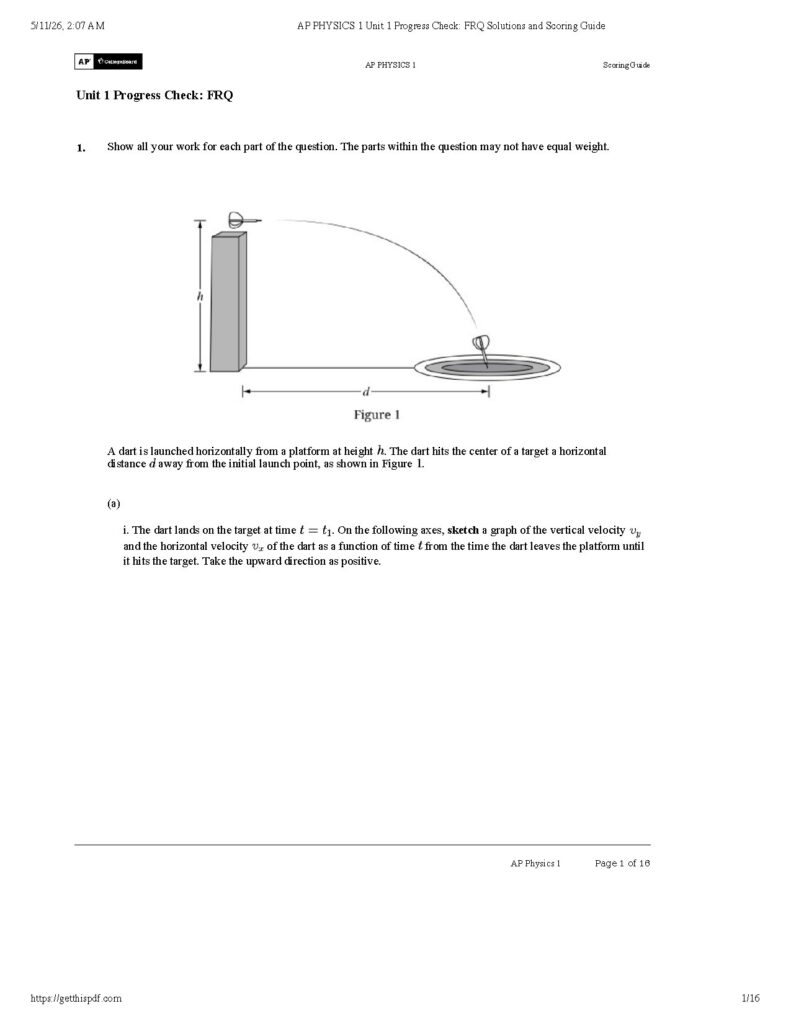
Projectile:
Motion in two dimensions,
v and angle θ with
horizontal, upward is +
x
-
component
no acceleration
=
cos
=
=

cos
y
-
component
acceleration is g
=
sin
=
½

horizontal range
=

2
max range at θ=45
o
14
Weight and mass
:
weight is force of gravity,
mass is the amount of
matter, it never changes
=
×
w is the weight
in newton (N)
, m is
the mass in kg and g is acceleration
due to gravity=9.81 ms
-2
15
Stability of an object
Lower the centre of gravity
→more stable the object is
Wider the base of an object →more stable the object is
16
M
omentum
Momentum=mass×velocity
p
=
m
×
v
u
nit is kg.m.s
-
1
or N.s
17
Conservation of linear
momentum
Total momentum before collision = total momentum after collision
+
=
+
18
Elastic collision
Total k
inetic energy before collision =
total
kinetic energy after collision
½
+
½
=
½
+
½
1
9
E
l
ast
ic
c
ol
li
sion
for two masses
or
=
the equation must satisfy
+
=
+
3
Important Equations for AS Physics - 9702 Prepared by Faisal Jaffer, Nov 2011
2
0
Inelastic collision
Total kinetic energy before collision>total kinetic energy after collision
½
+
½
>
½
+
½
2
1
Newton’s first law of
motion
O
bject in motion
stay in motion forever
object stationary stay stationary forever unless force applied
2
2
Newton’s second law of
motion

1

= 

=

- Net force applied
acceleration
- Mass of an object
1/acceleration
-1 N is the amount of force require
to create an acceleration of 1 ms
-2
of
mass of 1 kg; k=1Nkg
-1
m
-1
s
2
2
3
Newton’s third law of
motion
Action and reaction
forces
applied by two
objects
on each other is always
equal in magnitude and opposite in direction
2
4
Momentum and 2nd law of
motion
=


=

Rate of change of momentum is
equal to the net force applied
2
5
Impulse
=


Constant force acting for sho
r
t time
26
Density ‘ρ’
in kg
m
-
3
o
r
gcm
-3
=
m is the mass and V is the volume
-
ρ
o
f
Mercury
i
s 1
3.
6g
c
m
-
3
- ρ of water is 1gcm
-3
at 4
o
C
- ρ of air 0.001293gcm
-3
27
Pressure
p
in pascal (Pa)
=
F is the force in N and A is the area
on which the force applied in m
2
28
Pressure in fluids due
to
depth h in meters
=

ρ
is the density of the fluid, g is the
acceleration due to gravity and h is
the height or depth in metre
29
U
pthrust
:
- upward force applied by
fluid on an object


=

* upthrust is equal to the weight of the
liquid displaced
-
Object floats if the density of
object
is less than or equal to the density of
the fluid and object sinks if the
density of object is more than the
density of fluid
30
Measuring the density of
liquid using (upthrust) -
Archimedes principle






=








31
Torque
or moment of
force
=

×
sin
F applied perpendicular to d
3
2
Torque due to a
couple
o
r
two equal forces
C
ouple = one force ×
perpendicular
distance between the two forces
=

3
3
Conditions of equilibrium
Σ

=
0
Σ

=
0
-
Total or net force applied is zero
-Total torque applied is zero
3
4
Work
:
ΔW is the work in joules
=

×
cos
work that causes motion → E
k
work that store energy →E
p
F is the force, s is the displacement
in the direction of the force applied
and θ is the angle between F and s
3
5
External
w
ork done by an
expanding gas
=
In p-V graph the area under the graph
is the work done
p is the pressure in Pa and
Δ
V is the
expansion of gas in m
3
3
5
Work done in stretching a
spring
=
½
=
½

Work= area under the F-x graph
F is the force applied and x is the
extension
3
6
Principal of conservation
of mechanical energy
Loss of gain or E
p
=gain or loss of E
k
Δ
=
Δ

=
½
3
7
Electrical potential
energy:
Work done in bring the
unit positive charge from
infinity to a point.
,
=

q
is the quantity of charge in
coulomb and V is the potential
difference between the points.
/ 9
End of Document
62
You May Also Like

FAQs of Important Equations for AS Physics 9702 by Faisal Jaffer

What are the key equations for motion covered in this guide?
The guide covers essential equations for motion, including average velocity, instantaneous velocity, and average acceleration. It explains how to calculate displacement and time, as well as the relationships between velocity and acceleration. Additionally, it details uniformly accelerated motion equations, which are crucial for understanding free fall and projectile motion.
How does the document explain Newton's laws of motion?
Newton's laws of motion are explained with practical examples and applications. The first law states that an object in motion stays in motion unless acted upon by an external force. The second law relates force, mass, and acceleration, providing the formula F=ma. The third law emphasizes that for every action, there is an equal and opposite reaction, which is fundamental in analyzing interactions between objects.
What topics related to electric charge are included?
The document includes topics on electric charge, focusing on electric field intensity and Ohm's law. It explains the relationship between voltage, current, and resistance, providing formulas for calculating these quantities in circuits. Additionally, it discusses the concept of electromotive force and its significance in electrical systems.
What wave properties are discussed in the equations?
Wave properties discussed include wavelength, frequency, and wave speed, along with the wave equation v = fλ. The guide also covers the differences between longitudinal and transverse waves, as well as concepts like diffraction and interference. These principles are crucial for understanding wave behavior in various mediums.
How does the guide address energy conservation in physics?
The guide addresses the principle of conservation of mechanical energy, explaining how energy is transformed between kinetic and potential forms. It provides equations that illustrate energy conservation in different scenarios, such as free-fall motion and oscillations. This understanding is vital for solving problems related to energy in physics.

Related of Important Equations for AS Physics 9702 by Faisal Jaffer