Key Events in World History from 1200 to Present

Key Events in World History from 1200 to Present

Key events in world history from 1200 to the present highlight significant developments across various civilizations. This timeline includes the rise and fall of empires such as the Abbasid Caliphate and the Ottoman Empire, as well as pivotal events like the Crusades and the Black Death. It also covers the emergence of influential figures like Genghis Khan and Mansa Musa, detailing their impact on trade and cultural diffusion. Designed for students and history enthusiasts, this resource provides a comprehensive overview of major historical milestones and their global significance.

Key Points

  • Covers key events from 1200 to 2023, including the rise of the Ottoman Empire and the fall of the Abbasid Caliphate.
  • Highlights the impact of the Black Death on European and Middle Eastern populations, killing nearly one-third of the population.
  • Details the significance of Mansa Musa's pilgrimage to Mecca in 1324, showcasing the wealth of the Mali Empire.
  • Explores the cultural and economic developments during the Song Dynasty, including the expansion of trade and bureaucratic systems.
190
/ 7
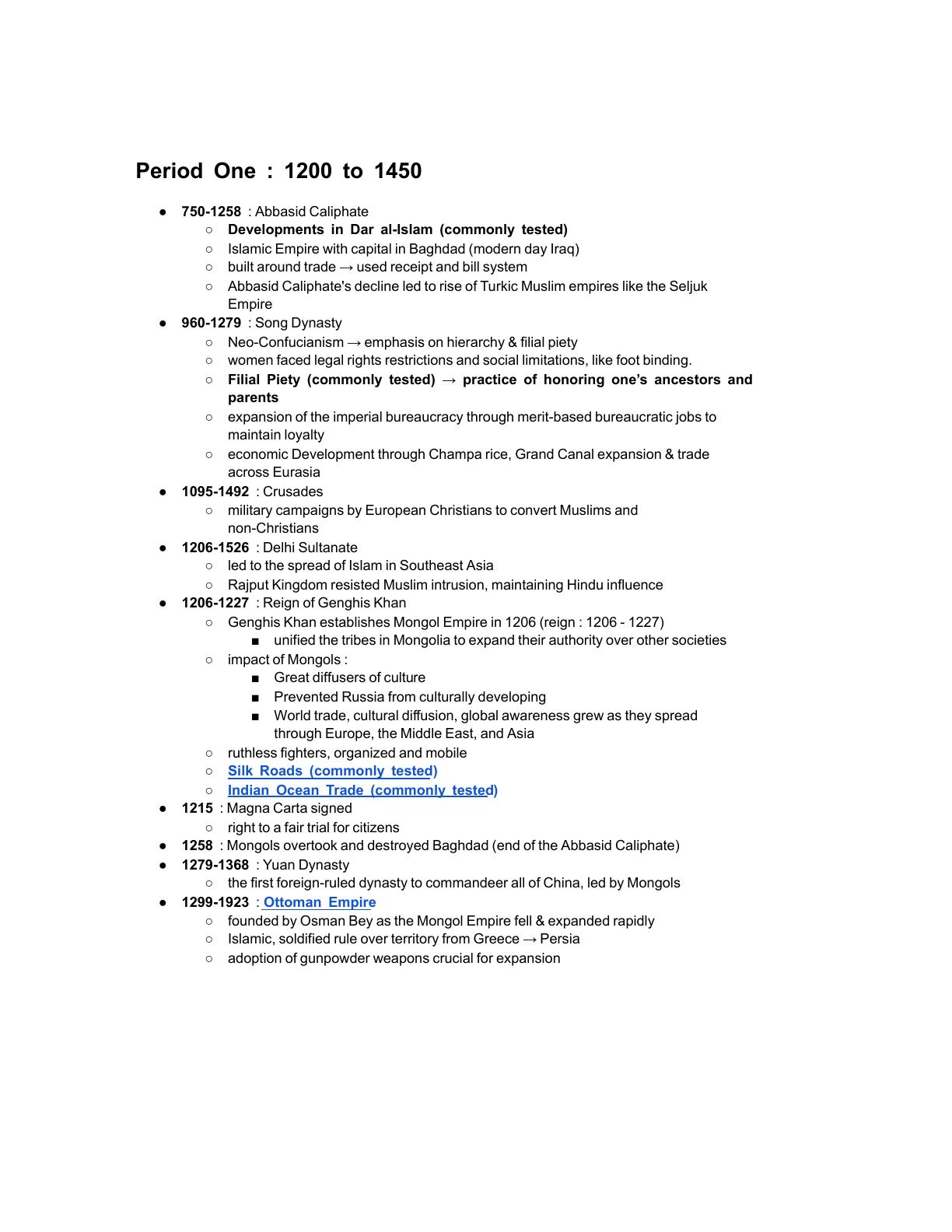
Period One : 1200 to 1450
750-1258 : Abbasid Caliphate
Developments in Dar al-Islam (commonly tested)
Islamic Empire with capital in Baghdad (modern day Iraq)
built around trade used receipt and bill system
Abbasid Caliphate's decline led to rise of Turkic Muslim empires like the Seljuk
Empire
960-1279 : Song Dynasty
Neo-Confucianism emphasis on hierarchy & filial piety
Filial Piety (commonly tested) practice of honoring one’s ancestors and
parents
expansion of the imperial bureaucracy through merit-based bureaucratic jobs to
maintain loyalty
economic Development through Champa rice, Grand Canal expansion & trade
across Eurasia
1095-1492 : Crusades
military campaigns by European Christians to convert Muslims and
non-Christians
1206-1526 : Delhi Sultanate
led to the spread of Islam in Southeast Asia
Rajput Kingdom resisted Muslim intrusion, maintaining Hindu influence
1206-1227 : Reign of Genghis Khan
Genghis Khan establishes Mongol Empire in 1206 (reign : 1206 - 1227)
unified the tribes in Mongolia to expand their authority over other societies
impact of Mongols :
Great diffusers of culture
Prevented Russia from culturally developing
World trade, cultural diffusion, global awareness grew as they spread
through Europe, the Middle East, and Asia
ruthless fighters, organized and mobile
Silk Roads (commonly tested)
Indian Ocean Trade (commonly tested)
1215 : Magna Carta signed
right to a fair trial for citizens
1258 : Mongols overtook and destroyed Baghdad (end of the Abbasid Caliphate)
1279-1368 : Yuan Dynasty
the first foreign-ruled dynasty to commandeer all of China, led by Mongols
1299-1923 : Ottoman Empire
founded by Osman Bey as the Mongol Empire fell & expanded rapidly
Islamic, soldified rule over territory from Greece Persia
adoption of gunpowder weapons crucial for expansion
5/11/26, 2:00 AM
AP World History Timeline: Key Events from 1200 to Present
https://getthispdf.com
1/7
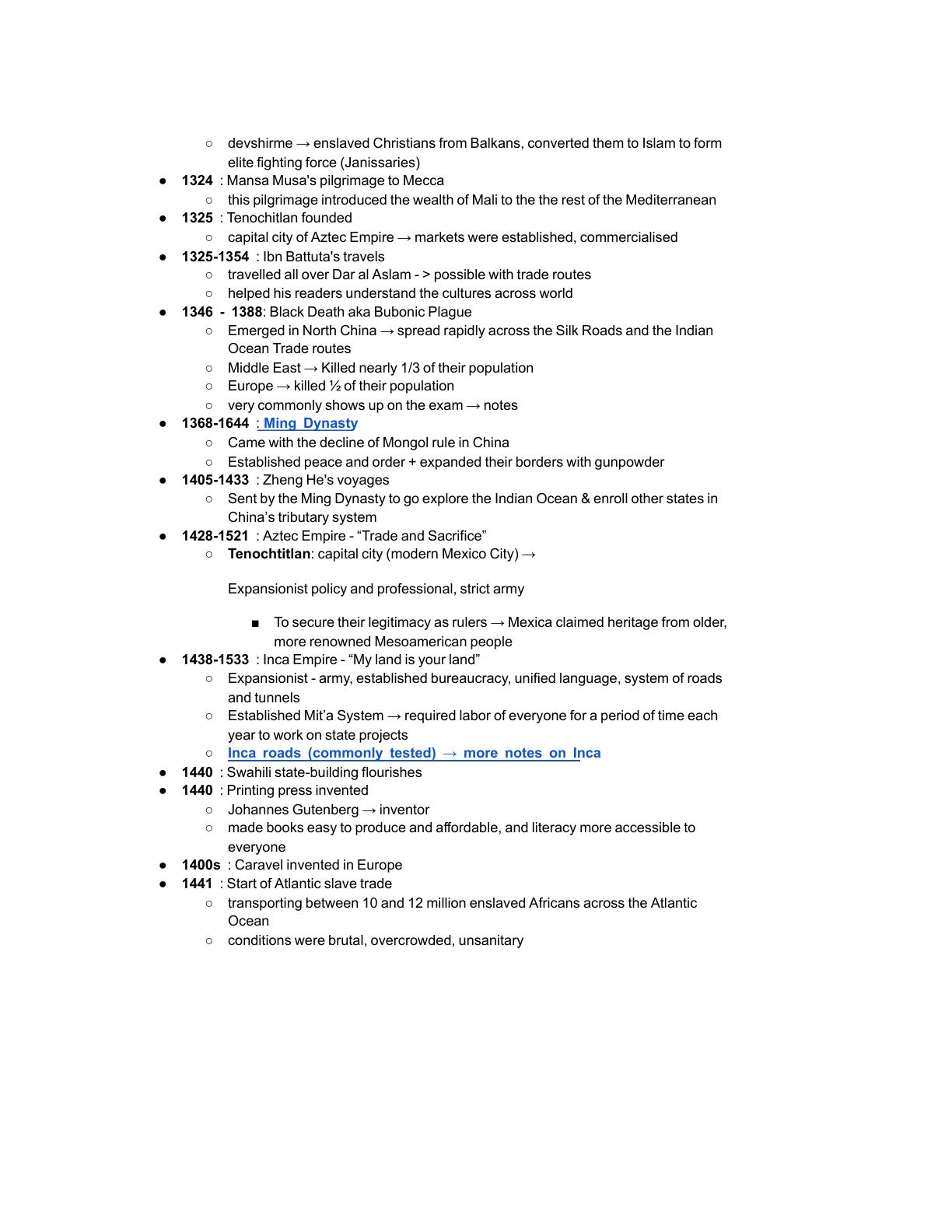
devshirme enslaved Christians from Balkans, converted them to Islam to form
elite fighting force (Janissaries)
1324 : Mansa Musa's pilgrimage to Mecca
this pilgrimage introduced the wealth of Mali to the the rest of the Mediterranean
1325 : Tenochitlan founded
capital city of Aztec Empire markets were established, commercialised
1325-1354 : Ibn Battuta's travels
travelled all over Dar al Aslam - > possible with trade routes
helped his readers understand the cultures across world
1346 - 1388: Black Death aka Bubonic Plague
Emerged in North China spread rapidly across the Silk Roads and the Indian
Ocean Trade routes
Middle East Killed nearly 1/3 of their population
Europe killed ½ of their population
very commonly shows up on the exam notes
1368-1644 : Ming Dynasty
Came with the decline of Mongol rule in China
Established peace and order + expanded their borders with gunpowder
1405-1433 : Zheng He's voyages
Sent by the Ming Dynasty to go explore the Indian Ocean & enroll other states in
China’s tributary system
1428-1521 : Aztec Empire - “Trade and Sacrifice”
Tenochtitlan: capital city (modern Mexico City)
Expansionist policy and professional, strict army
To secure their legitimacy as rulers Mexica claimed heritage from older,
more renowned Mesoamerican people
1438-1533 : Inca Empire - “My land is your land”
Expansionist - army, established bureaucracy, unified language, system of roads
and tunnels
Established Mit’a System required labor of everyone for a period of time each
year to work on state projects
Inca roads (commonly tested) more notes on Inca
1440 : Swahili state-building flourishes
1440 : Printing press invented
Johannes Gutenberg inventor
made books easy to produce and affordable, and literacy more accessible to
everyone
1400s : Caravel invented in Europe
1441 : Start of Atlantic slave trade
transporting between 10 and 12 million enslaved Africans across the Atlantic
Ocean
conditions were brutal, overcrowded, unsanitary
5/11/26, 2:00 AM
AP World History Timeline: Key Events from 1200 to Present
https://getthispdf.com
2/7
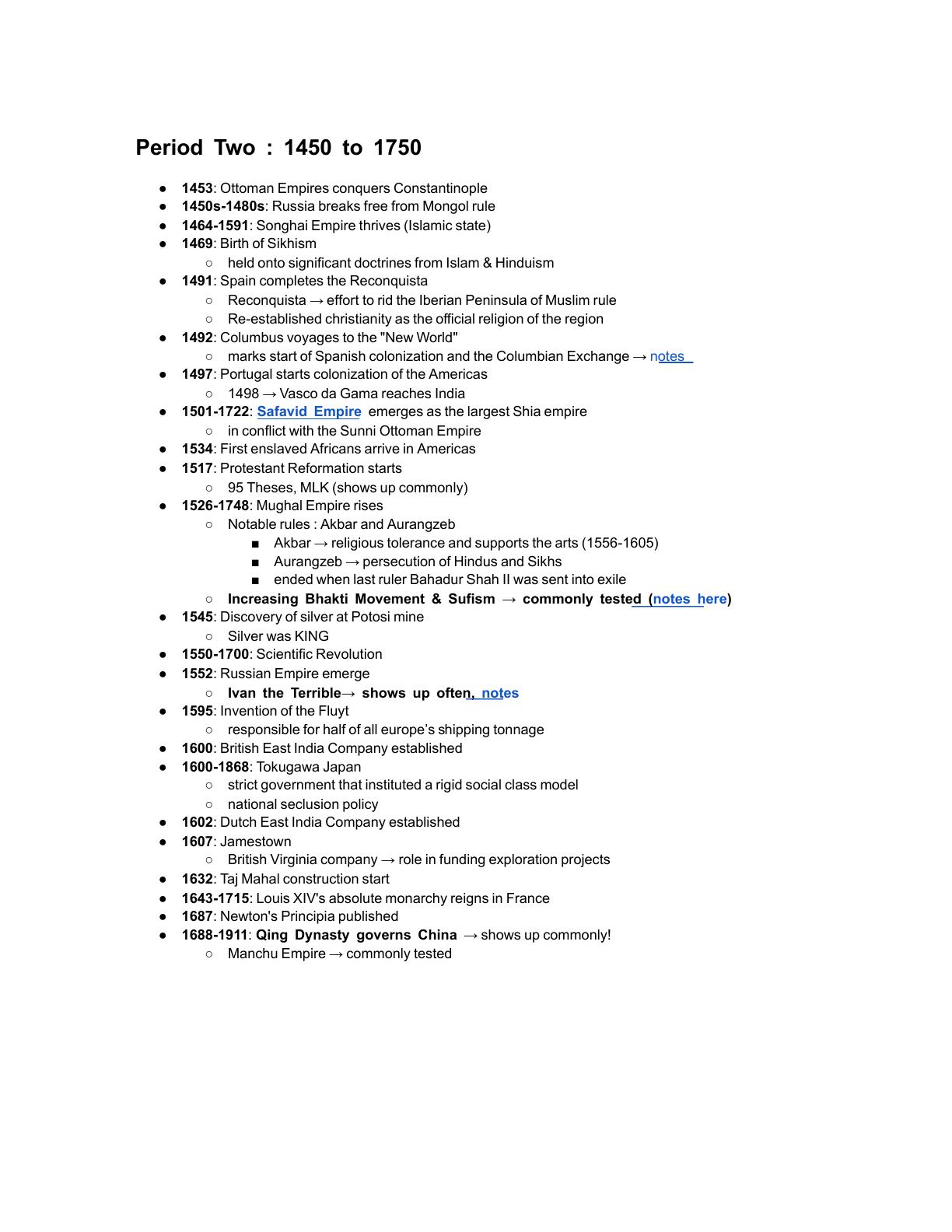
Period Two : 1450 to 1750
1453: Ottoman Empires conquers Constantinople
1450s-1480s: Russia breaks free from Mongol rule
1464-1591: Songhai Empire thrives (Islamic state)
1469: Birth of Sikhism
held onto significant doctrines from Islam & Hinduism
1491: Spain completes the Reconquista
Reconquista effort to rid the Iberian Peninsula of Muslim rule
Re-established christianity as the official religion of the region
1492: Columbus voyages to the "New World"
marks start of Spanish colonization and the Columbian Exchange notes
1497: Portugal starts colonization of the Americas
1498 Vasco da Gama reaches India
1501-1722: Safavid Empire emerges as the largest Shia empire
in conflict with the Sunni Ottoman Empire
1534: First enslaved Africans arrive in Americas
1517: Protestant Reformation starts
95 Theses, MLK (shows up commonly)
1526-1748: Mughal Empire rises
Notable rules : Akbar and Aurangzeb
Akbar religious tolerance and supports the arts (1556-1605)
Aurangzeb persecution of Hindus and Sikhs
ended when last ruler Bahadur Shah II was sent into exile
Increasing Bhakti Movement & Sufism commonly tested (notes here)
1545: Discovery of silver at Potosi mine
Silver was KING
1550-1700: Scientific Revolution
1552: Russian Empire emerge
Ivan the Terrible→ shows up often, notes
1595: Invention of the Fluyt
responsible for half of all europe’s shipping tonnage
1600: British East India Company established
1600-1868: Tokugawa Japan
strict government that instituted a rigid social class model
national seclusion policy
1602: Dutch East India Company established
1607: Jamestown
British Virginia company role in funding exploration projects
1632: Taj Mahal construction start
1643-1715: Louis XIV's absolute monarchy reigns in France
1687: Newton's Principia published
1688-1911: Qing Dynasty governs China shows up commonly!
Manchu Empire commonly tested
5/11/26, 2:00 AM
AP World History Timeline: Key Events from 1200 to Present
https://getthispdf.com
3/7
/ 7
End of Document
190
You May Also Like

FAQs of Key Events in World History from 1200 to Present

What were the main causes of the Black Death?
The Black Death, also known as the Bubonic Plague, emerged in North China and spread rapidly through trade routes such as the Silk Roads and the Indian Ocean. It was primarily caused by the bacterium Yersinia pestis, which was transmitted through fleas that infested rats. The disease had devastating effects, killing nearly one-third of the population in the Middle East and about half in Europe. The societal impact included labor shortages, economic decline, and significant shifts in social structures.
What impact did Genghis Khan have on global trade?
Genghis Khan, who established the Mongol Empire in 1206, significantly influenced global trade by unifying various tribes and creating a vast network of trade routes. His empire facilitated cultural diffusion and the exchange of goods across Europe, the Middle East, and Asia. The Mongols improved the safety and efficiency of the Silk Roads, leading to increased trade in silk, spices, and other commodities. This expansion of trade contributed to a greater global awareness and interconnectedness among different cultures.
What were the key achievements of the Song Dynasty?
The Song Dynasty, which lasted from 960 to 1279, is known for its advancements in technology, culture, and economics. It saw the introduction of Neo-Confucianism, emphasizing hierarchy and filial piety, which shaped societal values. The dynasty also expanded the imperial bureaucracy through merit-based examinations, enhancing governance. Economic developments included the cultivation of Champa rice, which improved agricultural productivity, and the expansion of the Grand Canal, facilitating trade across regions.
How did the Crusades affect Christian-Muslim relations?
The Crusades, military campaigns initiated by European Christians from 1095 to 1492, aimed to reclaim the Holy Land from Muslim control. These conflicts intensified Christian-Muslim relations, leading to both hostility and cultural exchanges. While the Crusades ultimately failed to establish lasting Christian control over Jerusalem, they opened up trade routes and introduced Europeans to Eastern goods and ideas. The legacy of the Crusades continues to influence perceptions and interactions between these two religious groups.

Related of Key Events in World History from 1200 to Present