Math 30-1 Transformations and Operations Practice Exam

Math 30-1 Transformations and Operations Practice Exam

Math 30-1 Transformations and Operations Practice Exam provides students with a comprehensive review of key concepts related to transformations and operations in mathematics. This exam includes various types of questions that cover transformations of functions, including translations, reflections, and stretches. Students will encounter problems that require them to analyze graphs, determine invariant points, and apply transformation equations. Ideal for high school students preparing for their Math 30-1 exam, this practice exam helps reinforce understanding of critical mathematical principles and prepares them for real exam scenarios.

Key Points

  • Includes a variety of questions on function transformations and operations.
  • Covers horizontal and vertical translations, reflections, and stretches.
  • Features problems related to invariant points and transformation equations.
  • Designed for high school students preparing for the Math 30-1 exam.
65
/ 12
www.math30.ca
1.
Math 30-1: Transformations and Operations
PRACTICE EXAM
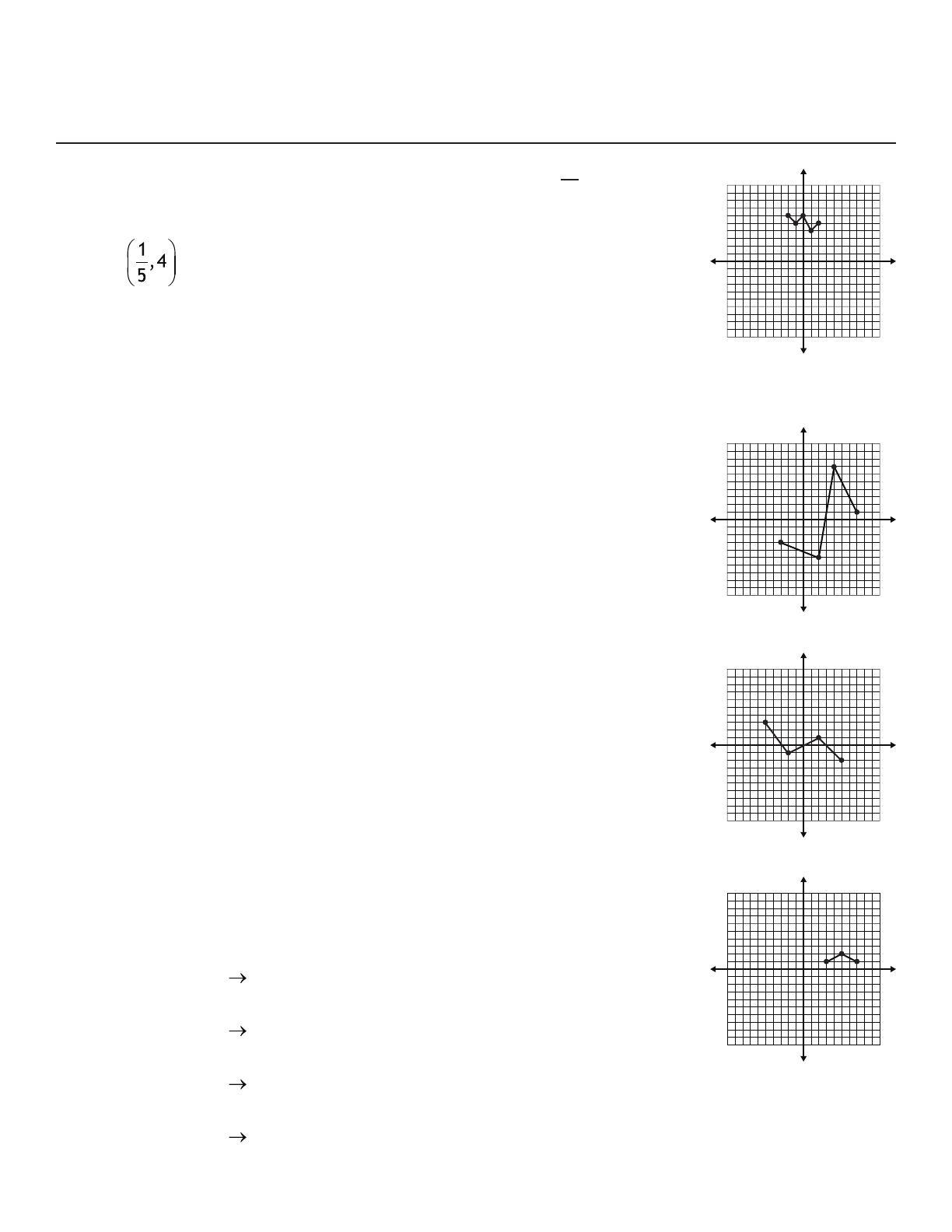
If the graph of f(x) undergoes the transformation
A.
C. (-5, 5)
D. (6, 0)
y = f( x)
1
5
,
a point that exists on the graph of the image is:
B. (2, 1)
2.
If the graph of f(x) undergoes the transformation x = f(y),
an invariant point is:
A. (7, 1)
C. (5, 5)
D. (3, 1)
B. (3, -3)
3.
If the graph of f(x) undergoes the transformation y - 4 = f(x),
then the range of the image is:
A. {y | -6 ≤ y ≤ -1, y ε R}
C. [-6, -1]
D. (2, 7)
B. {y | 2 ≤ y ≤ 7, y ε R}
4.
If the graph of f(x) is horizontally translated 6 units left, then the
corresponding transformation equation and mapping are:
A. Transformation Equation: y = f(x - 6);
Mapping: (x, y) (x - 6, y)
B. Transformation Equation: y = f(x - 6);
Mapping: (x, y) (x + 6, y)
C. Transformation Equation: y = f(x + 6);
Mapping: (x, y) (x - 6, y)
D. Transformation Equation: y = f(x + 6);
Mapping: (x, y) (x + 6, y)
Transformations and Operations Practice Exam
5.
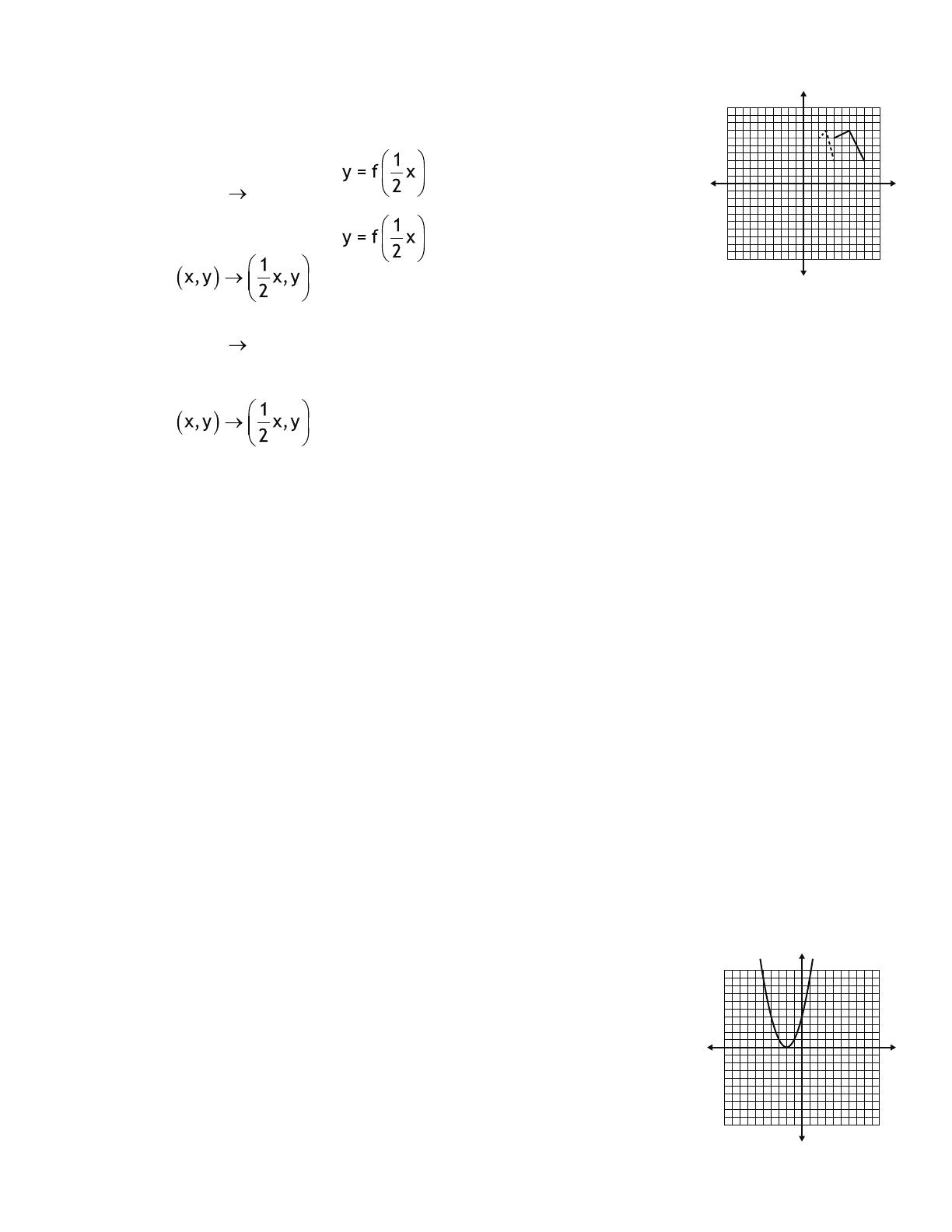
If f(x) (dashed line ---) is transformed to the image (solid line —),
then the corresponding transformation equation and mapping are:
A. Transformation Equation: ;
Mapping: (x, y) (2x, y)
B. Transformation Equation: ;
C. Transformation Equation: y = f(2x);
Mapping: (x, y) (2x, y)
D. Transformation Equation: y = f(2x);
Mapping:
Mapping:
6.
If the graph of f(x) = x
2
+ 1 is transformed by g(x) = f(2x), then the function of the image is:
A. g(x) = 4x
2
+ 1
C. g(x) = 2x
2
+ 2
D. g(x) = 2x + 1
B. g(x) = 2x
2
+ 1
7.
If the graph of f(x) = x
2
- 4 is transformed by g(x) = f(x) - 4, then the function of the image is:
A. g(x) = x
2
- 8
C. g(x) = (x - 4)
2
- 4
D. g(x) = (x + 4)
2
- 4
B. g(x) = x
2
8.
If the graph of f(x) = (x + 2)
2
is horizontally translated so it passes
through the point (6, 9), the transformation equation is:
A. y = f(x - 5)
C. Neither y = f(x - 5) nor y = f(x - 11).
D. Both y = f(x - 5) and y = f(x - 11).
B. y = f(x - 11)
www.math30.ca Transformations and Operations Practice Exam
$
n
100
200
300
400
500
20 40 60 80
R(n)
C(n)
9.
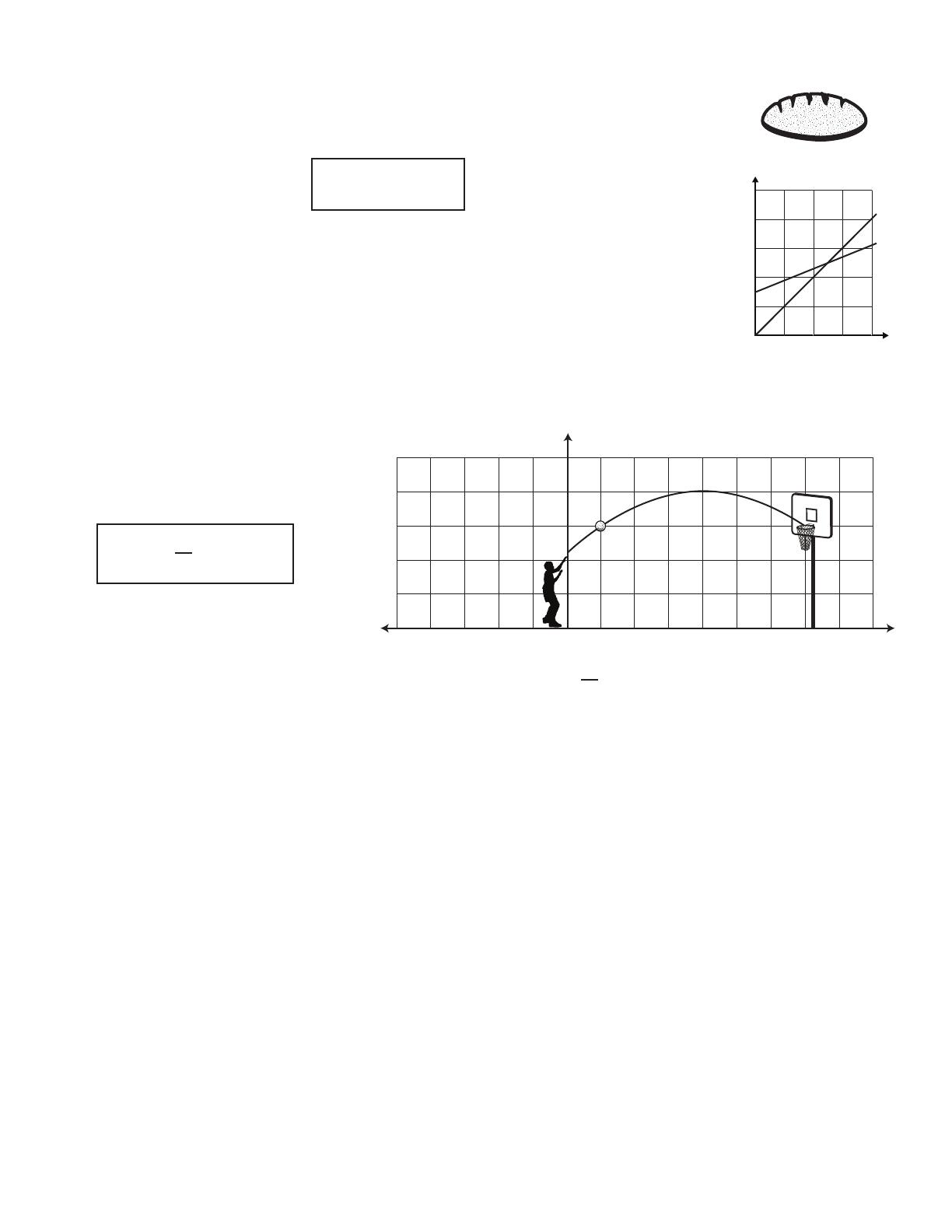
Sam sells bread at a farmers’ market for $5.00 per loaf. It costs $150 to
rent a table for one day at the farmers’ market, and each loaf of bread
costs $2.00 to produce. The cost (expenses) and revenue functions are:
A. C
2
(n) = 2n + 200 and R
2
(n) = n
C. C
2
(n) = 2(n - 50) + 150 and R
2
(n) = 5.2n
D. C
2
(n) = 2n + 200 and R
2
(n) = 6n
B. C
2
(n) = 2.4n + 200 and R
2
(n) = 6n
C(n) = 2n + 150
R(n) = 5n
If the cost of renting a table increases by $50/day, and Sam raises the
price of a loaf by 20%, then the new cost and revenue functions are:
2
d
h(d)
3
4
1
1 2 3 4 5 6 7
5
8 9-5 -4 -3 -2 -1 0
10.
A basketball player throws
a basketball. The path can
be modeled with the function:
h(d) = -
1
9
(d - 4)
2
+ 4
If the player moves so the equation of the shot is , the horizontal
distance of the player from the hoop is:
h(d) = -
1
9
(d + 1)
2
+ 4
A. 1 metre
C. 8 metres
D. 12 metres
B. 3 metres
11.
The transformation y = -3f[-4(x - 1)] + 2 is best described (sequentially) as:
A. Translations 1 unit left and 2 units up; reflections about both the x- and y-axis;
a vertical stretch by a scale factor of 3 and a horizontal stretch by a scale factor of 4.
C. Reflections about both the x- and y-axis; a vertical stretch by a scale factor of 1/3 and a
horizontal stretch by a scale factor of 4; and translations 1 unit right and 2 units up.
D. A vertical stretch by a scale factor of 3 and a horizontal stretch by a scale factor of 1/4;
reflections about both the x- and y-axis; and translations 1 unit right and 2 units up.
B. Translations 1 unit right and 2 units up; reflections about both the x- and y-axis;
a vertical stretch by a scale factor of 3 and a horizontal stretch by a scale factor of 1/4.
www.math30.caTransformations and Operations Practice Exam
/ 12
End of Document
65
You May Also Like

FAQs of Math 30-1 Transformations and Operations Practice Exam

What types of transformations are covered in this practice exam?
The practice exam covers various types of transformations, including horizontal and vertical translations, reflections across axes, and vertical stretches. Each question is designed to test students' understanding of how these transformations affect the graphs of functions. Students will learn to identify invariant points and apply transformation equations effectively. This comprehensive approach ensures that students are well-prepared for similar questions on their Math 30-1 exam.
How does the practice exam help students prepare for the Math 30-1 exam?
This practice exam serves as a valuable tool for students preparing for the Math 30-1 exam by providing a range of questions that mimic the style and difficulty of actual exam questions. It allows students to practice their problem-solving skills and gain confidence in their understanding of transformations and operations. By working through the exam, students can identify areas where they need further review, making their study sessions more efficient and targeted.
What is the significance of invariant points in function transformations?
Invariant points are crucial in understanding function transformations because they remain unchanged despite the transformations applied to the function. Identifying these points helps students visualize how transformations affect the graph of a function. For example, when a function is translated or reflected, the invariant points can indicate where the graph intersects the axes or remains fixed. This understanding is essential for accurately sketching transformed graphs and solving related problems.
What mathematical concepts are reinforced through this practice exam?
The practice exam reinforces several key mathematical concepts, including the properties of functions, the effects of transformations on graphs, and the ability to derive transformation equations. Students will also enhance their skills in analyzing graphs and understanding the relationships between different functions. These concepts are foundational for success in higher-level mathematics and are critical for the Math 30-1 curriculum.
How many questions are included in the Math 30-1 practice exam?
The Math 30-1 Transformations and Operations Practice Exam includes a variety of questions designed to cover all essential topics related to transformations. While the exact number may vary, students can expect a comprehensive set of problems that challenge their understanding and application of the material. This range ensures that students have ample opportunity to practice and refine their skills before the actual exam.

Related of Math 30-1 Transformations and Operations Practice Exam