Microeconomics Unit 6 Perfect Competition Notes

Microeconomics Unit 6 Perfect Competition Notes

Perfect competition is a market structure where individual buyers and sellers cannot influence product prices, making them price takers. This document explores the requirements for perfect competition, including the necessity for a large number of buyers and sellers, homogeneous products, and perfect knowledge of market conditions. It also discusses the demand curve faced by firms, the equilibrium position for profit maximization, and the implications of marginal revenue and marginal cost. Ideal for students studying microeconomics, these notes provide a comprehensive overview of key concepts and applications in real-world markets.

Key Points

  • Explains the characteristics of perfect competition and its market requirements.
  • Describes the demand curve for firms operating under perfect competition.
  • Analyzes the equilibrium conditions for profit maximization in competitive markets.
  • Covers the relationship between marginal revenue and marginal cost for firms.

416
/ 17
MICRO ECONOMICS
UNIT 6
PERFECT COMPETITION
CLAIRE HELSBY
MEMO
PERFECT COMPETITION
Perfect competition occurs when none of the individual market participants (ie buyers or
sellers) can influence the price of the product. Therefore all participants are price takers.
Requirements for perfect competition to exist
There must be a large number of buyers and sellers of the product.
There must be no collusion between sellers.
All the goods in the market must be identical (homogeneous).
Buyers and sellers must have complete freedom to enter or exit the market.
Buyers and sellers must have perfect knowledge of market conditions.
There must be no government intervention influencing buyers or sellers.
All the factors of production must be perfectly mobile.
No markets meet all the above requirements for perfect competition but there are some
approximations to these requirements in agriculture, international commodity markets and
financial markets like the JSE.
The word “perfect” in perfect competition does not mean that it is necessarily the most
desirable form of competition – it simply signifies the highest or most complete degree of
competition.
2
THE DEMAND FOR THE PRODUCT OF THE FIRM
Under perfect competition the price of a product is determined by supply and demand. The
individual firm is a price taker and can sell any quantity at the market price. No firm will
charge a price higher than the prevailing market price because it will then lose all of its
customers. Nor will a firm gain anything by charging a price that is lower than the existing
market price, since it can sell as many units of its output as it wishes at the market price.
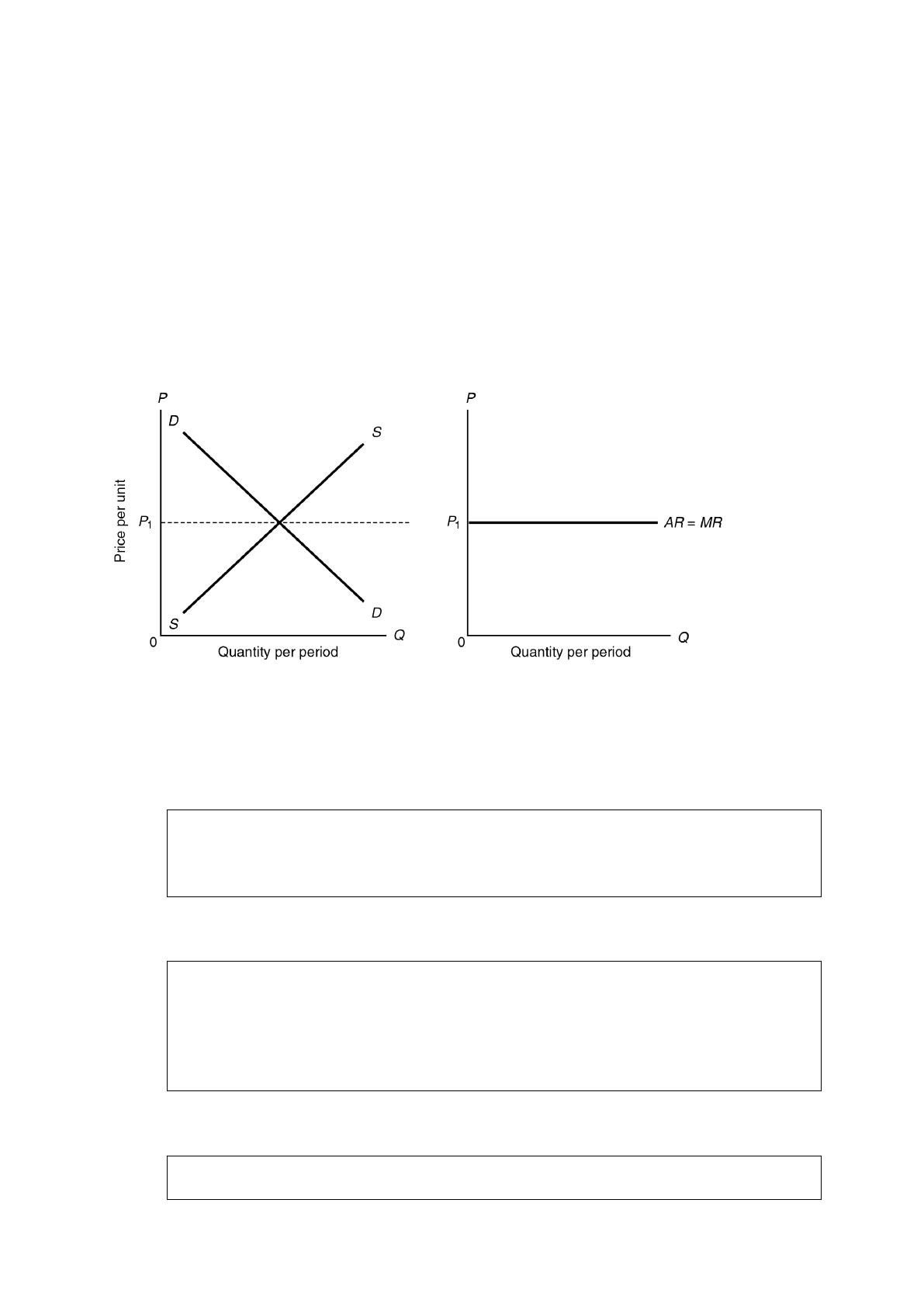
Under perfect competition the individual firm is faced by a demand curve which is horizontal
(or perfectly elastic) at the existing market price. We call this curve the demand curve for
the product of the firm. It is also known as the firm’s sales curve, the firm’s demand
curve or the demand curve facing the firm.
Fig 6.1 - The demand curve for the product of the firm under perfect competition
TASK 6.1 5 MARKS
6.1.1 Explain the graph on the left in figure 6.1 above. (2)
The graph on the left shows that the price of the product is determined in the market
by demand and supply. The firm can sell its whole output at that price.
6.1.2 Explain the graph on the right in figure 6.1 above. (2)
The fact that the firm can sell its whole output at that price is indicated by the
horizontal line on the right. This line is the demand curve for the product of the firm.
The firm’s average revenue (AR) and marginal revenue (MR) are equal to the price
of the product.
6.1.3 Which curve is the demand curve for the product of the firm in figure 6.1 above? (1)
The horizontal line.
3
/ 17
End of Document
416
You May Also Like

FAQs of Microeconomics Unit 6 Perfect Competition Notes

What are the main characteristics of perfect competition?
Perfect competition is defined by several key characteristics: a large number of buyers and sellers, homogeneous products, no barriers to entry or exit, and perfect information among participants. In this market structure, no single buyer or seller can influence the market price, leading to a situation where all firms are price takers. This idealized form of competition is rarely found in real-world markets but serves as a benchmark for evaluating market efficiency.
How is the demand curve represented for a firm in perfect competition?
In a perfectly competitive market, the demand curve faced by an individual firm is horizontal, indicating that the firm can sell any quantity of its product at the prevailing market price. This means that the firm's average revenue (AR) and marginal revenue (MR) are equal to the market price. If a firm attempts to charge a higher price, it will lose all its customers, while charging a lower price is unnecessary since it can sell all it wants at the market price.
What is the profit-maximizing output level for firms in perfect competition?
Firms in perfect competition maximize profits by producing at the output level where marginal revenue equals marginal cost (MR = MC). This condition ensures that the firm is not leaving potential profits on the table or incurring unnecessary losses. If MR exceeds MC, the firm can increase profits by producing more, while if MC exceeds MR, the firm should reduce output to avoid losses.
What happens to firms in the long run under perfect competition?
In the long run, firms in a perfectly competitive market will only earn normal profits due to the free entry and exit of firms. When existing firms make economic profits, new firms are attracted to the market, increasing supply and driving down prices until profits are eliminated. Conversely, if firms incur losses, some will exit the market, reducing supply and raising prices until remaining firms can cover their costs.

Related of Microeconomics Unit 6 Perfect Competition Notes