
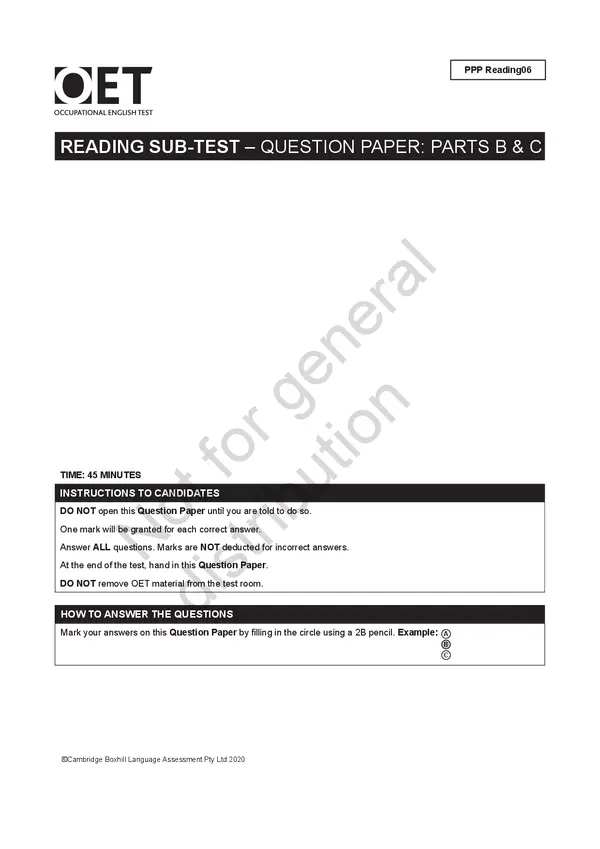

READING SUB-TEST – QUESTION PAPER: PARTS B & C
PPP Reading06
TIME: 45 MINUTES
INSTRUCTIONS TO CANDIDATES
DO NOT open this Question Paper until you are told to do so.
One mark will be granted for each correct answer.
Answer ALL questions. Marks are NOT deducted for incorrect answers.
At the end of the test, hand in this Question Paper.
DO NOT remove OET material from the test room.
Mark your answers on this Question Paper by filling in the circle using a 2B pencil. Example:
HOW TO ANSWER THE QUESTIONS
A
B
C
©Cambridge Boxhill Language Assessment Pty Ltd 2020
Not for general
distribution

Part B
In this part of the test, there are six short extracts relating to the work of health professionals. For questions 1-6,
choose the answer (A, B or C) which you think fits best according to the text.
A
B
C
1. According to the policy document, what should be assessed at the clinic?
the anticipated longevity of the pacemaker battery
whether a different type of pacemaker would be more suitable
reasons for delaying referral of the pacemaker wearer to the implant surgeon
Pacemaker Follow-up Clinic
Objectives:
1. To optimise the pacing system according to the individual patient needs whilst maximising
generator life.
2. To identify any abnormalities in the pacemaker system and complications of the therapy in
order to ensure prompt treatment.
3. To assess battery status to predict end-of-life of the pulse generator in order to permit timely
elective generator replacement.
Suggested appointments schedule:
- Yearly for pacemakers implanted for less than 7-10 years, depending on the manufacturers
recommendation
- 6 monthly for implants exceeding 7-10 years.
- 3-6 monthly for devices that show decline in battery life.
- At Cardiac Physiologist’s discretion for devices that require closer monitoring, e.g.
programming/lead issues.
The implant centre need only be contacted when seeking additional advice or when making a referral to
the implanting physician.
Not for general
distribution
PPP Reading06
©Cambridge Boxhill Language Assessment Pty Ltd 2020

A
B
C
2. What does this memo about dental anaesthesia tell nurses in the orthodontics department?
As a precaution, Prilocaine is used in low concentrations for all patients.
There may be circumstances when a higher dose of Lidocaine should be used.
One formulation of Mepivacaine is most suitable for patients with high blood pressure.
Memo
To: dental nurses
Subject:
Information for dental nurses regarding dental anaesthesia
Lidocaine is used in dental local anaesthetics in this orthodontics department. Lidocaine 2% combined with
adrenaline (1 in 80 000 or 12.5 micrograms/mL) is a safe and effective preparation, and therefore no justification
exists for stronger concentrations of adrenaline. Other local anaesthetics we keep in stock are Articaine
and Mepivacaine, purchased in cartridges suitable for dental use. Mepivacaine is available with or without
adrenaline, whereas Articaine is available only with adrenaline. In patients with severe hypertension, the use
of adrenaline in a local anaesthetic may be hazardous. For these patients, where Mepivacaine is unavailable,
Prilocaine can be used. However, there is some evidence that it can cause coronary vasoconstriction when used
at high doses. Common practice is therefore to limit the dose administered to patients with hypertension.
Not for general
distribution
PPP Reading06
©Cambridge Boxhill Language Assessment Pty Ltd 2020