Montclair State University Communications style guide and AP style short cuts

Montclair State University Communications style guide and AP style short cuts

The Montclair State University Communications Style Guide provides essential guidelines for writing and editing university publications. It combines AP style with university-specific rules, covering academic titles, degrees, and departmental names. This guide is invaluable for students, faculty, and staff involved in communications at Montclair State University. Key topics include punctuation rules, media references, and formatting for various types of content. Ideal for anyone looking to enhance their writing skills in an academic setting.

Key Points

  • Details capitalization rules for academic titles and departments at Montclair State University.
  • Explains the correct usage of punctuation according to AP style, including commas, dashes, and quotation marks.
  • Outlines guidelines for formatting titles of books, movies, and other media in university publications.
  • Provides specific examples of how to reference academic degrees and titles in writing.
99
/ 7
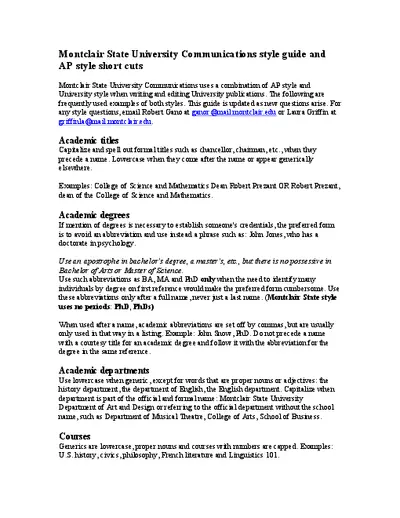
Montclair State University Communications style guide and
AP style short cuts
Montclair State University Communications uses a combination of AP style and
University style when writing and editing University publications. The following are
frequently used examples of both styles. This guide is updated as new questions arise. For
any style questions, email Robert Gano at ganor@mail.montclair.edu or Laura Griffin at
griffinla@mail.montclair.edu.
Academic titles
Capitalize and spell out formal titles such as chancellor, chairman, etc., when they
precede a name. Lowercase when they come after the name or appear generically
elsewhere.
Examples: College of Science and Mathematics Dean Robert Prezant OR Robert Prezant,
dean of the College of Science and Mathematics.
Academic degrees
If mention of degrees is necessary to establish someone's credentials, the preferred form
is to avoid an abbreviation and use instead a phrase such as: John Jones, who has a
doctorate in psychology.
Use an apostrophe in bachelor's degree, a master's, etc., but there is no possessive in
Bachelor of Arts or Master of Science.
Use such abbreviations as BA, MA and PhD only when the need to identify many
individuals by degree on first reference would make the preferred form cumbersome. Use
these abbreviations only after a full name, never just a last name. (Montclair State style
uses no periods: PhD, PhDs)
When used after a name, academic abbreviations are set off by commas, but are usually
only used in that way in a listing. Example: John Snow, PhD. Do not precede a name
with a courtesy title for an academic degree and follow it with the abbreviation for the
degree in the same reference.
Academic departments
Use lowercase when generic, except for words that are proper nouns or adjectives: the
history department, the department of English, the English department. Capitalize when
department is part of the official and formal name: Montclair State University
Department of Art and Design or referring to the official department without the school
name, such as Department of Musical Theatre, College of Arts, School of Business.
Courses
Generics are lowercase, proper nouns and courses with numbers are capped. Examples:
U.S. history, civics, philosophy, French literature and Linguistics 101.
Clubs
Formal names of school clubs are capitalized. Honors Student Organization, but
lowercase any informal or shortened terms for clubs, such as crew.
COMPOSITION TITLES
Apply the guidelines listed here to book titles, computer game titles, movie titles, opera
titles, play titles, poem titles, album and song titles, radio and television program titles,
and the titles of lectures, speeches and works of art. (We ital movie, plays, books, TV
shows).
The guidelines, followed by a block of examples:
Use Title case: Capitalize the principal words, including prepositions and
conjunctions of four or more letters.
Italicize movies, books,
Capitalize an article — the, a, an — or words of fewer than four letters if it is the
first or last word in a title – set articles in quotations
Italicize the names of all such works except the Bible and books that are primarily
catalogs of reference material. In addition to catalogs, this category includes
almanacs, directories, dictionaries, encyclopedias, gazetteers, handbooks and
similar publications. Do not use quotation marks around such software titles as
WordPerfect or Windows.
Translate a foreign title into English unless a work is generally known by its
foreign name. An exception to this is reviews of musical performances. In those
instances, generally refer to the work in the language it was sung in, so as to
differentiate for the reader. However, musical compositions in Slavic languages
are always referred to in their English translations.
Italicize names of movies, books, TV shows, newspapers, magazines: i.e. Gone With the
Wind, Of Mice and Men, For Whom the Bell Tolls, Time After Time, the NBC-TV Today
show, the CBS Evening News, The Mary Tyler Moore Show. The New York Times.
Use quotation marks also for the title of an episode, a chapter of a book or the title of an
article inside a magazine or newspaper…i.e. : "Chuckles Bites the Dust," an episode of
The Mary Tyler Moore Show, a chapter of a book or the title of an article inside a
magazine, such as “Out of the Shadows” in the Sept. 2013 issue of Montclair magazine.
Names of most websites and apps are capitalized without quotes: Facebook, Foursquare.
Exception: "FarmVille" and similar computer game apps are in quotes.
Foreign works: Mozart's The Marriage of Figaro if sung in English but Le Nozze di
Figaro if sung in Italian. Mozart's The Magic Flute if sung in English but Die
Zauberfloete if sung in German.
For other classical music titles, use quotation marks around the composition's
nicknames but not compositions identified by its sequence.

Examples: Dvorak's "New World Symphony." Dvorak's Symphony No. 9.
Magazine, Newspapers
Use ital for newspaper and magazine titles. Also, if the word magazine is part of the
name it gets capitalized and italicized, if not, it does not:
Examples: Montclair magazine; O, The Oprah Magazine; The New York Times
Magazine, TIME magazine, People magazine.
If the the in newspaper names is part of the paper’s official name, capitalize it. If not, use
lowercase. Examples: The New York Times, the New York Daily News, The Montclarion,
the Tampa Bay Times.
Media
In the sense of mass communication, such as magazines, newspapers, the news services,
radio, television and online, etc., the word is plural: The news media are resisting
attempts to limit their freedom.
WEB/INTERNET
Use Web (short for World Wide Web), but website, webcam, webcast and webmaster.
Also it’s the Internet, email, e-book, e-reader, iPhone, Google,
Avoid URLs that are particularly lengthy and complicated, unless essential to guide the
reader to a particular document (get a short URL). Also don’t use the http://www.
Example: Use montclair.edu instead of www.montclair.edu.
Radio
Radio stations’ call letters appear in all caps. Use hyphens to separate from AM or
FM: WDAY-FM, KFYR-AM.
SPORTS
Athletic director
Use the singular athletic (not athletics) unless otherwise in a formal title, but also director
of athletics
Coach
Lowercase as a job description, not a formal title. Capitalize when used as a term of
address. “Coach told me,” or “Coach Taylor told me.” When used as a full title before
the name, capitalize but lowercase after the name.
NCAA
NCAA is acceptable in all references for National Collegiate Athletic Association. We
are Division III.
Team names
/ 7
End of Document
99
You May Also Like

FAQs of Montclair State University Communications style guide and AP style short cuts

What are the capitalization rules for academic titles?
The guide specifies that formal titles such as 'Dean' or 'Chancellor' should be capitalized when they precede a name. However, when these titles follow a name or are used generically, they should be in lowercase. For example, 'Dean Robert Prezant' is correct, while 'Robert Prezant, dean of the College of Science and Mathematics' is also correct.
How should punctuation be used in academic writing?
The style guide emphasizes the importance of proper punctuation according to AP style. It instructs writers to place periods and commas inside quotation marks, while dashes, semicolons, and question marks should be placed according to their relevance to the quoted material. This ensures clarity and consistency in academic writing.
What formatting guidelines are provided for media titles?
According to the guide, titles of books, movies, and TV shows should be italicized, while articles and chapters should be placed in quotation marks. This helps distinguish between different types of works and maintains a professional standard in university publications.
What is the preferred way to reference academic degrees?
The guide advises against using abbreviations for academic degrees unless necessary for clarity. Instead, it suggests using phrases like 'John Jones, who has a doctorate in psychology.' It also specifies the correct use of apostrophes in terms like 'bachelor's degree' and 'master's degree.'

Related of Montclair State University Communications style guide and AP style short cuts