Near Point Convergence Screening Guide for Educators PDF

Near Point Convergence Screening Guide for Educators PDF

This document is a comprehensive screening guide focused on Near Point Convergence, aimed at educators and health professionals. It outlines the purpose of the screening, which is to assess the ability of students to focus on a single object at close range. The guide includes detailed instructions on how to set up the screening, the necessary equipment, and step-by-step procedures for conducting the test. Key topics covered include pass criteria, referral criteria for further evaluation, and tips for effective screening. The document is structured to facilitate easy understanding and implementation, making it a valuable resource for teachers, parents, and eye care professionals. It emphasizes the importance of monitoring students’ visual skills and provides recommendations for referrals when necessary.

93
/ 2
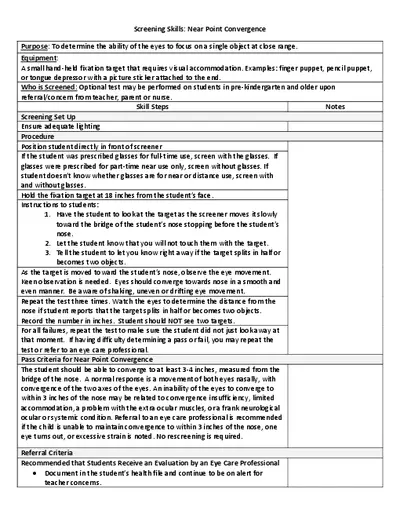
Screening Skills: Near Point Convergence
Purpose: To determine the ability of the eyes to focus on a single object at close range.
Equipment:
A small hand-held fixation target that requires visual accommodation. Examples: finger puppet, pencil puppet,
or tongue depressor with a picture sticker attached to the end.
Who is Screened: Optional test may be performed on students in pre-kindergarten and older upon
referral/concern from teacher, parent or nurse.
Skill Steps
Notes
Screening Set Up
Ensure adequate lighting
Procedure
Position student directly in front of screener
If the student was prescribed glasses for full-time use, screen with the glasses. If
glasses were prescribed for part-time near use only, screen without glasses. If
student doesn’t know whether glasses are for near or distance use, screen with
and without glasses.
Hold the fixation target at 18 inches from the student’s face.
Instructions to students:
1. Have the student to look at the target as the screener moves it slowly
toward the bridge of the student’s nose stopping before the student’s
nose.
2. Let the student know that you will not touch them with the target.
3. Tell the student to let you know right away if the target splits in half or
becomes two objects.
As the target is moved toward the student’s nose, observe the eye movement.
Keen observation is needed. Eyes should converge towards nose in a smooth and
even manner. Be aware of shaking, uneven or drifting eye movement.
Repeat the test three times. Watch the eyes to determine the distance from the
nose if student reports that the target splits in half or becomes two objects.
Record the number in inches. Student should NOT see two targets.
For all failures, repeat the test to make sure the student did not just look away at
that moment. If having difficulty determining a pass or fail, you may repeat the
test or refer to an eye care professional.
Pass Criteria for Near Point Convergence
The student should be able to converge to at least 3-4 inches, measured from the
bridge of the nose. A normal response is a movement of both eyes nasally, with
convergence of the two axes of the eyes. An inability of the eyes to converge to
within 3 inches of the nose may be related to convergence insufficiency, limited
accommodation, a problem with the extra ocular muscles, or a frank neurological
ocular or systemic condition. Referral to an eye care professional is recommended
if the child is unable to maintain convergence to within 3 inches of the nose, one
eye turns out, or excessive strain is noted. No rescreening is required.
Referral Criteria
Recommended that Students Receive an Evaluation by an Eye Care Professional
Document in the student’s health file and continue to be on alert for
teacher concerns.
Helpful Tips:
This skill requires practice
Consider using the Symptoms Questionnaire to obtain more vision-related information from teachers
and parent/guardian
/ 2
End of Document
93

You May Also Like

Related of Near Point Convergence Screening Guide for Educators PDF