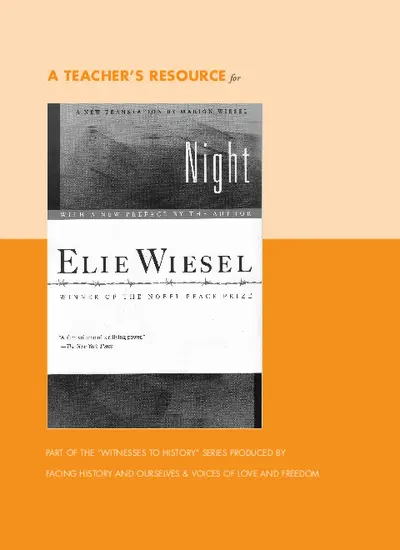
Night Elie Wiesel: A Teacher’s Resource

Night Elie Wiesel: A Teacher’s Resource

Night by Elie Wiesel is a poignant memoir detailing the author's harrowing experiences during the Holocaust. This teacher resource provides educators with comprehensive activities and discussions aimed at exploring themes of identity, memory, and the moral implications of witnessing history. Designed for high school students, it includes critical responses, literary analysis, and cross-curricular activities that connect the text to broader historical contexts. The resource also emphasizes the importance of storytelling and the lessons learned from Wiesel's experiences in Auschwitz.

Key Points

  • Includes activities for exploring identity and memory in Night
  • Offers critical responses and literary analysis for classroom discussions
  • Connects themes of the Holocaust to contemporary moral choices
  • Designed for high school educators teaching Elie Wiesel's memoir
376
/ 57
A TEACHER’S RESOURCE for
PART OF THE “WITNESSES TO HISTORY” SERIES PRODUCED BY
FACING HISTORY AND OURSELVES & VOICES OF LOVE AND FREEDOM
A TEACHER’S RESOURCE for
Night
by Elie Wiesel
Part of the “Witnesses to History” series produced by
Facing History and Ourselves & Voices of Love and Freedom
ii Night Voices of Love and Freedom • Facing History and Ourselves
Acknowledgments
Voices of Love and Freedom (VLF) is a nonprofit educational organization that pro-
motes literacy, values, and prevention. VLF teacher resources are designed to help
students:
• appreciate literature from around the world
• develop their own voices as they learn to read and write
• learn to use the values of love and freedom to guide their lives
• and live healthy lives free of substance abuse and violence.
Voices of Love and Freedom was founded in 1992 and is a collaboration of the Judge
Baker Childrens Center, Harvard Graduate School of Education, City University of
New York Graduate School, and Wheelock College.
For more information, call 617-635-6433, fax 617-635-6422,
e-mail VLFBOSTON@aol.com, or write Voices of Love and Freedom,
67 Alleghany St., Boston, MA 02120.
Facing History and Ourselves National Foundation, Inc. (FHAO) is a national educa-
tional and teacher training organization whose mission is to engage students of
diverse backgrounds in an examination of racism, prejudice, and antisemitism in
order to promote the development of a more humane and informed citizenry. By
studying the historical development and lessons of the Holocaust and other exam-
ples of genocide, students make the essential connection between history and the
moral choices they confront in their own lives.
For more information, contact FHAO, National Office, 16 Hurd Road, Brook-
line, MA 02445; 617-232-1595; http://www.facing.org.
FHAO Guide Review Committee: Fran Colletti, Jan Darsa, Phyllis Goldstein,
Marc Skvirsky, Margot Stern Strom.
Harcourt General Charitable Foundation, Inc. has awarded a grant to VLF and
FHAO to jointly produce teacher resources for the secondary grades. Other funders
of this unique project include the following organizations: The Boston Company,
Carnegie Corporation of New York, Facing History and Ourselves Young Leadership
Network, New England Hi-Tech Charity Foundation, Parametric Technology Cor-
poration, the Surdna Foundation, and The TJX Companies, Inc.
Teacher Resource Writers: Pat Walker, Director of VLF, and Phyllis Goldstein,
FHAO, with assistance from Jan Darsa, FHAO
Design and Production: Lolly Robinson, interior; Jenifer Snow, covers
This teacher resource is based on the following edition: Night by Elie Wiesel, Bantam Books, 1986, 25th
Anniversary Edition.
Teacher Resource © 1999 Voices of Love and Freedon, Inc. and Facing History and Ourselves National Fou-
dation. All rights reserved. Not to be reproduced without permission.

/ 57
End of Document
376
You May Also Like

FAQs of Night Elie Wiesel: A Teacher’s Resource

What themes are explored in Elie Wiesel's Night?
Night explores profound themes such as identity, memory, and the moral responsibilities of witnessing history. Eliezer's journey through the Holocaust illustrates the struggle to maintain one's identity amidst dehumanization and suffering. The narrative also emphasizes the importance of remembering and telling stories to honor the victims and prevent future atrocities. Through Wiesel's experiences, readers are prompted to reflect on their own moral choices in the face of injustice.
How does Eliezer's relationship with his father evolve throughout Night?
Eliezer's relationship with his father is central to the narrative of Night, showcasing the bond that sustains them through their harrowing experiences. Initially, they rely on each other for emotional and physical support, but as the conditions worsen, Eliezer's feelings of fear and anger complicate their relationship. His father's declining health and eventual death profoundly impact Eliezer, leading him to feel a sense of freedom that is both liberating and haunting. This evolution highlights the struggle between familial loyalty and the instinct for survival.
What role does faith play in Night?
Faith is a significant theme in Night, as Eliezer grapples with his beliefs in the face of unimaginable suffering. Initially, he is deeply religious, engaging in prayer and rituals, but as he witnesses the atrocities of the Holocaust, his faith is severely tested. Eliezer's anger towards God reflects his struggle to reconcile the existence of evil with his understanding of a benevolent deity. Ultimately, his journey illustrates the complexities of faith during times of crisis and the search for meaning amidst despair.
What is the significance of music in Night?
Music serves as a powerful symbol in Night, representing both beauty and the human spirit's resilience amidst horror. The character Juliek plays a violin in the barracks, offering a moment of solace and connection among the prisoners. This act of playing music amidst despair highlights the importance of art and culture as a means of preserving humanity. Eliezer's reflections on the music underscore the contrast between life and death, as well as the fleeting moments of beauty that can exist even in the darkest of times.

Related of Night Elie Wiesel: A Teacher’s Resource