PostLab Titration Concepts QA

PostLab Titration Concepts QA

This document is a comprehensive Q&A guide on titration concepts in analytical chemistry. It covers primary and secondary standards, indicators, and methods for determining concentrations, including the Winkler method and water hardness. Ideal for students and educators, it serves as a valuable resource for understanding titration techniques and calculations.

273
/ 4
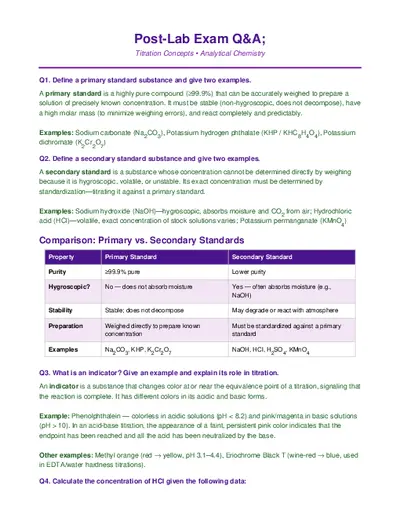
Post-Lab Exam Q&A;
Titration Concepts • Analytical Chemistry
Q1. Define a primary standard substance and give two examples.
A primary standard is a highly pure compound (99.9%) that can be accurately weighed to prepare a
solution of precisely known concentration. It must be stable (non-hygroscopic, does not decompose), have
a high molar mass (to minimize weighing errors), and react completely and predictably.
Examples: Sodium carbonate (Na
2
CO
3
), Potassium hydrogen phthalate (KHP / KHC
8
H
4
O
4
), Potassium
dichromate (K
2
Cr
2
O
7
)
Q2. Define a secondary standard substance and give two examples.
A secondary standard is a substance whose concentration cannot be determined directly by weighing
because it is hygroscopic, volatile, or unstable. Its exact concentration must be determined by
standardization—titrating it against a primary standard.
Examples: Sodium hydroxide (NaOH)—hygroscopic, absorbs moisture and CO
2
from air; Hydrochloric
acid (HCl)—volatile, exact concentration of stock solutions varies; Potassium permanganate (KMnO
4
)
Comparison: Primary vs. Secondary Standards
Property Primary Standard Secondary Standard
Purity 99.9% pure Lower purity
Hygroscopic? No — does not absorb moisture Yes — often absorbs moisture (e.g.,
NaOH)
Stability Stable; does not decompose May degrade or react with atmosphere
Preparation Weighed directly to prepare known
concentration
Must be standardized against a primary
standard
Examples Na
2
CO
3
, KHP, K
2
Cr
2
O
7
NaOH, HCl, H
2
SO
4
, KMnO
4
Q3. What is an indicator? Give an example and explain its role in titration.
An indicator is a substance that changes color at or near the equivalence point of a titration, signaling that
the reaction is complete. It has different colors in its acidic and basic forms.
Example: Phenolphthalein — colorless in acidic solutions (pH < 8.2) and pink/magenta in basic solutions
(pH > 10). In an acid-base titration, the appearance of a faint, persistent pink color indicates that the
endpoint has been reached and all the acid has been neutralized by the base.
Other examples: Methyl orange (red yellow, pH 3.1–4.4), Eriochrome Black T (wine-red blue, used
in EDTA/water hardness titrations).
Q4. Calculate the concentration of HCl given the following data:
A student titrated 25.00 mL of HCl with 0.1050 M NaOH. The titration required 22.40 mL of NaOH to reach
the endpoint.
Solution:
The balanced equation is: HCl + NaOH NaCl + H
2
O (1:1 mole ratio)
Moles of NaOH = M × V = 0.1050 mol/L × 0.02240 L = 0.002352 mol
Since the mole ratio is 1:1, moles of HCl = 0.002352 mol
Concentration of HCl = moles / volume = 0.002352 mol / 0.02500 L = 0.09408 M
Rounded to 4 significant figures: [HCl] = 0.09408 M
Q5. What is an oxidation-reduction (redox) titration? Give an example.
A redox titration involves a reaction where electrons are transferred between the titrant and the analyte.
One substance is oxidized (loses electrons) while the other is reduced (gains electrons). The endpoint is
detected by an indicator or by the color change of the titrant itself.
Example: Titration of Fe
2+
with KMnO
4
. In acidic solution, permanganate (MnO
4
, purple) oxidizes iron(II)
to iron(III), and is itself reduced to Mn
2+
(colorless). The endpoint is reached when a persistent faint
purple/pink color appears, indicating excess KMnO
4
. KMnO
4
acts as its own indicator.
Q6. What is the Winkler method? Why is dissolved oxygen (DO) important?
The Winkler method is a classical wet-chemical technique for determining the concentration of dissolved
oxygen (DO) in water samples. It involves:
Step 1 (Fixation): MnSO
4
and alkaline KI are added to the water sample. Dissolved oxygen oxidizes
Mn
2+
to MnO(OH)
2
(brown precipitate).
Step 2 (Acidification): H
2
SO
4
is added. The precipitate dissolves and liberates I
2
(iodine) in proportion
to the original DO.
Step 3 (Titration): The liberated I
2
is titrated with sodium thiosulfate (Na
2
S
2
O
3
) using starch as an
indicator (blue colorless endpoint).
Why test DO? Dissolved oxygen is critical for aquatic life. Low DO indicates poor water quality, pollution,
or eutrophication. Measuring DO helps assess water health, sewage treatment efficiency, and the
environmental impact of industrial discharge.
Q7. What is water hardness? How is it determined and removed?
Water hardness is a measure of the concentration of dissolved calcium (Ca
2+
) and magnesium (Mg
2+
)
ions in water. It is expressed in mg/L as CaCO
3
.
Types of hardness:
Temporary hardness — Caused by dissolved bicarbonates (Ca(HCO
3
)
2
, Mg(HCO
3
)
2
). Removed by
boiling (precipitates as CaCO
3
).
Permanent hardness — Caused by dissolved sulfates and chlorides (CaSO
4
, MgCl
2
). Cannot be
removed by boiling.
Determination: EDTA complexometric titration at pH 10 buffer using Eriochrome Black T indicator. Color
change: wine-red blue at endpoint.
Methods of removal:
• Boiling (temporary hardness only)
• Addition of washing soda (Na
2
CO
3
) — precipitates Ca
2+
and Mg
2+
as insoluble carbonates
• Ion exchange resins — replace Ca
2+
/Mg
2+
with Na
+
• Distillation — removes all dissolved minerals

/ 4
End of Document
273

You May Also Like

Related of PostLab Titration Concepts QA