Rajya Sabha

Rajya Sabha

Rajya Sabha, established on April 3, 1952, serves as the upper house of India's Parliament, providing essential federal representation. It is a permanent body, with one-third of its members retiring every two years, ensuring legislative continuity. The Rajya Sabha includes 12 members nominated by the President for their expertise in fields like literature, science, and social service. This document outlines its key functions, historical milestones, and constitutional provisions, making it a valuable resource for students and researchers interested in Indian governance.

Key Points

  • Explains the formation of the Rajya Sabha on April 3, 1952, as India's upper house of Parliament.
  • Describes the unique structure of the Rajya Sabha as a permanent body with staggered member retirements.
  • Highlights the role of the Rajya Sabha in representing states and union territories at the federal level.
  • Details the nomination of 12 members by the President, emphasizing their expertise in various fields.
233
/ 2
The Birth of the Rajya Sabha: April 3, 1952
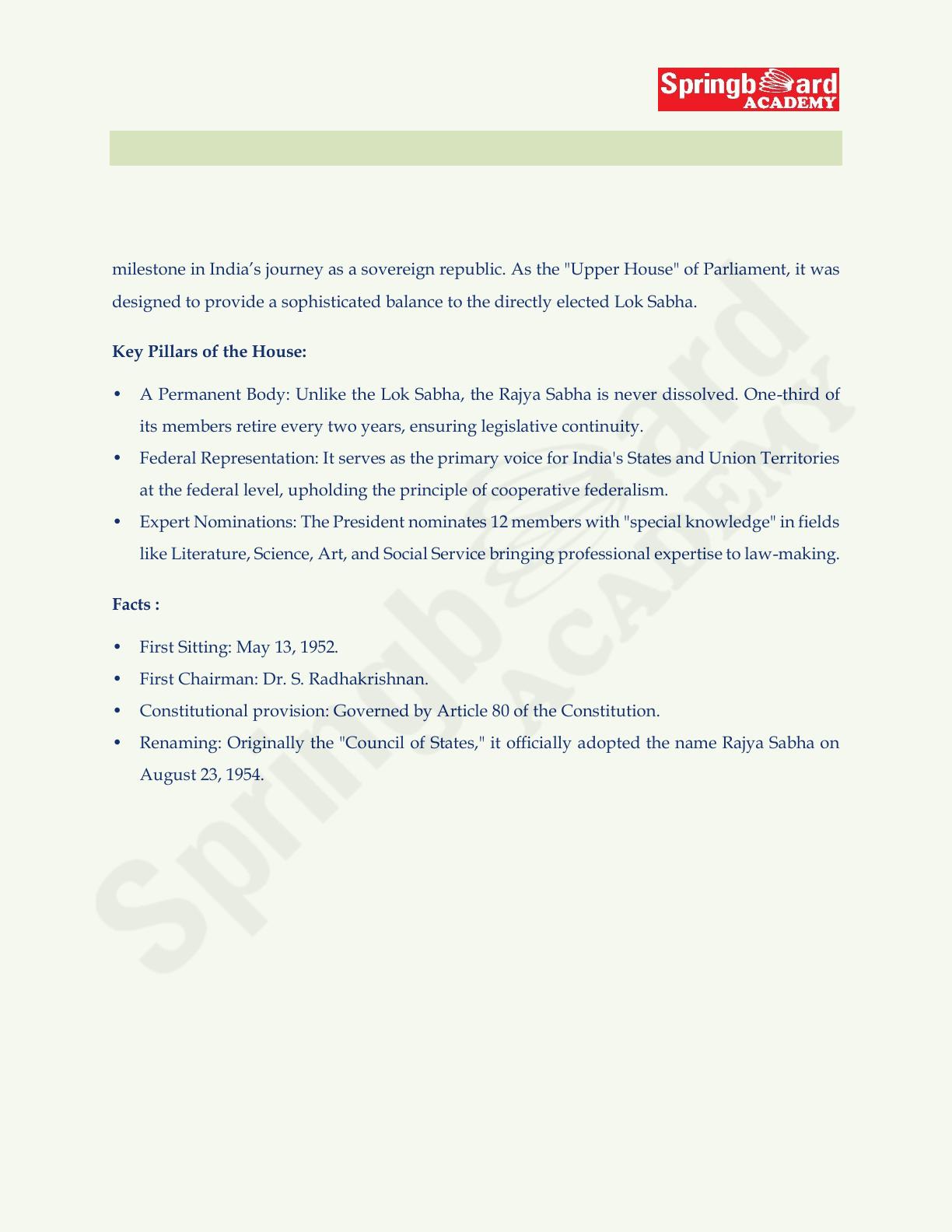
On this day in 1952, the Rajya Sabha (Council of States) was officially constituted, marking a
milestone in India’s journey as a sovereign republic. As the "Upper House" of Parliament, it was
designed to provide a sophisticated balance to the directly elected Lok Sabha.
Key Pillars of the House:
A Permanent Body: Unlike the Lok Sabha, the Rajya Sabha is never dissolved. One-third of
its members retire every two years, ensuring legislative continuity.
Federal Representation: It serves as the primary voice for India's States and Union Territories
at the federal level, upholding the principle of cooperative federalism.
Expert Nominations: The President nominates 12 members with "special knowledge" in fields
like Literature, Science, Art, and Social Service bringing professional expertise to law-making.
Facts :
First Sitting: May 13, 1952.
First Chairman: Dr. S. Radhakrishnan.
Constitutional provision: Governed by Article 80 of the Constitution.
Renaming: Originally the "Council of States," it officially adopted the name Rajya Sabha on
August 23, 1954.
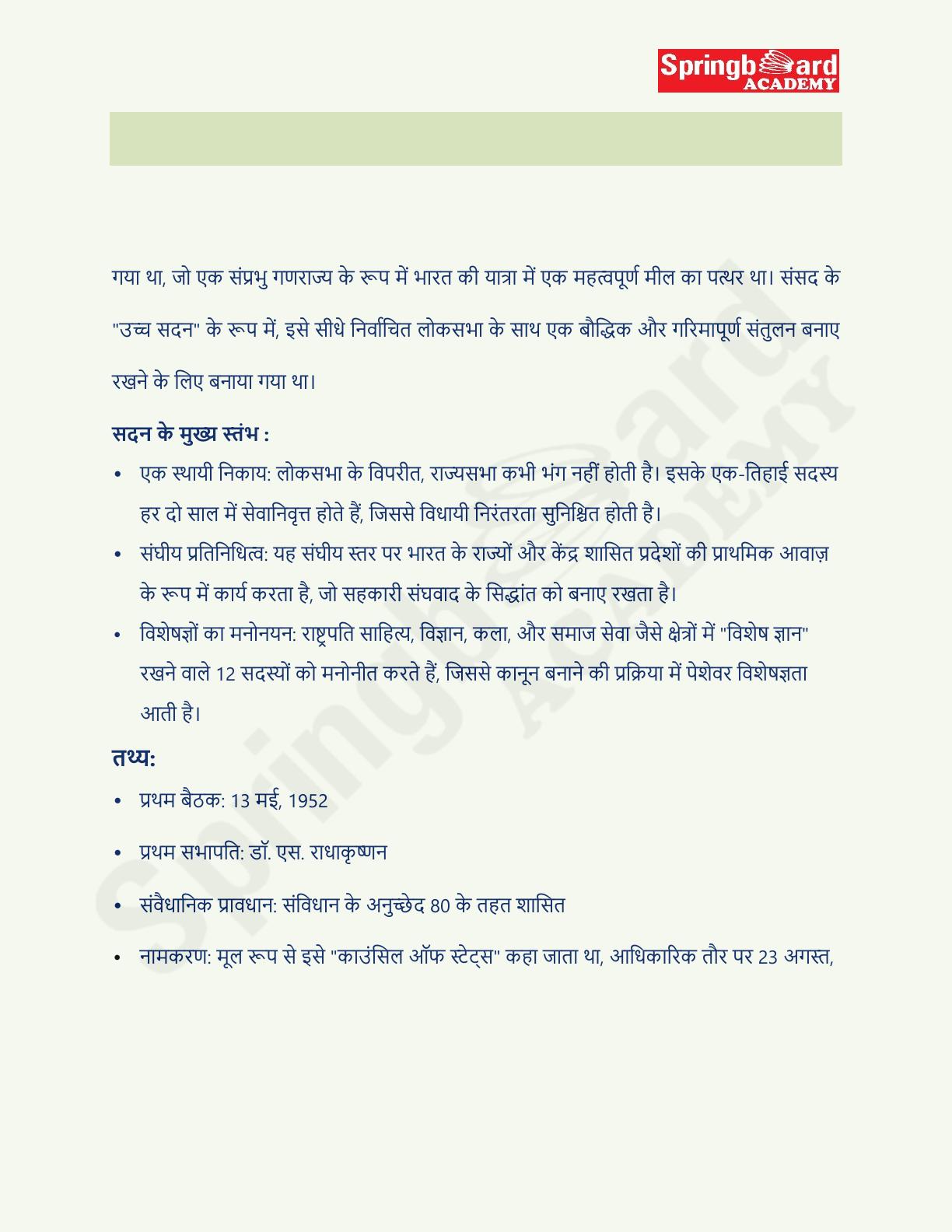
  : 3 , 1952
    3 , 1952   (Council of States)      
 ,                   
" "   ,       󰌹   
 󰌹   
   :
  :   ,       - 
      , 󰌹    
 :         󰌹    
    ,     󰌹   
  : 
 , , ,    " "
 12    , 󰌹     

:
 : 13 , 1952
 : . .  
 :    80   󰌹
:   "󰌹  "   ,    23 ,
1954    ''  
/ 2
End of Document
233
You May Also Like

FAQs of Rajya Sabha

What is the significance of the Rajya Sabha in Indian governance?
The Rajya Sabha plays a crucial role in India's parliamentary system by serving as the upper house, which balances the directly elected Lok Sabha. It ensures that the interests of states and union territories are represented at the national level, promoting cooperative federalism. By being a permanent body, it maintains legislative continuity, allowing for experienced lawmakers to contribute to governance over time. This structure helps in deliberating on important national issues and legislation.
Who was the first Chairman of the Rajya Sabha?
Dr. S. Radhakrishnan served as the first Chairman of the Rajya Sabha when it was constituted in 1952. His leadership was instrumental in shaping the functioning of this upper house, ensuring that it operated effectively within the framework of the Indian Constitution. As a prominent philosopher and statesman, Radhakrishnan's contributions helped establish the Rajya Sabha's role in the legislative process and its importance in Indian democracy.
What are the key features of the Rajya Sabha?
Key features of the Rajya Sabha include its status as a permanent body, meaning it is never dissolved, unlike the Lok Sabha. One-third of its members retire every two years, ensuring a rotation that maintains continuity in legislative processes. Additionally, it serves as a platform for federal representation, allowing states and union territories to voice their concerns at the national level. The nomination of 12 members by the President for their expertise in various fields further enriches the house's legislative capabilities.
What constitutional article governs the Rajya Sabha?
The Rajya Sabha is governed by Article 80 of the Indian Constitution, which outlines its composition and powers. This article specifies the number of members, the process of their election and nomination, and the terms of service. It establishes the framework within which the Rajya Sabha operates, ensuring that it fulfills its role in the legislative process effectively. Understanding Article 80 is essential for grasping the constitutional basis of the Rajya Sabha's functions.

Related of Rajya Sabha