Teaching Guide: J. R. R. Tolkien’s The Hobbit

Teaching Guide: J. R. R. Tolkien’s The Hobbit

J. R. R. Tolkien’s The Hobbit is a classic fantasy novel that follows the journey of Bilbo Baggins, a hobbit who reluctantly embarks on an adventure with a group of dwarves to reclaim their treasure from the dragon Smaug. This teaching guide is designed for educators and students in Year 6 and up, focusing on key themes, character development, and narrative structure. It includes discussion questions for each chapter, helping students explore the text's rich literary elements and moral lessons. The guide also emphasizes the Hero’s Journey and different models of heroism, making it an essential resource for literature classes and book clubs.

Key Points

  • Explores the themes of adventure, bravery, and friendship in The Hobbit.
  • Includes detailed discussion questions for each chapter to enhance comprehension.
  • Analyzes the character development of Bilbo Baggins throughout the narrative.
  • Examines the elements of the Hero’s Journey as depicted in Tolkien's work.
  • Focuses on the moral lessons and recurring themes present in the story.
404
/ 7
1
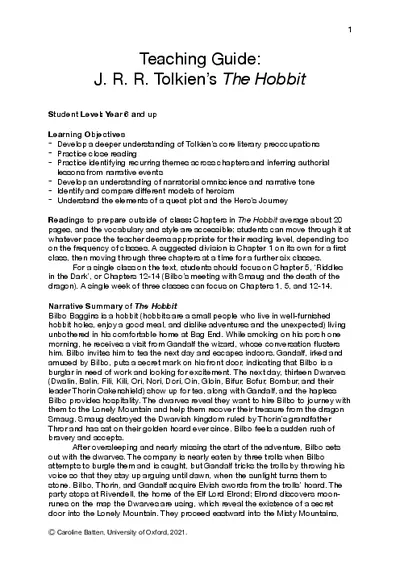
Teaching Guide:!
J. R. R. Tolkien’s The Hobbit!
Student Level: Year 6 and up
Learning Objectives
-
Develop a deeper understanding of Tolkien’s core literary preoccupations!
-
Practice close reading!
-
Practice identifying recurring themes across chapters and inferring authorial
lessons from narrative events!
-
Develop an understanding of narratorial omniscience and narrative tone!
-
Identify and compare dierent models of heroism!
-
Understand the elements of a quest plot and the Hero’s Journey!
Readings to prepare outside of class: Chapters in The Hobbit average about 20
pages, and the vocabulary and style are accessible; students can move through it at
whatever pace the teacher deems appropriate for their reading level, depending too
on the frequency of classes. A suggested division is Chapter 1 on its own for a first
class, then moving through three chapters at a time for a further six classes. !
# For a single class on the text, students should focus on Chapter 5, ‘Riddles
in the Dark’, or Chapters 12-14 (Bilbo’s meeting with Smaug and the death of the
dragon). A single week of three classes can focus on Chapters 1, 5, and 12-14.!
Narrative Summary of The Hobbit
Bilbo Baggins is a hobbit (hobbits are a small people who live in well-furnished
hobbit holes, enjoy a good meal, and dislike adventures and the unexpected) living
unbothered in his comfortable home at Bag End. While smoking on his porch one
morning, he receives a visit from Gandalf the wizard, whose conversation flusters
him. Bilbo invites him to tea the next day and escapes indoors. Gandalf, irked and
amused by Bilbo, puts a secret mark on his front door, indicating that Bilbo is a
burglar in need of work and looking for excitement. The next day, thirteen Dwarves
(Dwalin, Balin, Fili, Kili, Ori, Nori, Dori, Oin, Gloin, Bifur, Bofur, Bombur, and their
leader Thorin Oakenshield) show up for tea, along with Gandalf, and the hapless
Bilbo provides hospitality. The dwarves reveal they want to hire Bilbo to journey with
them to the Lonely Mountain and help them recover their treasure from the dragon
Smaug. Smaug destroyed the Dwarvish kingdom ruled by Thorin’s grandfather
Thror and has sat on their golden hoard ever since. Bilbo feels a sudden rush of
bravery and accepts.!
# After oversleeping and nearly missing the start of the adventure, Bilbo sets
out with the dwarves. The company is nearly eaten by three trolls when Bilbo
attempts to burgle them and is caught, but Gandalf tricks the trolls by throwing his
voice so that they stay up arguing until dawn, when the sunlight turns them to
stone. Bilbo, Thorin, and Gandalf acquire Elvish swords from the trolls’ hoard. The
party stops at Rivendell, the home of the Elf Lord Elrond; Elrond discovers moon-
runes on the map the Dwarves are using, which reveal the existence of a secret
door into the Lonely Mountain. They proceed eastward into the Misty Mountains,
Caroline Batten, University of Oxford, 2021.
2
and, taking shelter from a storm, are captured by goblins and taken under the
mountain to be killed. Gandalf again helps free them and as they escape Bilbo falls,
hits his head, and is left behind in the dark tunnel. !
# Alone in the dark, Bilbo finds a ring on the ground and puts it in his pocket.
He continues down the tunnel until he arrives at an underground lake. A creature
called Gollum, who lives on a tiny island in the middle of the lake, arrives to
investigate (and consider eating) Bilbo. The two end up engaging in a riddle contest:
if Gollum wins, he gets to eat Bilbo, and if Bilbo wins, Gollum will show him the way
out of the mountain. After a tense contest, Bilbo stumps Gollum with the question
‘What have I got in my pocket?’ which is technically a cheat. Gollum goes back to
his island to find his prized possession, a ring that makes the wearer invisible, and
kill Bilbo. He cannot find the ring and becomes distressed — and suspicious. Bilbo
realises Gollum means to attack him and flees, Gollum in hot pursuit. Bilbo trips, the
ring slips onto his finger, and Gollum runs right past him; Bilbo realises he is
invisible. Bilbo follows Gollum to the exit, takes pity on him, and decides not to kill
him. Instead he leaps over Gollum’s head and exits the mountain, finding the
Dwarves again.!
# The goblins and their Warg allies (large, intelligent, evil wolves) pursue the
party that night, but they are rescued by gigantic Eagles, who owe Gandalf a debt.
The company stays for several days with a man called Beorn, who can shape-shift
into a bear, before heading on to Mirkwood, which they must cross to reach the
Lonely Mountain. Gandalf departs on an errand to defeat an evil sorcerer called the
Necromancer, and the rest of the party enters Mirkwood without him. After a long
time in the dark and miserable forest, low on supplies, they disregard Gandalf and
Beorn’s orders not to leave the path, trying to join a feast held by the Wood-Elves.
They get lost and are captured by giant spiders; Bilbo proves his worth by rescuing
all the Dwarves and killing many of the spiders. The Elves, under the leadership of
King Thranduil, then capture the Dwarves and imprison them. Bilbo sneaks invisibly
into Thranduil’s palace and eventually manages to free the Dwarves by packing
them all into empty wine-barrels the Elves send down the river to Lake-town.!
# The party reveal their identities in Lake-town and are welcomed by the
people, who are excited to hear that someone is finally going to kill the dragon
(though some are skeptical). They arrive at the Lonely Mountain and struggle to find
the secret door —$until Bilbo, hearing a thrush knocking on a stone, looks up and
sees the last sunlight of Durin’s Day shining on the cli wall, revealing the entrance.
Bilbo is sent down to encounter Smaug, whom he answers in clever riddles, and
steals a golden cup from the hoard. Smaug is enraged by the theft, and suspects
that the party had the help of Lake-town. He leaves the Lonely Mountain unguarded
— which the Dwarves enter to escape his fire — and goes to destroy Lake-town.
The Thrush, part of an ancient race of birds who can communicate with men, hears
Bilbo describe a bare patch in Smaug’s treasure-crusted armour, and conveys this
information to a Lake-town man called Bard, a descendant of the Lords of Dale,
who shoots and kills Smaug as the dragon ravages the town.!
# The men of Lake-town go to the Dwarves in the Lonely Mountain and make
historical claims on a portion of the treasure, which they want to use to rebuild the
town. Thranduil and the Wood-Elves also arrive, also making historical claims on the
treasure. The Dwarves refuse all comers and instead summon Thorin’s kinsman
Dáin for military support. Thorin is sinking deeper into ‘dragon sickness’ and
obsession with the gold. Bilbo, attempting to avoid war, steals the prized

Caroline Batten, University of Oxford, 2021.
3
Arkenstone, greatest treasure of Thror, from the hoard and delivers it up to the men
of Lake-town, who are now accompanied by Gandalf, and Thorin is forced to broker
peace to get the Arkenstone back. The three assembled armies, now in truce, are
suddenly attacked by an army of goblins and Wargs from the Misty Mountains,
come to claim the treasure for themselves. The Battle of Five Armies ensues, and
the Dwarves, Elves, and Men prevail with the help of the eagles, though they sustain
heavy losses, including Thorin himself. Thorin forgives Bilbo on his deathbed, and
Bilbo and Gandalf return to Bag End, bearing Bilbo’s share of the treasure. There
they discover that the other hobbits have assumed Bilbo dead and are auctioning
o his belongings. Bilbo manages to chase down all his silverware and settle back
into Bag End, but the other hobbits ever after considered him strange for having
gone on an adventure.!
Discussion Questions By Chapter
Chapter 1!
1. The first sentence of The Hobbit is famous. What’s so compelling about it? What
do we learn about hobbits in the very first paragraph, and how does Tolkien set
a tone for the book with his opening?!
2. How would you describe the ‘narrative voice’ of this text?!
3. What does the ‘good morning’ conversation (and the begging of pardons) reveal
about Bilbo and Gandalf? What is Tolkien showing us about language here?!
4. How and why does Tolkien integrate verse and song in this chapter? Why do the
Dwarves sing?!
5. What do Bilbo’s Baggins and Took sides represent? When do they awaken?!
6. What’s wrong with the dragon’s attitude to treasure? How do the dragon and the
Dwarves relate to treasure dierently?!
7. What is the structure of a quest plot? How is The Hobbit setting up its quest
plot? What aside from the treasure do we expect will be achieved?!
Chapters 2-4!
1. The Hobbit is a travel story as much as a quest; its subtitle is There and Back
Again. What is the experience of leaving home like for Bilbo? What sort of
character development does travel allow in this telling?!
2. What recognisable fairy tale elements can we find in the troll episode?!
3. Why is Rivendell called the Last Homely House?!
4. Why does Tolkien bother to give histories to Gandalf, Thorin, and Bilbo’s
swords? What does the reference to Gondolin add to the story, and how does it
heighten the stakes in the confrontation with the Great Goblin?!
Chapter 5!
1. What kinds of riddles do Gollum and Bilbo each tell? Are there themes that unify
each of their riddles?!
2. What kind of encounter do Gollum and Bilbo have initially? What’s the role of
curiosity in this encounter? What is their interaction like, and is there any kind of
emotional connection between them, however briefly?!
3. How do Gollum and Bilbo manage to answer one another’s riddles? What
happens to Gollum’s attitude during the riddle game?!
4. Why does Bilbo take pity on Gollum? Does Gollum deserve pity?!
Caroline Batten, University of Oxford, 2021.
/ 7
End of Document
404
You May Also Like

FAQs of Teaching Guide: J. R. R. Tolkien’s The Hobbit

What is the main plot of The Hobbit?
The Hobbit follows Bilbo Baggins, a hobbit who enjoys a quiet life until the wizard Gandalf and a group of thirteen dwarves arrive at his home. They enlist Bilbo to help reclaim their homeland and treasure from the dragon Smaug. Throughout the journey, Bilbo faces various challenges, including trolls, goblins, and giant spiders, which force him to grow from a timid hobbit into a clever and brave hero. The story culminates in a battle for the treasure, highlighting themes of greed, friendship, and the importance of courage.
What are the key themes explored in The Hobbit?
Key themes in The Hobbit include the heroism of the ordinary individual, the value of friendship and loyalty, and the corrupting influence of greed. Bilbo's transformation from a reluctant participant to a courageous hero illustrates the idea that anyone can rise to the occasion when faced with challenges. The interactions between Bilbo and the dwarves also emphasize the importance of camaraderie and teamwork in overcoming obstacles. Additionally, the story critiques the obsession with wealth, particularly through the character of Smaug and Thorin's eventual downfall due to 'dragon sickness.'
How does Bilbo Baggins change throughout the story?
Bilbo Baggins undergoes significant character development in The Hobbit, evolving from a cautious and comfort-seeking hobbit into a resourceful and brave adventurer. Initially, he is reluctant to leave his home, but as the journey progresses, he faces numerous challenges that test his courage and wit. His encounters with characters like Gollum and Smaug reveal his growing cleverness and bravery. By the end of the story, Bilbo has not only helped reclaim the dwarves' treasure but has also gained a deeper understanding of himself and the world around him, marking his transformation into a true hero.
What is the significance of the riddle contest between Bilbo and Gollum?
The riddle contest between Bilbo and Gollum serves as a pivotal moment in The Hobbit, showcasing Bilbo's quick thinking and resourcefulness. This encounter highlights the theme of intelligence over brute strength, as Bilbo relies on his wits to escape a dire situation. The contest also introduces the magical ring that grants invisibility, which becomes crucial to Bilbo's survival and development throughout the story. This moment not only emphasizes Bilbo's growth but also sets the stage for the larger conflicts that arise later in the narrative.

Related of Teaching Guide: J. R. R. Tolkien’s The Hobbit