


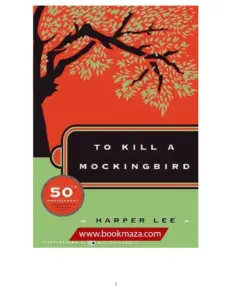
Set in 1930s Alabama, Harper Lee’s To Kill a Mockingbird is a coming-of-age story narrated by young Scout Finch. Her lawyer father, Atticus, defends Tom Robinson, a Black man falsely accused of raping a white woman, exposing the town’s deep-seated racism and moral hypocrisy. The novel explores themes of empathy, injustice, and lost innocence.

1
To Kill a Mockingbird
by Harper Lee
Retold by Jen Sanders, Beth Sampson,
& teachers of the Newton Public Schools

2
Setting: Maycomb, Alabama, 1930’s Narrator: Jean Louise “Scout” Finch
Chapter 1
When my brother Jem was almost 13 he broke his arm, badly. Even though it healed, we
always talked about what really caused the accident. I said the Ewells, but he said Dill and Boo
Radley started it. But then he said if our ancestors, the Finches had never moved to Alabama,
then none of this would have happened, and the rest is history.
We’re southerners. We think it’s a big deal who your family is, where you’ve come
from, and what you’re known for. Our ancestor, Simon Finch, was a stingy and religious man.
He saved up all his money to buy up Finch’s Landing, and for generations that’s where our
family has lived. My Aunt Alexandra still lives here now with her quiet husband. My father
Atticus Finch, went to Montgomery, Alabama to study law, and his brother Jack went to Boston
to study to be a doctor. My father moved back to Maycomb once he finished law school.
Maycomb was a tired, old town back in those days. People moved slowly, ambling
across the town square. Days seemed long, especially on hot summer days. People didn’t hurry,
because there was nowhere to go, nothing to buy, no money to buy it with, and nothing to see.
We lived on the main street, Atticus, Jem, and I. Our father played with us, read to us,
and treated us fine. We had a cook too, Calpurnia. She was strict with me. She always asked
me why I didn’t behave as well as Jem. But he was older anyhow. She always won our battles;
my father always took her side. Our mother died of a heart attack when I was two so I didn’t
remember her. Jem seemed to miss her though.
One day during the summer when I was six and Jem was nine, we were playing in our
neighborhood as usual. We heard something in Miss Rachel’s garden. We found a boy sitting
looking at us.
He said, “I’m Charles Baker Harris. I can read.”
“So what?” I said.
Jem wanted to get a better look at him so he said, “Why don’t you come over, Charles
Baker Harris.”
“Folks call me Dill, “ he said, struggling to fit under the fence. Dill told us he was from
Mississippi, but was spending the summer with his aunt Rachel. He had seen a bunch of movies,

3
so he described them to us, and we spent the next days acting them out. He was very creative,
and always had good ideas. We eventually got tired of recreating Dracula and other stories.
That’s when Dill’s fascination with the Radley house began.
The Radley house had sagging shingles, and a drooping porch. The grass was too high
and the paint had turned gray and dingy. Even in the long, hot summer, the doors were shut up
tight. There was a rumor that it was haunted. People said “Boo” Radley went out at night and
peeped in people’s windows. That he breathed on flowers and they froze instantly. They said he
committed little crimes in the night but not one ever saw him.
The history of the story is that Arthur, “Boo”, got into a bad crowd in high school. They
swore, fought, and got into real trouble when they locked a court officer in the outhouse
(bathroom). Boo’s father was so strict that the judge let him take Boo home, and no one had
seen him since. Years later, the story goes, Boo was making a scrapbook out of articles from the
Maycomb Tribune when he stabbed his father with a pair of scissors, and kept right on cutting.
Mr. Radley was not a nice man. He went to town each day but never spoke to us even if
we said “Good Morning, Sir.”
When he died, Calpurnia said, “There goes the meanest man God ever blew breath into.”
The neighborhood thought maybe Boo would come out, but his older brother Nathan moved in
and he was just as mean. Atticus didn’t like us to talk about the Radleys much, but the more we
told Dill about the Radleys, the more he wanted to know. He would stand there hugging the light
pole.
“Wonder what he does in there,” he would murmur. “Wonder what he looks like?”
Jem said Boo was six and a half feet tall, ate squirrels and cats, his teeth were yellow, and
he drooled most of the time.
“Let’s try to make him come out,” said Dill. Dill bet Jem to go up and knock on the
door. Jem thought about it for three days.
“You’re scared,” Dill said.
“Ain’t scared, just trying to be respectful,” Jem said.
Three days later, after Dill had taunted him and called him scared repeatedly, Jem finally
gave in. He walked slowly to the Radley yard, threw open the gate, sped to the house, slapped it
with his hand, and sprinted back to us. When we were safe on our porch, we looked back at the
old, droopy house. We thought we saw a slight movement inside.