6 Marker Examples for Exam Preparation

6 Marker Examples for Exam Preparation

6 Marker Examples provide essential practice questions and detailed answers for students preparing for various examinations. This resource focuses on key topics and concepts that are frequently tested, making it ideal for learners seeking to enhance their understanding and performance. Each example is crafted to help students grasp the format and expectations of 6-mark questions, ensuring they can effectively articulate their knowledge. Suitable for high school and college students, this guide serves as a valuable tool for exam revision and mastery of subject matter.

Key Points

  • Includes a variety of 6-mark question examples across multiple subjects.
  • Provides detailed answer structures to help students formulate responses.
  • Covers essential topics frequently encountered in exams.
  • Designed for high school and college students preparing for assessments.
54
/ 4
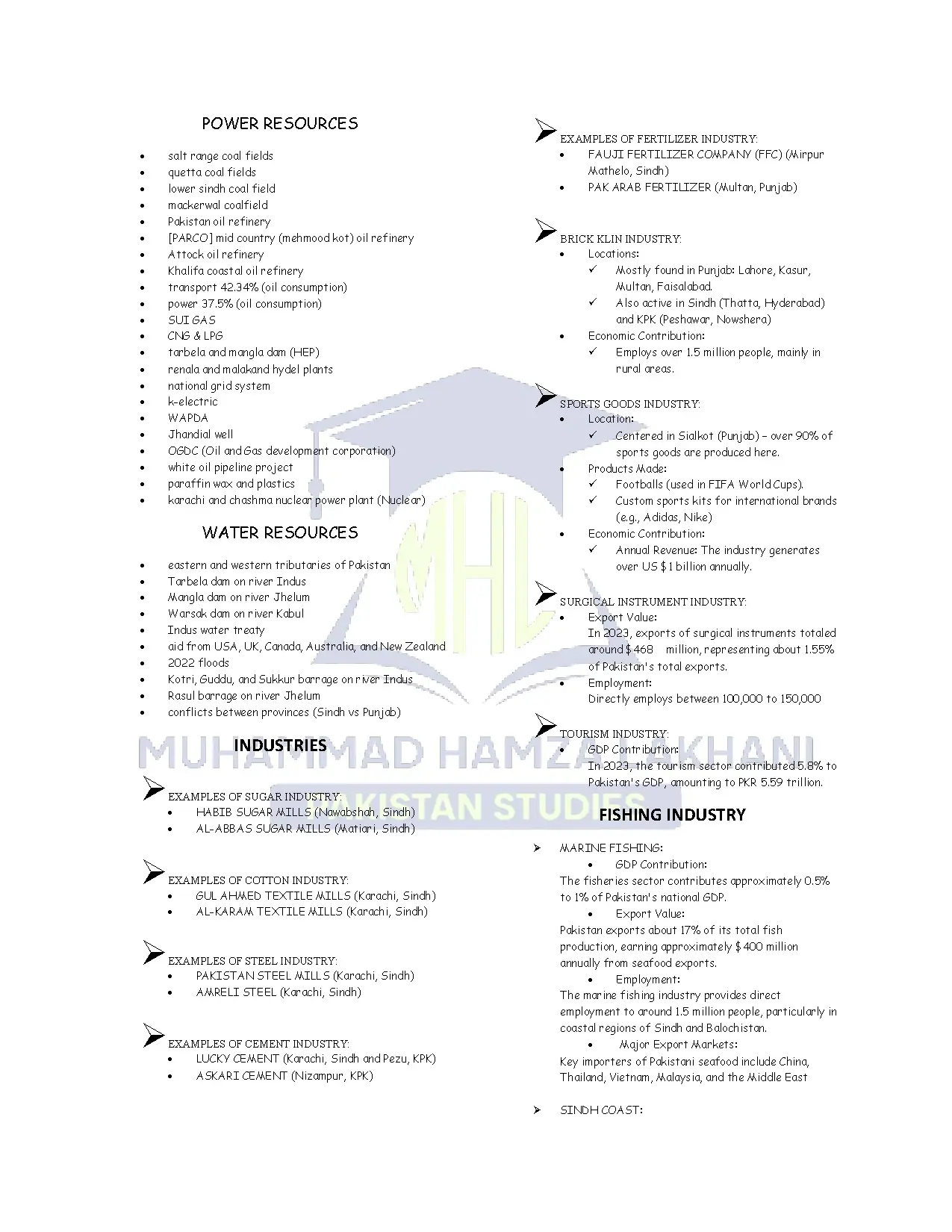
POWER RESOURCES
salt range coal fields
quetta coal fields
lower sindh coal field
mackerwal coalfield
Pakistan oil refinery
[PARCO] mid country (mehmood kot) oil refinery
Attock oil refinery
Khalifa coastal oil refinery
transport 42.34% (oil consumption)
power 37.5% (oil consumption)
SUI GAS
CNG & LPG
tarbela and mangla dam (HEP)
renala and malakand hydel plants
national grid system
k-electric
WAPDA
Jhandial well
OGDC (Oil and Gas development corporation)
white oil pipeline project
paraffin wax and plastics
karachi and chashma nuclear power plant (Nuclear)
WATER RESOURCES
eastern and western tributaries of Pakistan
Tarbela dam on river Indus
Mangla dam on river Jhelum
Warsak dam on river Kabul
Indus water treaty
aid from USA, UK, Canada, Australia, and New Zealand
2022 floods
Kotri, Guddu, and Sukkur barrage on river Indus
Rasul barrage on river Jhelum
conflicts between provinces (Sindh vs Punjab)
INDUSTRIES
EXAMPLES OF SUGAR INDUSTRY:
HABIB SUGAR MILLS (Nawabshah, Sindh)
AL-ABBAS SUGAR MILLS (Matiari, Sindh)
EXAMPLES OF COTTON INDUSTRY:
GUL AHMED TEXTILE MILLS (Karachi, Sindh)
AL-KARAM TEXTILE MILLS (Karachi, Sindh)
EXAMPLES OF STEEL INDUSTRY:
PAKISTAN STEEL MILLS (Karachi, Sindh)
AMRELI STEEL (Karachi, Sindh)
EXAMPLES OF CEMENT INDUSTRY:
LUCKY CEMENT (Karachi, Sindh and Pezu, KPK)
ASKARI CEMENT (Nizampur, KPK)
EXAMPLES OF FERTILIZER INDUSTRY:
FAUJI FERTILIZER COMPANY (FFC) (Mirpur
Mathelo, Sindh)
PAK ARAB FERTILIZER (Multan, Punjab)
BRICK KLIN INDUSTRY:
Locations:
Mostly found in Punjab: Lahore, Kasur,
Multan, Faisalabad.
Also active in Sindh (Thatta, Hyderabad)
and KPK (Peshawar, Nowshera)
Economic Contribution:
Employs over 1.5 million people, mainly in
rural areas.
SPORTS GOODS INDUSTRY:
Location:
Centered in Sialkot (Punjab) over 90% of
sports goods are produced here.
Products Made:
Footballs (used in FIFA World Cups).
Custom sports kits for international brands
(e.g., Adidas, Nike)
Economic Contribution:
Annual Revenue: The industry generates
over US $1 billion annually.
SURGICAL INSTRUMENT INDUSTRY:
Export Value:
In 2023, exports of surgical instruments totaled
around $468 million, representing about 1.55%
of Pakistan's total exports.
Employment:
Directly employs between 100,000 to 150,000
TOURISM INDUSTRY:
GDP Contribution:
In 2023, the tourism sector contributed 5.8% to
Pakistan's GDP, amounting to PKR 5.59 trillion.
FISHING INDUSTRY
MARINE FISHING:
GDP Contribution:
The fisheries sector contributes approximately 0.5%
to 1% of Pakistan's national GDP.
Export Value:
Pakistan exports about 17% of its total fish
production, earning approximately $400 million
annually from seafood exports.
Employment:
The marine fishing industry provides direct
employment to around 1.5 million people, particularly in
coastal regions of Sindh and Balochistan.
Major Export Markets:
Key importers of Pakistani seafood include China,
Thailand, Vietnam, Malaysia, and the Middle East
SINDH COAST:
Karachi Fish Harbrour
Korangi Fish Harbrour
Keti Bandar Jetty
MAKRAN COAST:
Gwadar
Pasni
Ormara
SUBSISTENCE FISHING:
Indus River Near Thatta (Riverine
communities rely on fishing as a main
source)
INLAND FISHING:
Indus River (Sindh and Punjab)
Manchar Lake (Sindh)
FISH MARKETING:
GDP Contribution:
The fisheries sector contributes around 1-
2% to Pakistan's national GDP.
Production:
Employment:
The fish marketing industry provides employment to
millions, including fishermen, processors, and
marketers, especially in coastal regions.
Processed and fresh fish are exported to countries
like China, UAE, Thailand, and Malaysia, earning
foreign exchange.
EXAMPLE OF SUSTAINABLE FISHERIES:
Mangrove Replantation in Indus Delta
(Sindh)
WWF and government projects are restoring
mangrove forests, which are nurseries for marine
species.
Turtle Excluder Devices (Karachi Coast)
Some fishing boats are being equipped with TEDs to
reduce bycatch and protect endangered sea turtles.
AGRICULTURE
GDP Contribution:
Agriculture contributes around 1820% to
Pakistan’s GDP.
It is the second-largest sector of the
economy after services.
Employment:
Provides employment to about 3840% of
the labor force.
A large portion of the rural population
depends directly on agriculture.
Major Crops:
Food Crops: Wheat, rice, maize, and barley.
Cash Crops: Cotton, sugarcane, and tobacco.
Livestock:
Contributes over 60% of the agriculture
sector’s value.
Includes cattle, buffalo, sheep, goats, and
poultry.
Major agricultural exports include rice,
cotton, fruits (mangoes, citrus), and
vegetables.
SMALL SUBSISTENCE FARMING:
Potowar Plateau (Punjab) Farmers grow wheat and
pulses mainly for family use due to low rainfall and
small landholdings.
CASH CROP FARMING:
Cotton (Punjab & Sindh) Grown for textile
industries and export; major cash crop of
Pakistan.
Sugarcane (Punjab, Sindh, KP) Used in sugar and
ethanol production; sold to sugar mills.
Tobacco (Mardan & Swabi KP) Sold to
cigarette companies; not for food use.
Rice (Punjab & Sindh) Basmati rice is grown for
domestic markets and export.
Fruits like Mangoes (Multan, Sindh) Exported
to Gulf and Western countries for high income.
WHEAT:
RAINFALL: Moderate/200-500mm
TEMPERATURE: 10-20°C (when sowing) 25-30°C
(when harvesting)
SOIL: Alluvial/Clay
Land: Flat
HYV SEEDS: Shah Khan, Maxi Pak
RICE:
RAINFALL: Heavy/1270 to over 2000mm
SOIL: Alluvial
TEMPERATURE: 25-35°C
HYV SEEDS: Iripak6, Basmati
Land: Level Ground
COTTON:
RAINFALL: Ample
SOIL: Loamy/Alluvial
LAND: Level Land
TEMPERATURE: 25-35°C
HYV SEEDS: Nayaab 78, Karishma
SUGARCANE:
RAINFALL: Heavy/over 1500mm
SOIL: Alluvial Loamy/Clay
LAND: Flat
TEMPERATURE: 25-35°C
HYV SEEDS: HFS 240, HS 12
MAIZE:
RAINFALL: 50-500mm
LAND: Flat
TEMPERATURE: 20-30°C
MILLET:
RAINFALL: Draught rainfall
SOIL: Poorly Sandy
TEMPERATURE: 30-35°C
BARRANI FARMING:
Found mostly in Potohar Plateau (Punjab) and
Balochistan uplands.
EXAMPLES: Wheat, Barley, Mustard
LIVESTOCK FARMING:
Dairy Farming The raising of cattle, buffaloes,
and goats for milk production.
SUBSISTENCE LIVESTOCK FARMING: Khyber
Pakhtunkhwa (Swat, Dir) Families rear cattle and poultry
for home consumption.
BUFFALOES:
Most Important Dairy Animal:
Buffaloes are the main source of milk in Pakistan,
producing around 65% of total milk.
CATTLES:
Second Most Important Livestock Animal:
Cattle are raised for milk, meat, hides, and draft work,
especially in rural areas.
SHEEPS AND GOATS:
Widespread in Arid and Hilly Areas:
Reared in Balochistan, Sindh, Khyber
Pakhtunkhwa, and Gilgit-Baltistan..
GOVERNMENT EFFORTS TO INCREASE AGRICULTURE:
Irrigation Projects:
Construction of dams, canals, and tube wells to supply
water to farms.
Tarbela and Mangla dams store water for irrigation.
Subsidies and Credit Schemes:
Farmers are given loans and subsidies for fertilizers,
seeds, and machinery.
Zarai Taraqiati Bank provides agricultural credit.
Improved Seeds and Fertilizers:
Government distributes high-yield and disease-
resistant seeds.
Promotes use of chemical and organic fertilizers.
Training and Extension Services:
Agricultural officers guide farmers on modern
techniques, pest control, and crop rotation.
Mechanization and Equipment:
Encouraging use of tractors, harvesters, and
threshers to increase productivity.
Research Institutions:
Support from PARC (Pakistan Agricultural Research
Council) to develop better farming practices.
MINERAL RESOURCES
GDP Contribution:
The mining and quarrying sector contributes about
2.4% to Pakistan’s total GDP.
Within the industrial sector, it makes up around
13.19% of the output.
Key Minerals:
Includes coal, natural gas, crude oil, chromite, gypsum,
limestone, rock salt, and marble.
Growth in Production:
Coal production increased from 9.7 million tons (FY
2022) to 15 million tons (FY 2023).
Cheaper and safer than underground mining.
GOVERNMENT POLICIES FOR MINERAL DEVELOPMENT:
1. Establishment of Authorities:
Creation of PMDC (Pakistan Mineral Development
Corporation) to explore and develop mineral
resources.
Geological Survey of Pakistan (GSP) conducts
surveys to locate new mineral deposits.
2. Foreign Investment Promotion:
Encouragement of foreign companies through
joint ventures (e.g., Saindak copper-gold project
with China).
Offering tax incentives and simplified licensing.
3. Modern Mining Techniques:
Promotion of modern equipment and safety
standards to improve efficiency and reduce
environmental damage.
Examples in Pakistan:
Saindak copper-gold project with China includes
modern safety and environment controls.
Reko Diq project expected to follow international
sustainable mining practices.
FOREST
GDP Contribution:
The forestry sector contributes around 0.4% to 0.5%
to Pakistan’s national GDP.
Forest Area:
Forests cover only about 5% of Pakistan’s land area
(well below the international standard of 25%).
Location: Artificially planted near canals Changa
Manga, Chichawatni (Punjab).
Government Efforts In Pakistan:
Billion Tree Tsunami (20152018)
Launched by: Khyber Pakhtunkhwa Government
Objective: Plant 1 billion trees to combat
deforestation and climate change.
Achieved target ahead of schedule, recognized by
WWF as a successful model.
Ten Billion Tree Tsunami (20192023)
Launched by: Federal Government of Pakistan
Goal: Plant 10 billion trees across Pakistan in multiple
phases.
Green Pakistan Programme (2016)
Initiated under Prime Minister’s vision to improve
forest cover.
Aimed at planting trees on degraded forest land and
along canals, roads, and urban areas.
National Tree Plantation Drives:
Regular plantation campaigns held on occasions like
Independence Day, Earth Day, and Tree Plantation
Day.
Involve students, volunteers, armed forces, and civil
society.
Agha Khan Rural Program:
AKRSP is a non-governmental initiative working in
Gilgit-Baltistan and Chitral.
Local people are involved in reforestation, nursery
development, and awareness campaigns.
The program has planted millions of trees and helps
maintain sustainable forestry in northern Pakistan.
Examples:

/ 4
End of Document
54
You May Also Like

FAQs of 6 Marker Examples for Exam Preparation

What types of subjects are covered in the 6 Marker Examples?
The 6 Marker Examples encompass a range of subjects, including mathematics, science, and social studies. Each subject is represented with relevant questions that reflect common exam formats. This diversity allows students to practice across different disciplines, enhancing their overall exam readiness. The examples are tailored to align with curriculum standards, ensuring they are applicable to various educational systems.
How can students effectively use the 6 Marker Examples for exam preparation?
Students can utilize the 6 Marker Examples by first reviewing the questions to understand the format and expectations. After attempting the questions, they should compare their answers with the provided detailed structures. This process helps identify areas of strength and weakness, allowing for targeted revision. Additionally, practicing under timed conditions can simulate the exam environment, further enhancing preparation.
What is the significance of practicing 6-mark questions?
Practicing 6-mark questions is crucial for developing the ability to articulate complex ideas clearly and concisely. These questions often require in-depth analysis and critical thinking, which are essential skills in higher education and professional settings. By mastering this format, students can improve their confidence and performance in exams, as well as their overall understanding of the subject matter.
Are the answer structures provided in the 6 Marker Examples flexible?
Yes, the answer structures in the 6 Marker Examples are designed to be flexible. While they provide a guideline for structuring responses, students are encouraged to adapt their answers based on their understanding and interpretation of the question. This flexibility allows for creativity in responses while still adhering to the key points that examiners look for.
Who can benefit from the 6 Marker Examples?
The 6 Marker Examples are beneficial for high school and college students who are preparing for exams that include structured response questions. They are particularly useful for those looking to improve their analytical writing skills and understanding of key concepts across various subjects. Additionally, educators can use these examples to guide students in developing effective study habits and exam strategies.

Related of 6 Marker Examples for Exam Preparation