Ap 3-d Art And Design Sample Syllabus 1

Ap 3-d Art And Design Sample Syllabus 1

AP 3-D Art and Design Sample Syllabus 1 outlines a comprehensive curriculum for students pursuing advanced placement in three-dimensional art and design. The syllabus emphasizes inquiry-based learning, encouraging students to explore materials, processes, and concepts through sustained investigation. Key instructional goals include mastering 3-D skills, synthesizing artistic ideas, and articulating creative processes. This syllabus serves as a guide for teachers and students preparing for the AP 3-D Art and Design exam, detailing specific requirements and assessment criteria. Ideal for educators and students aiming to enhance their artistic capabilities and portfolio development.

Key Points

  • Includes curricular requirements for AP 3-D Art and Design courses
  • Emphasizes inquiry-based learning and sustained investigation
  • Outlines assessment criteria for selected works and sustained investigation
  • Provides opportunities for students to develop 3-D skills through practice and experimentation
372
/ 14
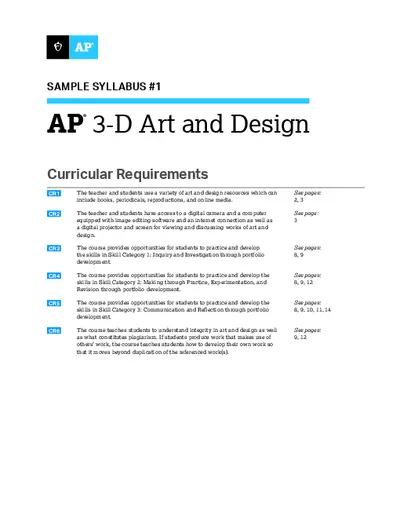
SAMPLE SYLLABUS #1
AP
®
3-D Art and Design
Curricular Requirements
CR1
The teacher and students use a variety of art and design resources which can
include books, periodicals, reproductions, and online media.
See pages:
2, 3
CR2
The teacher and students have access to a digital camera and a computer
equipped with image editing software and an internet connection as well as
a digital projector and screen for viewing and discussing works of art and
design.
See page:
3
CR3
The course provides opportunities for students to practice and develop
the skills in Skill Category 1: Inquiry and Investigation through portfolio
development.
See pages:
8, 9
CR4
The course provides opportunities for students to practice and develop the
skills in Skill Category 2: Making through Practice, Experimentation, and
Revision through portfolio development.
See pages:
8, 9, 12
CR5
The course provides opportunities for students to practice and develop the
skills in Skill Category 3: Communication and Reflection through portfolio
development.
See pages:
8, 9, 10, 11, 14
CR6
The course teaches students to understand integrity in art and design as well
as what constitutes plagiarism. If students produce work that makes use of
others’ work, the course teaches students how to develop their own work so
that it moves beyond duplication of the referenced work(s).
See pages:
9, 12
AP-Course Audit Teacher Resources
© 2025 College Board
Advanced Placement 3-D Art
and Design Sample Syllabus #1
College Course Equivalent
The AP 3-D Art and Design course is designed to be the equivalent of a one-semester,
introductory college course in three-dimensional (3-D) art and design.
Course Description
The AP 3-D Art and Design course framework presents an inquiry-based approach to
learning about and making forms and structures in art and design. Students are expected
to conduct an in-depth, sustained investigation of materials, processes, concepts, and
ideas in three dimensions. The framework focuses on concepts and skills emphasized
within college art and design 3-D foundation courses with the same intent: to help
students become inquisitive, thoughtful artists and designers able to create, explore,
and develop works as well as to articulate information about their work. AP 3-D Art
and Design students develop and apply skills of inquiry and investigation, practice,
experimentation, exploration, revision, communication, and reflection.
Instructional Goals
The AP 3-D Art and Design course addresses the following learning outcomes:
The ability to conduct a sustained investigation through practice, experimentation,
and revision, guided by questions and explorations.
The ability to skillfully master and synthesize materials, processes, concepts,
and ideas.
The ability to articulate, through three-dimensional works and in writing, information
about one’s work.
AP 3-D Art and Design Curricular Requirements
1. Students will be encouraged to investigate a variety of 2-D and 3-D creative art and
design resources to enhance their aesthetic understanding and generate possibilities
for their sustained investigation as well as the Selected Works section of the AP 3-D
Art and Design Exam. The following online resources can be valuable tools:
CR1
2. While online resources are phenomenal tools for inspiration, students are expected
to experience two-dimensional and three-dimensional art and design in person as
well. Students will use sketchbooks to document at least one work of art and design
they experience in person each week. Examples include architecture; both wheel-
and hand-constructed ceramic vessels; sculpture in clay; carved and/or constructed
wood, metal, stone, wax, or wire; 3-D fashion forms; graphics constructions; and art
and design in the classroom, at home, or in the community. Students should observe
diverse visual forms, investigating how materials, processes, concepts, and ideas
used in a work relate to the context of the artist/designer.
CR1
The syllabus must include
at least two examples
(titles, URLs, etc.) of art
and design resources
(e.g., books, periodicals,
reproductions, and online
media) that are used to
support specific learning
goals.
2
AP-Course Audit Teacher Resources
© 2025 College Board
Advanced Placement 3-D Art and Design Sample Syllabus #1
3. Printed and digital art and design magazines such as Art in America, Art News, and
Works That Work will be available in the classroom and/or school library to allow a
constant flow of new information resources, both historical and contemporary, for
investigating materials, processes, and ideas.
CR1
4. Regular screenings in class of short videos on contemporary artists and designers
from the Art21 website will offer students a wide variety of potential sources of
inspiration for portfolio development.
5. Throughout the year, while building their AP 3-D Art and Design portfolios, students
will create a website to build a digital portfolio, facilitating ongoing class discussions,
and enabling each student to see their growing portfolio in digital form through the
process of development. These digital portfolios include both finished and in-process
works such as pages scanned or photographed from sketchbooks, journals, and other
analog resources, as well as writing about their work.
CR1
A Flotone graduated backdrop and umbrella lamps will be available for students to
photograph and document work. We will be using Adobe Photoshop to enhance images,
clearly showing materials, processes, and ideas. During group critiques, students project
images of their work and discuss how they relate to specific AP portfolio requirements.
CR2
Throughout the course, students will be assigned short, open-ended digital art and design
challenges. These assignments begin with teacher presentations of “tech tips” that show
students how to use digital resources to support their three-dimensional design portfolio
development. Students work in a tech room equipped with digital cameras, desktop and
laptop computers, Adobe Photoshop, a digital projector, and a large digital display.
CR2
Each week, class time is dedicated to collaborative demonstrations via digital projector.
Students will share best practices for using cell phone cameras and free editing apps to
make quality images of works and process documentation. Demos also include instruction
on creative uses of the class set of digital cameras, computers, scanner, and accompanying
software.
Beginning in November, students will begin uploading work to the AP digital submission
web application. This web-based submission process is used for both the Sustained
Investigation section, and the Selected Works section of the AP 3-D Art and Design
Portfolio Exam. The AP 3-D Art and Design portfolio digital submission web application
(apstudio.ets.org/apstudioart) is accessible to coordinators, teachers, and students
beginning in November of each year. Teachers and students will use the digital
submission web application to:
Upload and view student digital portfolios while their work is in progress.
Track student progress toward a completed portfolio.
Review the digital portfolios for completeness and accuracy before and after formally
submitting portfolios.
CR2
The syllabus must explicitly
state that students and
teachers have access to:
digital cameras (these
can include cell
phones)
computers or other
devices with image
editing software
a digital projector,
or means to display
artwork and/or
resources to facilitate
viewing and discussion
with students
3
/ 14
End of Document
372
You May Also Like

FAQs of Ap 3-d Art And Design Sample Syllabus 1

What are the main components of the AP 3-D Art and Design syllabus?
The AP 3-D Art and Design syllabus includes curricular requirements, instructional goals, and assessment criteria. It emphasizes inquiry-based learning, allowing students to explore materials and processes through sustained investigations. The syllabus outlines the expectations for portfolio development, including the Selected Works section and the Sustained Investigation section, which require students to demonstrate mastery of 3-D skills and articulate their creative processes. Additionally, it provides guidelines for ethical practices in art making.
How does the syllabus support student portfolio development?
The syllabus supports student portfolio development by incorporating opportunities for practice, experimentation, and revision throughout the course. Students are encouraged to document their artistic processes and reflect on their learning experiences. The curriculum includes specific assignments that require students to create a digital portfolio, showcasing both finished and in-progress works. This approach helps students articulate their artistic vision and prepares them for the AP 3-D Art and Design exam.
What skills are emphasized in the AP 3-D Art and Design course?
The AP 3-D Art and Design course emphasizes several key skills, including inquiry and investigation, making through practice and experimentation, and communication through reflection. Students are expected to master 3-D art techniques and synthesize materials, processes, and ideas in their work. The curriculum also encourages students to articulate their creative processes and engage in collaborative critiques, fostering a deeper understanding of artistic integrity and originality.
What is the significance of the Selected Works section in the syllabus?
The Selected Works section is significant as it allows students to showcase their best three-dimensional works, demonstrating their mastery of materials and processes. Each work submitted must reflect the student's individual artistic vision and be accompanied by written responses that articulate the ideas behind the work. This section is crucial for assessment, as it evaluates students' ability to synthesize artistic concepts and communicate their creative intentions effectively.

Related of Ap 3-d Art And Design Sample Syllabus 1