AP 3D Design Summer Homework

AP 3D Design Summer Homework

AP 3D Design Summer Homework outlines essential tasks for students preparing for the AP 3D Design course. It includes requirements for 250 stock photographs, three complete works of art, and a contemporary artist research presentation. Students will explore various artistic themes such as texture, balance, and negative space through their photography. The guide also emphasizes the importance of using recycled and natural materials in sculptural projects, encouraging creativity and resourcefulness. This comprehensive homework assignment is designed for high school students enrolled in AP 3D Design, helping them develop their artistic skills and prepare for the upcoming school year.

Key Points

  • Requires 250 stock photographs organized by themes like texture and balance.
  • Involves creating three complete works of art using cardboard, recycled, and natural materials.
  • Includes a contemporary artist research presentation with visual samples and evaluations.
  • Students must brainstorm and list 100 concentration ideas for their projects.
421
/ 9
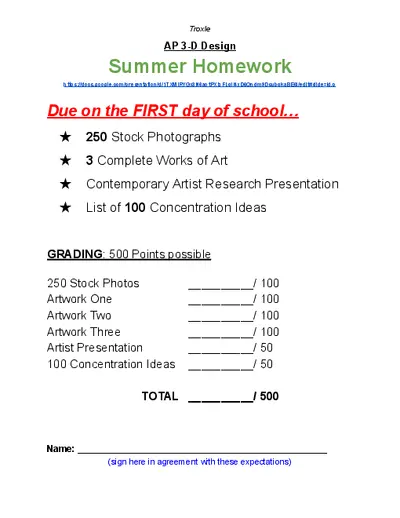
Troxle
AP 3-D Design
Summer Homework
https://docs.google.com/presentation/d/1TXMjRYGx3N6aotPXjqFLqij4xD6Ondm9DsubqkaBE6I/edit#slide=id.p
Due on the FIRST day of school…
250 Stock Photographs
3 Complete Works of Art
Contemporary Artist Research Presentation
List of 100 Concentration Ideas
GRADING: 500 Points possible
250 Stock Photos __________/ 100
Artwork One __________/ 100
Artwork Two __________/ 100
Artwork Three __________/ 100
Artist Presentation __________/ 50
100 Concentration Ideas __________/ 50
TOTAL __________/ 500
Name: _________________________________________________
(sign here in agreement with these expectations)
250 Stock Photos (organized on Google Drive)
3D Form / 3 Viewpoints = 75 photos
(25 different forms from 3 different angles = 75 total)
Human Figure = 25 photos
(WHOLE figure posed, in motion - head to toe)
Negative Space = 25 photos
Texture = 25 photos
Shadow & Form = 25 photos
(photos include the form & the shape of the shadow it casts - pay attention
to the lighting; without light there is no shadow!)
Balance = 30 photos
Symmetry = 10 photos
Asymmetry = 10 photos
Radial Symmetry = 10 photos
Your Choice = 50 - 75 photos
(ALL 250 photos must be taken by YOU. There must be 250 DIFFERENT photos, you
cannot duplicate images between categories.)
Contemporary Artist Research
Research a contemporary 3D artist whose work you like
Name of artist
Website address / contact information
General information about them, their background, education, etc.
Medium of choice (glass, stone, wood, etc)
5 visual samples of their work
Evaluate 1 of their works
Discuss how they used the Elements & Principles of Design
What you like about their work
Arrange information on a Google Slides presentation
Share with me ntroxle@caschools.us
100 Concentration Ideas (attached sheets)
3 Complete Pieces of ART
Project Specifications: In your sketchbook brainstorm, plan &
sketch EACH project you create
(this will be the procedure for EVERYTHING in this class)
CARDBOARD: Use the piece of cardboard to create a
sculptural piece that elevates the material beyond the
cheap, ordinary material that it is. NO color or decoration
may be added to the cardboard. NO glue may be used; you
must find ways to join the material without adhesives of any
kind! Look for resources to get ideas of how other artists
working in this medium have solved this design challenge.
There are plenty of alternative ways to solve this problem!
RECYCLED: Collect materials that have served their
purpose and are destined for the landfill! Create an
interesting sculpture that takes into consideration the
shape, size and forms of the objects you are using. Any
joining materials and methods may be used with
consideration to craftsmanship so the joining of the pieces
is not a visible distraction to the finished work (no dripping
glue blobs showing). You may add color if necessary to
unify your piece or make the purpose more evident.
NATURAL: Go for a stroll and gather natural materials
from your environment. Use these as your building medium
to construct a sculpture that highlights the color, textures
and shapes of the objects you are using. Any joining
materials and methods may be used with consideration to
craftsmanship so the joining of the pieces is not a visible
distraction to the finished work (no dripping glue blobs
showing).
/ 9
End of Document
421
You May Also Like

FAQs of AP 3D Design Summer Homework

What types of photographs are required for the AP 3D Design homework?
Students must submit 250 stock photographs categorized into specific themes. This includes 75 photos of 3D forms from three viewpoints, 25 photos of human figures, and additional photos focusing on negative space, texture, shadow and form, and balance. Each category has specific requirements, ensuring a diverse and comprehensive collection that showcases different artistic elements.
What are the project specifications for the three complete pieces of art?
Students are required to create three distinct sculptural pieces using different materials. The first project involves using cardboard without any color or glue, challenging students to explore innovative joining techniques. The second project focuses on recycled materials, where students must craft sculptures that consider the shape and form of the objects used. Lastly, the natural materials project encourages students to gather items from their environment to highlight their textures and colors in the sculpture.
How should students present their research on a contemporary artist?
The contemporary artist research presentation requires students to select a 3D artist whose work they admire. They must gather information about the artist's background, education, and preferred medium, along with five visual samples of their work. Students will evaluate one piece, discussing the elements and principles of design used, as well as their personal reflections on the artwork. This presentation must be organized using Google Slides and shared with the instructor.
What is the purpose of the 100 concentration ideas list?
The 100 concentration ideas list serves as a brainstorming tool for students to explore potential themes and concepts for their art projects. This exercise encourages creativity and helps students identify specific areas of interest within the realm of 3D design. By generating a diverse list, students can refine their artistic focus and develop a clearer vision for their upcoming works.

Related of AP 3D Design Summer Homework