AP Art Creative Process Steps: Concept vs. Reality
AP Art Course Goals:
Students are to:
1) Conduct an in-depth, sustained investigation through practice, experimentation, and revision, guided by an
essential question(s);
2) Skillfully synthesize materials, processes, and ideas; and
3) Articulate, in writing, information about one’s work.
The most successful portfolio submissions will demonstrate:
1) Visual evidence of advanced 2-D, 3-D, or drawing skills
2) Visual evidence of synthesis of materials, processes, and ideas
3) Visual evidence of the written idea in all five works of art. This includes notes and writings about all sections of
the creative process.
What are Sustained Investigations and Essential Questions? Let’s start with the Sustained Investigations
A Sustained Investigation is a deep dive into information, concepts, ideas, and questions surrounding a central focus
called an Essential Question. The Sustained Investigation leads to a series of personally creative artworks. This
investigation process helps demonstrate improved thought processes, decision making in creativity and composition,
critical thinking skills, and constructive improvements. This process also connects to the overall structure of the College
Board portfolio by focusing on the artistic process of developing and improving ideas over time and synthesis of final
works to the Essential Question.
What are the steps to a Sustained Investigation and the Creative Process?
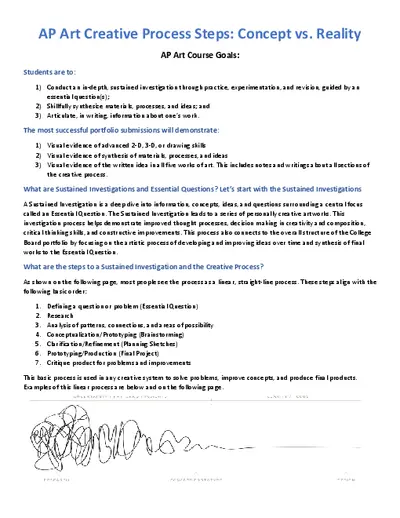
As shown on the following page, most people see the process as a linear, straight-line process. These steps align with the
following basic order:
1. Defining a question or problem (Essential Question)
2. Research
3. Analysis of patterns, connections, and areas of possibility
4. Conceptualization/Prototyping (Brainstorming)
5. Clarification/Refinement (Planning Sketches)
6. Prototyping/Production (Final Project)
7. Critique product for problems and improvements
This basic process is used in any creative system to solve problems, improve concepts, and produce final products.
Examples of this linear process are below and on the following page.