AP Calculus AB Unit 5 Progress Check FRQ Part B

AP Calculus AB Unit 5 Progress Check FRQ Part B

AP Calculus AB Unit 5 Progress Check FRQ Part B focuses on key concepts in calculus, including critical points, inflection points, and the behavior of functions. This assessment is designed for students preparing for the AP Calculus exam, specifically targeting the understanding of derivatives and their applications. The document includes various problems that require students to analyze graphs, classify critical points, and determine intervals of increase and decrease. It serves as a valuable resource for reinforcing calculus concepts and improving problem-solving skills.

Key Points

  • Analyzes critical points and classifies them as relative maxima or minima.
  • Identifies points of inflection and explains their significance in function behavior.
  • Examines the behavior of functions on specified intervals, including increasing and decreasing trends.
  • Utilizes derivatives to determine the rate of change in various contexts.
358
/ 9
AP Calculus AB Scoring Guide
Unit 5 Progress Check: FRQ Part B
Copyright © 2017. The College Board. These materials are part of a College Board program. Use or distribution of these materials online or
in print beyond your school’s participation in the program is prohibited.
Page 1 of 9
1.
NO CALCULATOR IS ALLOWED FOR THIS QUESTION.
Show all of your work, even though the question may not explicitly remind you to do so. Clearly
label any functions, graphs, tables, or other objects that you use. Justifications require that you
give mathematical reasons, and that you verify the needed conditions under which relevant
theorems, properties, definitions, or tests are applied. Your work will be scored on the
correctness and completeness of your methods as well as your answers. Answers without
supporting work will usually not receive credit.
Unless otherwise specified, answers (numeric or algebraic) need not be simplified. If your
answer is given as a decimal approximation, it should be correct to three places after the
decimal point.
Unless otherwise specified, the domain of a function is assumed to be the set of all real
numbers for which is a real number.
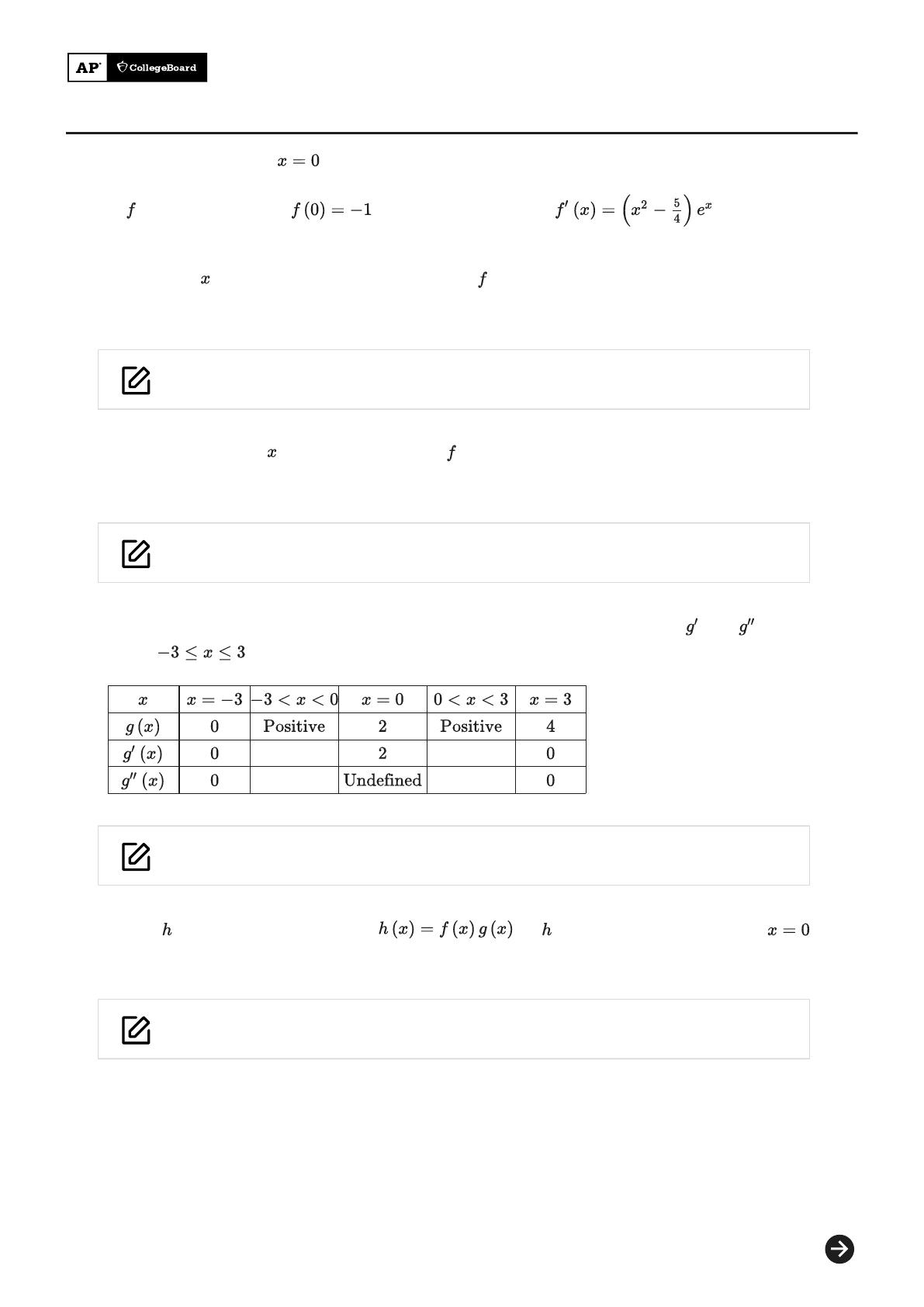
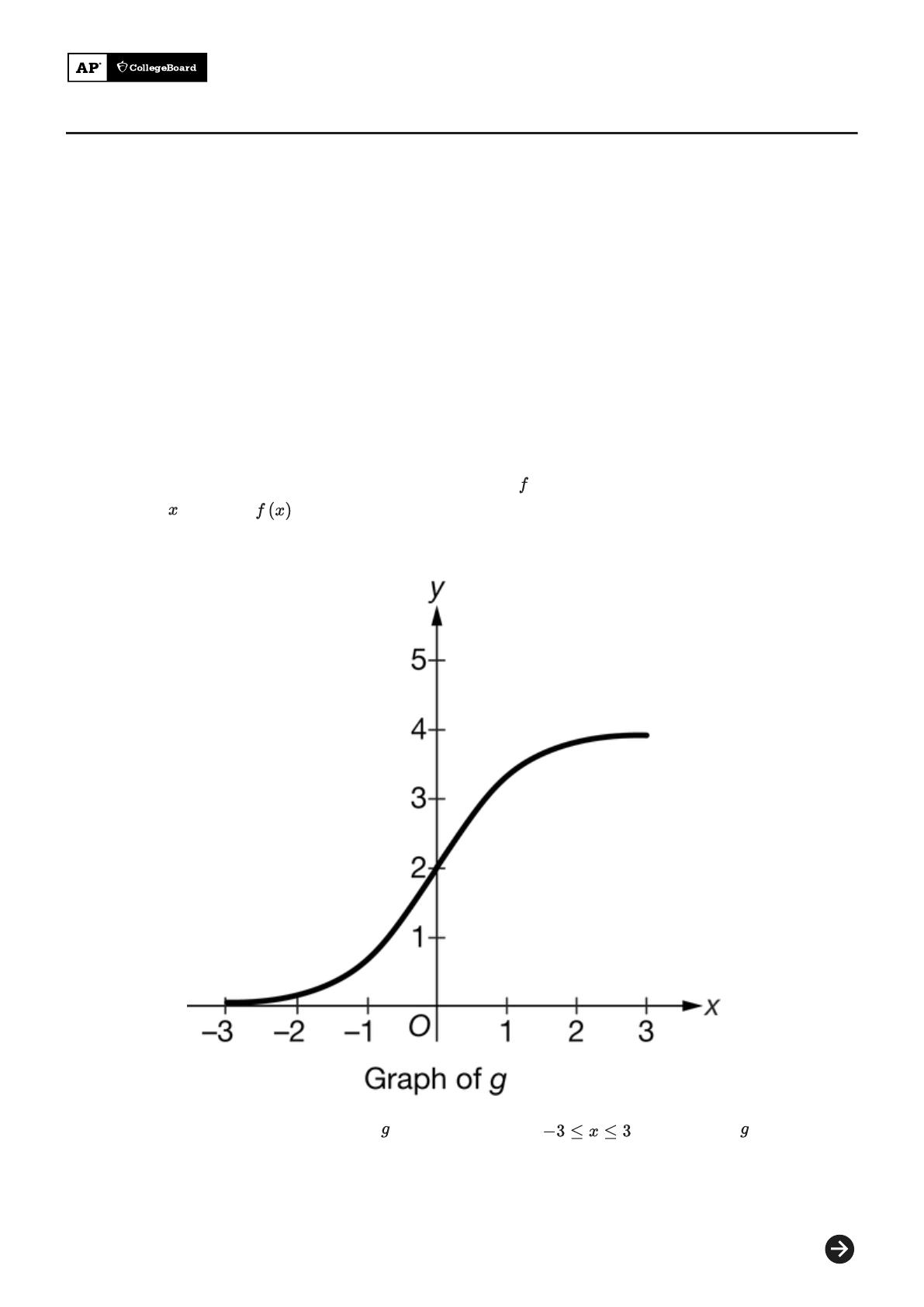
The graph of the continuous function is shown above for . The function is twice
AP Calculus AB Scoring Guide
Unit 5 Progress Check: FRQ Part B
Copyright © 2017. The College Board. These materials are part of a College Board program. Use or distribution of these materials online or
in print beyond your school’s participation in the program is prohibited.
Page 2 of 9
differentiable, except at .
Let be the function with and derivative given by .
(a) Find the -coordinate of each critical point of . Classify each critical point as the location
of a relative minimum, a relative maximum, or neither. Justify your answers.
Please respond on separate paper, following directions from your teacher.
(b) Find all values of at which the graph of has a point of inflection. Give reasons for your
answers.
Please respond on separate paper, following directions from your teacher.
(c) Fill in the missing entries in the table below to describe the behavior of and on the
interval . Indicate Positive or Negative. Give reasons for your answers.
Please respond on separate paper, following directions from your teacher.
(d) Let be the function defined by . Is increasing or decreasing at
? Give a reason for your answer.
Please respond on separate paper, following directions from your teacher.
Part A
AP Calculus AB Scoring Guide
Unit 5 Progress Check: FRQ Part B
Copyright © 2017. The College Board. These materials are part of a College Board program. Use or distribution of these materials online or
in print beyond your school’s participation in the program is prohibited.
Page 3 of 9
Note: Sign charts are a useful tool to investigate and summarize the behavior of a function. By itself a
sign chart for or is not a sufficient response for a justification.
The first point requires reference to
A maximum of 1 out of 3 points is earned for only one correct critical point with correct identification and
justification, and no incorrect critical points are included.
Select a point value to view scoring criteria, solutions, and/or examples and to score the response.
0
1 2 3
The student response accurately includes all three of the criteria below.
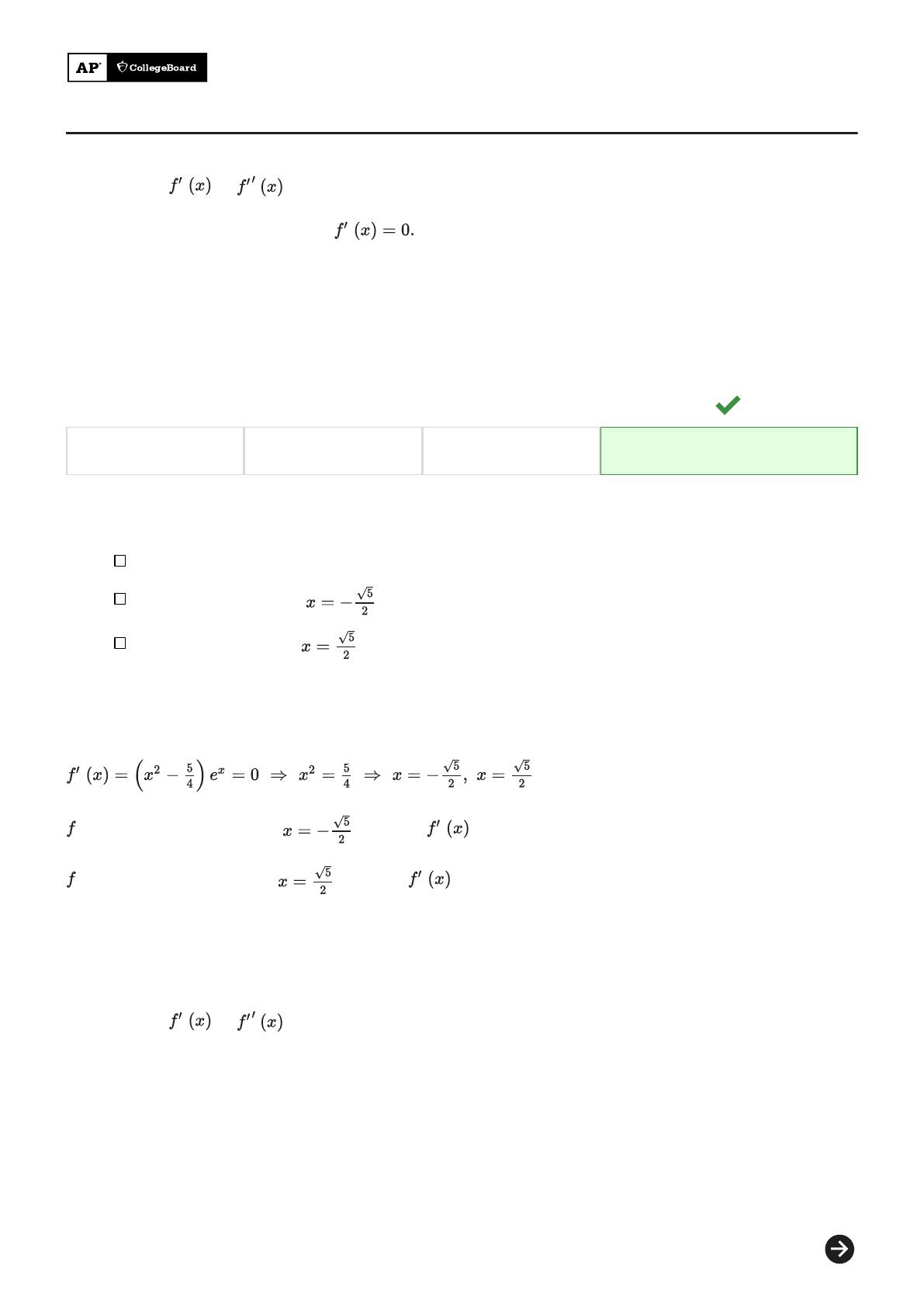
critical points
relative maximum at with justification
relative minimum at with justification
Solution:
has a relative maximum at because changes from positive to negative there.
has a relative minimum at because changes from negative to positive there.
Part B
Note: Sign charts are a useful tool to investigate and summarize the behavior of a function. By itself a
sign chart for or is not a sufficient response for a justification.
A maximum of 1 out of 2 points is earned if only one point of inflection with reason and no incorrect points
of inflection.
Select a point value to view scoring criteria, solutions, and/or examples and to score the response.
/ 9
End of Document
358
You May Also Like

FAQs of AP Calculus AB Unit 5 Progress Check FRQ Part B

What are critical points in calculus?
Critical points are values of a function where the derivative is either zero or undefined. These points are significant because they can indicate locations of relative maxima, minima, or points of inflection. In the context of the AP Calculus exam, identifying and classifying these points helps students understand the overall behavior of functions. Analyzing critical points is essential for graphing functions and solving optimization problems.
How do you determine points of inflection?
Points of inflection occur where a function changes its concavity, which can be identified by examining the second derivative. If the second derivative changes sign at a certain point, that point is a point of inflection. This concept is crucial in calculus as it helps in understanding the curvature of graphs and the behavior of functions. Recognizing points of inflection can aid in sketching accurate graphs and solving related problems.
What is the significance of the first derivative test?
The first derivative test is used to determine whether a critical point is a relative maximum, minimum, or neither. By analyzing the sign of the first derivative before and after the critical point, students can conclude how the function behaves around that point. If the derivative changes from positive to negative, the critical point is a relative maximum; if it changes from negative to positive, it is a relative minimum. This test is a fundamental tool in calculus for optimizing functions.
What does it mean for a function to be increasing or decreasing?
A function is increasing on an interval if its derivative is positive throughout that interval, indicating that the function's values are rising. Conversely, a function is decreasing if its derivative is negative, meaning the function's values are falling. Understanding these concepts is vital for analyzing the behavior of functions and is often tested in AP Calculus assessments. Students must be able to identify these intervals based on the derivative's sign.
How can sign charts be used in calculus?
Sign charts are graphical tools that help visualize the behavior of a function based on its first and second derivatives. By plotting the signs of these derivatives, students can easily identify intervals where the function is increasing, decreasing, or concave up or down. This method simplifies the process of analyzing complex functions and is particularly useful for determining critical points and points of inflection. Sign charts are a common technique taught in AP Calculus courses.

Related of AP Calculus AB Unit 5 Progress Check FRQ Part B