AP Calculus BC Unit 7 Progress Check FRQ Part A

AP Calculus BC Unit 7 Progress Check FRQ Part A

The AP Calculus BC Unit 7 Progress Check focuses on Free Response Questions (FRQs) designed to assess students' understanding of calculus concepts. It includes problems related to differential equations, tangent lines, and the application of calculus in real-world scenarios. This scoring guide provides detailed criteria for evaluating student responses, ensuring alignment with the AP exam standards. Ideal for AP Calculus students preparing for the exam, it covers essential topics and problem-solving techniques necessary for success.

Key Points

  • Includes detailed scoring criteria for AP Calculus BC FRQs
  • Covers differential equations and their applications in real-world contexts
  • Focuses on tangent line approximations and initial conditions
  • Designed for AP Calculus students preparing for the May exam
283
/ 9
AP Calculus BC Scoring Guide
Unit 7 Progress Check: FRQ Part A
Copyright © 2017. The College Board. These materials are part of a College Board program. Use or distribution of these materials online or
in print beyond your school’s participation in the program is prohibited.
Page 1 of 9
1.
NO CALCULATOR IS ALLOWED FOR THIS QUESTION.
Show all of your work, even though the question may not explicitly remind you to do so. Clearly
label any functions, graphs, tables, or other objects that you use. Justifications require that you
give mathematical reasons, and that you verify the needed conditions under which relevant
theorems, properties, definitions, or tests are applied. Your work will be scored on the
correctness and completeness of your methods as well as your answers. Answers without
supporting work will usually not receive credit.
Unless otherwise specified, answers (numeric or algebraic) need not be simplified. If your
answer is given as a decimal approximation, it should be correct to three places after the
decimal point.
Unless otherwise specified, the domain of a function is assumed to be the set of all real
numbers for which is a real number.
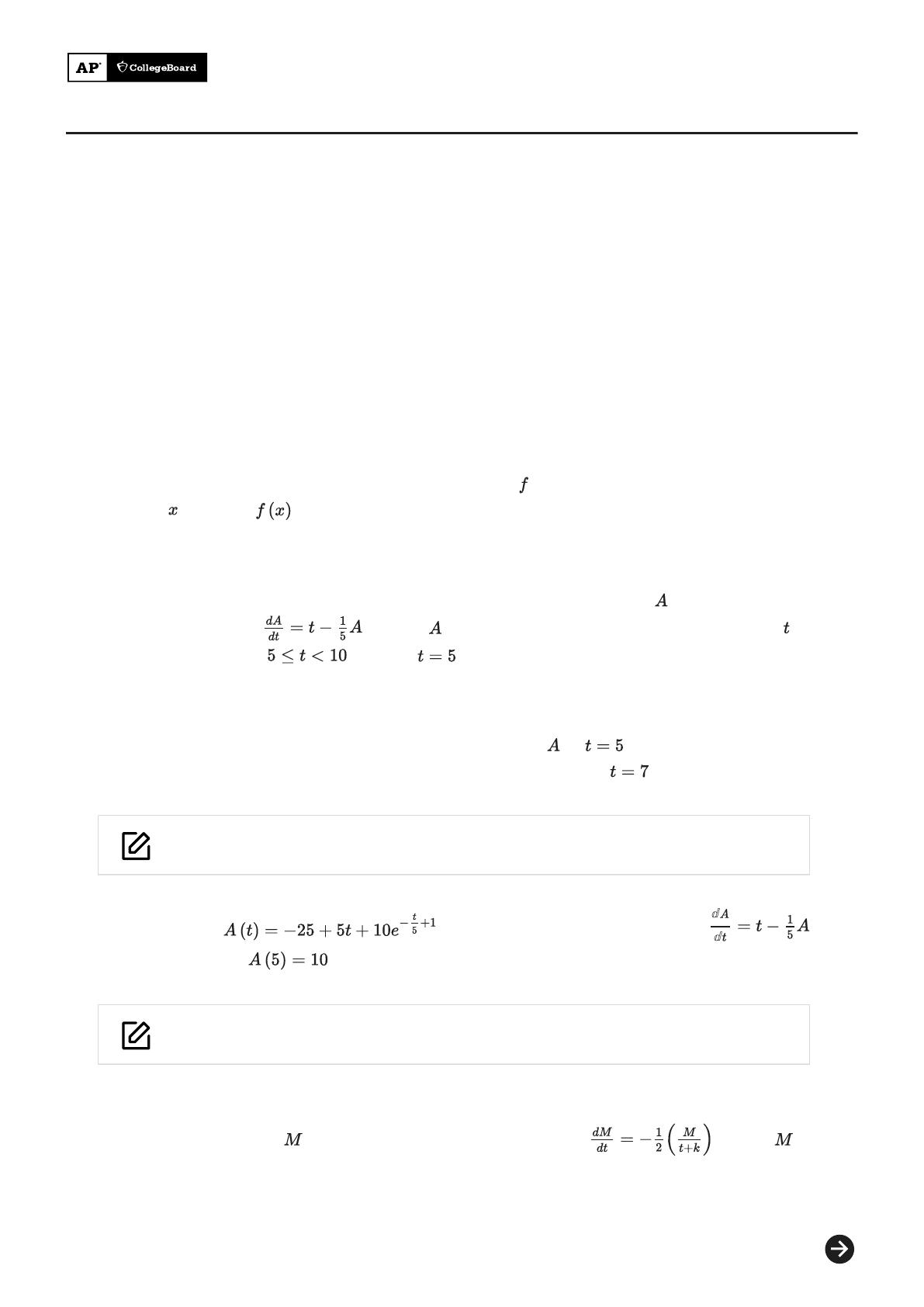
The population of a virus in a host can be modeled by the function that satisfies the
differential equation , where is measured in millions of virus cells and is
measured in days for . At time days, there are 10 million cells of the virus in
the host.
(a) Write an equation for the line tangent to the graph of at . Use the tangent line to
approximate the number of virus cells in the host, in millions, at time days.
Please respond on separate paper, following directions from your teacher.
(b) Show that satisfies the differential equation
with initial condition .
Please respond on separate paper, following directions from your teacher.
(c) The host receives an antiviral medication. The amount of medication in the host is
modeled by the function that satisfies the differential equation , where is

AP Calculus BC Scoring Guide
Unit 7 Progress Check: FRQ Part A
Copyright © 2017. The College Board. These materials are part of a College Board program. Use or distribution of these materials online or
in print beyond your school’s participation in the program is prohibited.
Page 2 of 9
measured in milligrams, is measured in days since the host received the medication, and is
a positive constant. If the amount of medication in the host is 30 milligrams at time days
and 15 milligrams at time days, what is in terms of ?
Please respond on separate paper, following directions from your teacher.
Part A
For the second point, it is incorrect to state rather than
Select a point value to view scoring criteria, solutions, and/or examples to score the response.
0
1 2
The student response accurately includes both of the criteria below.
tangent line equation
approximation
Solution:
An equation for the line tangent to the graph of at is
At time days, there are approximately million virus cells in the host.
Part B
Select a point value to view scoring criteria, solutions, and/or examples and to score the response.
AP Calculus BC Scoring Guide
Unit 7 Progress Check: FRQ Part A
Copyright © 2017. The College Board. These materials are part of a College Board program. Use or distribution of these materials online or
in print beyond your school’s participation in the program is prohibited.
Page 3 of 9
0
1 2 3
The student response accurately includes all three of the criteria below.
verification of initial condition
verification that
Solution:
Part C
Zero out of 4 points earned if no separation of variables.
At most 2 out of 4 points earned [1-1-0-0] if no constant of integration.
Both antiderivatives must be correct to earn the second point.
The fourth point requires an expression for The domain of is included with the solution; this
is not a requirement to earn the fourth point.
Select a point value to view scoring criteria, solutions, and/or examples and to score the response.
0
1 2 3 4
The student response accurately includes all four of the criteria below.
/ 9
End of Document
283
You May Also Like

FAQs of AP Calculus BC Unit 7 Progress Check FRQ Part A

What types of problems are included in the AP Calculus BC Unit 7 Progress Check?
The Unit 7 Progress Check includes various Free Response Questions (FRQs) that assess students' understanding of differential equations, tangent lines, and the application of calculus concepts. Students are required to show their work and justify their answers, which is crucial for scoring well on the AP exam. The problems often involve real-world applications, making it essential for students to connect theoretical knowledge with practical scenarios.
How is the scoring for the AP Calculus BC FRQs structured?
Scoring for the AP Calculus BC Free Response Questions is based on specific criteria outlined in the scoring guide. Each response is evaluated for correctness, completeness, and the clarity of the mathematical reasoning provided. Points are awarded for correct answers, appropriate use of calculus concepts, and the ability to communicate solutions effectively. This structured approach helps ensure that students are assessed fairly and consistently.
What is the significance of tangent lines in calculus?
Tangent lines are fundamental in calculus as they represent the instantaneous rate of change of a function at a given point. In the context of the AP Calculus BC exam, students must be able to find the equation of a tangent line and use it to approximate values of functions. Understanding tangent lines also lays the groundwork for more advanced topics such as derivatives and integrals, making it a critical concept for students to master.
What role do initial conditions play in solving differential equations?
Initial conditions are crucial when solving differential equations as they provide specific values that help determine the unique solution of the equation. In the context of the AP Calculus BC exam, students must understand how to apply initial conditions to verify their solutions and ensure they meet the requirements of the problem. This concept is essential for accurately modeling real-world scenarios, where initial values often dictate the behavior of a system.
How can students effectively prepare for the AP Calculus BC exam using this scoring guide?
Students can prepare for the AP Calculus BC exam by using the scoring guide to understand the expectations for Free Response Questions. By reviewing the scoring criteria, students can identify key areas to focus on, such as showing work, justifying answers, and applying calculus concepts correctly. Practicing with past FRQs and comparing their responses to the scoring guide will help students improve their problem-solving skills and increase their confidence for the exam.

Related of AP Calculus BC Unit 7 Progress Check FRQ Part A

