AP Chemistry Types of Chemical Reactions and Solution Stoichiometry

AP Chemistry Types of Chemical Reactions and Solution Stoichiometry

AP Chemistry focuses on the types of chemical reactions and solution stoichiometry essential for mastering the subject. This resource covers key concepts such as synthesis, decomposition, single and double replacement reactions, and combustion. It also delves into solution properties, including electrolytes, molarity, and the preparation of standard solutions. Ideal for AP Chemistry students preparing for exams, it provides exercises and examples to reinforce understanding of chemical interactions and calculations. The content is structured to aid in grasping complex topics and enhancing problem-solving skills.

Key Points

  • Explains synthesis, decomposition, and combustion reactions in detail.
  • Covers the properties of electrolytes and non-electrolytes in solutions.
  • Includes exercises on calculating molarity and preparing standard solutions.
  • Describes the principles of acid-base reactions and their applications in stoichiometry.
73
/ 17
AP* Chemistry
TYPES OF CHEMICAL REACTIONS
& SOLUTION STOICHIOMETRY
Chemists have used reactions to produce the materials Teflon, nylon, Dacron, Kevlar, polystyrene, and PVC
among many others!
WATER, THE COMMON SOLVENT
x Properties – Water has a high specific heat, high heat of vaporization, high
cohesive and adhesive forces. All of these properties contribute to life on this
planet!
x The H
2
O – the two O—H bonds are polar covalent since oxygen has a higher
electronegativity and thus the electrons are more attracted to the oxygen and
spend more time there. This creates a partial charge indicated by the Greek
lower case letter delta, G
This unequal charge distribution makes the molecule polar. Also notice the
105q bond angle, the two unshared electron pairs are “hogs” and require
more space than shared pairs thus the usual 109.5q bond angle is squished to
about 105q
There are TWO unshared electron pairs associated with the oxygen atom that make the partial negative
charge 2G
x hydration – Since opposites attract, the positive ends
of water are greatly attracted to the negative ions in a
crystal structure while the converse is also true.
x solubility – NaCl is highly soluble while AgCl is
classified as insoluble. When the hydration
attractions are greater than the crystal lattice [ion-ion] attractions, the compound is soluble.
Also note that the particles are charged IONS.
They have a full charge rather than the partial charge on the poles of the water molecule.
*AP is a registered trademark of the College Board, which was not involved in the production of this product.
© 2013 by René McCormick. All rights reserved.
!
!
!
!
!
!
!
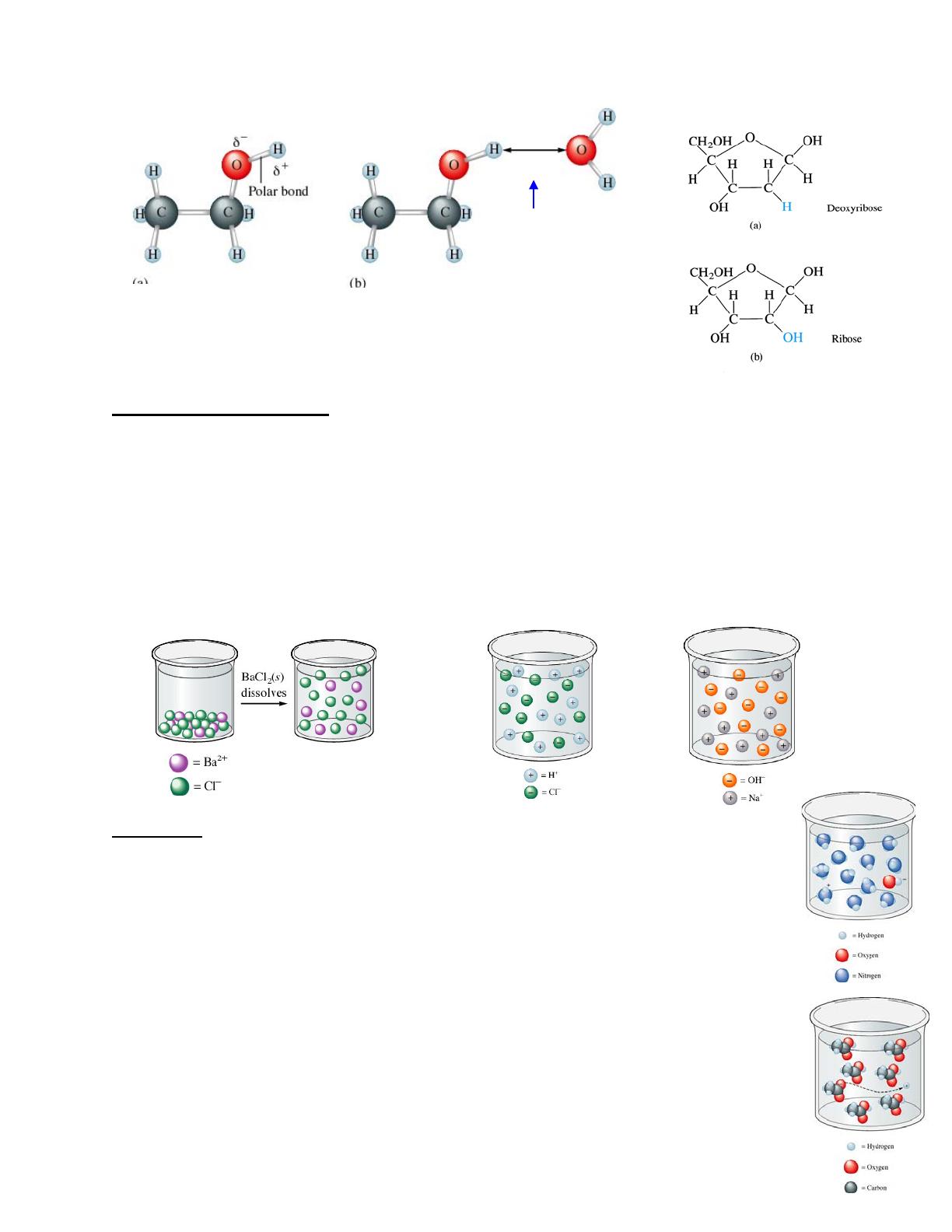
Hydration in action due to
an electrostatic attraction
called a hydrogen bond.
Can also be represented
by a dashed line.
ethanol
ethanol IS attracted to water
Water can also dissolve nonionic substances such as alcohols and sugars among others. Alcohols and
sugars contain O—H bonds that are polar just as the O—H bond in water. This polarity makes the
molecule soluble.
Fats do not dissolve in water since they are nonpolar.
“Like dissolves like” is a useful guideline for predicting solubility, BUT it is not an explanation!
You must address the electrostatic (“opposites attract”) aspects of solute-solvent interactions.
THE NATURE OF AQUEOUS SOLUTIONS: STRONG AND WEAK ELECTROLYTES
Remember a solution is a homogeneous mixture where a solute is dissolved in a solvent. Aqueous solutions
are solutions where the solvent is water.
Properties of Aqueous Solutions
x electrolytes – solutions that conduct an electric current; the more mobile & charged
particles present, the higher the concentration of ions in solution, the better the
conduction. The magnitude of the charge also matters.
x strong – completely dissociate (consult solubility rules—strong acids, strong bases and
soluble salts)
x Barium chloride is an ionic salt that completely ionizes in water, HCl is a strong acid that
completely dissociates into H
+
ions and Cl
ions in water while NaOH is a strong base that
completely dissociates into Na
+
ions and OH
ions water. All 3 release mobile, charged
particles that readily conduct electricity.
x COMMON Strong acids: HCl, HBr, HI, HNO
3
, H
2
SO
4
[loses first H
+
easily and exists
mainly as H
+
and HSO
4
ions in water], and HClO
4
x COMMON Strong bases: Oxides and Hydroxides of I & II A metals [solubility issues with
the IIA’s]
x weak – do not completely dissociate; only about 1% dissociation (The weak acid, acetic
acid and the weak base ammonia are pictured right. Both are classic examples!)
Types of Reactions & Solution Stoichiometry
2

nonelectrolytes – solutions where dissolving has occurred but the solute does not make ions and therefore
cannot conduct electricity. (Pure water, sugar, alcohols, antifreeze, and starch)
x Svante Arrhenius was the first to identify the conductive properties of solutions in the late 1890’s.
He correctly postulated that the extent to which a solution can conduct an electric current depends
directly on the number of ions present.
THE COMPOSITION OF SOLUTIONS
Chemical reactions often take place when two solutions are mixed. To perform stoichiometric calculations in
such cases two things must be known: (1) The nature of the reaction which depends on the exact substance and
whether it exists as ions or molecules in solution AND (2) the amount of chemical (number of moles) present in
the solution. Our favorite concentration unit is molarity:
x Molarity – is a concentration unit of moles per liter. [NaCl] = 0.75 M means 0.75 moles of salt is
contained in 1.00 L of solution. The square brackets indicate whatever is inside is a) in solution and
b) its concentration is expressed in molarity. You may use either the square brackets or the unit M
to express units of molarity on the AP exam.
Preparing Solutions of KNOWN concentration
x Weigh out the solid as accurately as possible, place in a volumetric flask, add only enough distilled
water to dissolve the solid and swirl to completely dissolve the solid THEN add a bit more water, filling
to the mark on the flask. If you dump solid into 1.00 L of water you are neglecting the space the solid
will occupy and your molar concentration will NOT be correct!
moles of solute
Molarity [ ]
Liters of solution
M
grams
MM
Liters of solution
M
Types of Reactions & Solution Stoichiometry
3
/ 17
End of Document
73
You May Also Like

FAQs of AP Chemistry Types of Chemical Reactions and Solution Stoichiometry

What are the main types of chemical reactions covered in AP Chemistry?
AP Chemistry outlines several key types of chemical reactions, including synthesis, decomposition, single replacement, and double replacement reactions. Each type is defined by the way reactants interact to form products. For instance, in synthesis reactions, two or more reactants combine to form a single product, while in decomposition reactions, a single compound breaks down into simpler substances. Understanding these categories is crucial for predicting the outcomes of chemical reactions and balancing equations.
How is molarity calculated in solution stoichiometry?
Molarity is a key concept in solution stoichiometry, defined as the number of moles of solute per liter of solution. To calculate molarity, you divide the number of moles of solute by the volume of the solution in liters. For example, if you dissolve 11.5 grams of NaOH in enough water to make 1.50 liters of solution, you first convert grams to moles using the molar mass of NaOH, then apply the molarity formula. This calculation is fundamental for understanding concentrations in chemical reactions.
What role do electrolytes play in chemical reactions?
Electrolytes are substances that dissociate into ions in solution and can conduct electricity. In AP Chemistry, strong electrolytes completely dissociate into ions, enhancing conductivity, while weak electrolytes only partially dissociate. Understanding the behavior of electrolytes is essential for predicting solubility and reactivity in chemical reactions. For instance, when mixing solutions, the presence of electrolytes can influence whether a precipitate forms, which is a critical concept in double replacement reactions.
What is the significance of acid-base reactions in stoichiometry?
Acid-base reactions are a vital part of stoichiometry, involving the neutralization of acids and bases to form water and a salt. In AP Chemistry, students learn to balance these reactions and calculate the concentrations of reactants and products. The concept of equivalence points in titrations is also explored, where the number of moles of acid equals the number of moles of base. This understanding is crucial for various applications, including titration experiments and real-world chemical processes.
How do precipitation reactions occur in aqueous solutions?
Precipitation reactions occur when two aqueous solutions are mixed, resulting in the formation of an insoluble solid, known as a precipitate. In AP Chemistry, students learn to predict these reactions using solubility rules, which determine whether a compound will dissolve or precipitate. For example, mixing solutions of Na2SO4 and Pb(NO3)2 leads to the formation of PbSO4, a precipitate, while the other ions remain in solution. Understanding these reactions is essential for mastering solution chemistry.

Related of AP Chemistry Types of Chemical Reactions and Solution Stoichiometry

