AP Human Geography Exam 1 Practice Questions and Answers

AP Human Geography Exam 1 Practice Questions and Answers

AP Human Geography Exam 1 provides a comprehensive set of practice questions designed for students preparing for the AP Human Geography exam. This resource includes multiple-choice questions covering key topics such as urbanization, economic sectors, and demographic trends. Each question is crafted to reflect the style and rigor of the actual exam, making it an essential tool for effective study. Ideal for high school students aiming to excel in AP Human Geography, this practice exam enhances understanding of critical concepts and prepares learners for exam success.

Key Points

  • Includes 75 multiple-choice questions aligned with AP Human Geography curriculum
  • Covers essential topics such as urban patterns, economic activities, and demographic transitions
  • Offers insights into geographic concepts like site and situation, dependency ratios, and cultural ecology
  • Designed for AP students to practice and prepare for the May exam effectively

127
/ 35
PRACTICE EXAM 1
AP Human Geography
Section I
TIME: 60 minutes
75 multiple-choice questions
(Answer sheets appear in the back of this book.)
Directions: Each of the following questions is followed by five suggested answers or completions. Select the best answer
choice.
1. All the following have been considered new industrial countries EXCEPT
(A) Hong Kong (D) China
(B) South Korea (E) Indonesia
(C) Brazil
2. Which of the following is an example of a quinary-sector economic activity?
(A) Working at a cash register at McDonald’s
(B) Serving as a researcher for human genetic cloning
(C) Serving on the U.S. president’s cabinet
(D) Converting crude oil into gasoline
(E) Plowing land in preparation for planting a crop
3. London has become a world city in part because of its proximity to ports and other places that foster development.
This reason for London’s historic growth relates to the city’s
(A) site (D) situation
(B) sovereignty (E) distance decay
(C) redlining
4. Which of the following is a valid difference between the urban patterns of the United States and those of Latin
America?
(A) Unlike U.S. cities, Latin American cities have ghettos.
(B) U.S cities follow a sector pattern, whereas Latin American cities follow concentric zones.
(C) Gentrification is more present in Latin American cities.
(D) Latin American cities have more-defined industrial sectors.
(E) Unlike U.S. cities, Latin American cities show patterns of wealthy residents emanating from the city’s central
business district.
5. The number of people under the age of 15 plus the number of people above the age of 64 divided by the number of
the people aged 15 through 64 is defined as
(A) carrying capacity (D) age-sex pyramid
(B) primary economic sector (E) infrastructure
(C) dependency ratio
6. Governments such as those once controlled by the Taliban in Afghanistan and the Ayatollah Khomeini in Iran are
classified as
(A) landlocked (D) theocratic
(B) parliamentary (E) microstates
(C) federal
7. All the following were original members of the European Community, the predecessor to the European Union,
EXCEPT
(A) France (D) Italy
(B) Belgium (E) The Netherlands
(C) United Kingdom
8. In 1492, Christopher Columbus’s voyage took nearly 40 days to cross the Atlantic Ocean, a trip that would take a
modern ship less than one week. This difference best reflects the geographic concept of
(A) distance decay (D) space-time compression
(B) uneven development (E) distribution
(C) stimulus diffusion
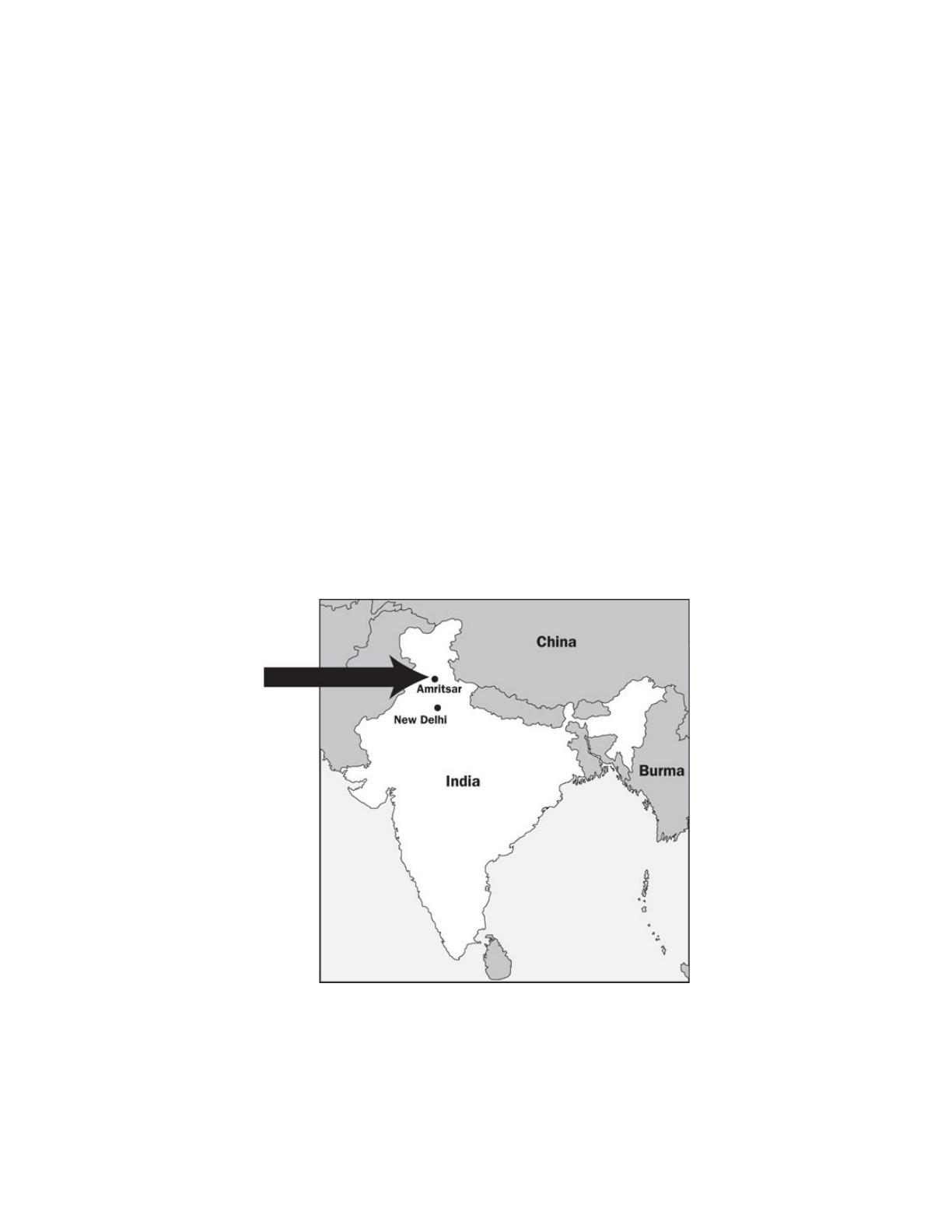
9. The arrow on the map above points to a city in India containing the largest number of shrines from which of the
following religions?
(A) Sikhism (D) Christianity
(B) Shintoism (E) Hinduism
(C) Buddhism
10. The region outlined above contains delivery destinations served by United Trucking. Which of the following
classifications best fits this region?
(A) Functional (D) Mental
(B) Formal (E) Perceptual
(C) Vernacular
11. Compared with the world pattern of crude birth rates, the world pattern of crude death rates shows
(A) more variation because of the vast inequalities in minimal health care throughout the world
(B) less variation because of the general availability of minimal health care facilities throughout the world
(C) equal variation because of the offsetting effect of birth and death rates throughout the world
(D) no variation
(E) high variation because of the high infant mortality in some world regions
12. Which of the following would be most attracted to export-processing zones in less-developed countries?
(A) Transnational corporations assembling products that are bulk reducing or not weight gaining
(B) Multinational firms wanting to build world headquarters
(C) Quaternary-sector workers wanting to find jobs
(D) Technopoles
(E) International lending agencies
13. The second agricultural revolution developed at the same time as
(A) growing urban markets were demanding increased food production
(B) improved genetic modification of food allowed for increased harvests in developing countries
(C) humans were forming communes and practicing open-field farming
(D) vast shortages in laborers existed because of communicable diseases
(E) large streams of migrants moved from core to peripheral countries
/ 35
End of Document
127
You May Also Like

FAQs of AP Human Geography Exam 1 Practice Questions and Answers

What are the key themes covered in the AP Human Geography Exam 1?
The AP Human Geography Exam 1 covers a variety of themes including urbanization, economic sectors, and demographic trends. Key topics include the differences between urban patterns in the U.S. and Latin America, the implications of the dependency ratio, and the significance of agricultural revolutions. Students will encounter questions that test their understanding of geographic concepts such as site and situation, as well as the impact of cultural ecology on human development.
How does the AP Human Geography Exam 1 assess understanding of demographic trends?
The exam assesses understanding of demographic trends through questions that require students to analyze population pyramids, fertility rates, and life expectancy. For instance, students may be asked to interpret changes in China's population structure over time, particularly in relation to the one-child policy and its effects on the dependency ratio. This helps students connect theoretical concepts with real-world demographic data.
What types of economic activities are explored in the AP Human Geography Exam 1?
The exam explores various economic activities categorized into primary, secondary, tertiary, and quinary sectors. Questions may focus on examples of each sector, such as agricultural practices, manufacturing processes, and service-oriented jobs. Understanding these categories is crucial for analyzing economic development and globalization trends in different regions.
What is the significance of urban patterns in the AP Human Geography Exam 1?
Urban patterns are significant in the AP Human Geography Exam 1 as they illustrate how cities develop and function within different cultural and economic contexts. Students are expected to analyze the layout of cities, the distribution of wealth, and the impact of gentrification. Understanding these patterns helps students grasp the complexities of urban geography and its implications for social equity and environmental sustainability.
How does the AP Human Geography Exam 1 prepare students for the actual AP exam?
The AP Human Geography Exam 1 prepares students by simulating the format and content of the actual AP exam. It includes a variety of question types that reflect the exam's emphasis on critical thinking and application of geographic concepts. By practicing with these questions, students can identify areas of strength and weakness, allowing for targeted study and improved performance on the exam.

Related of AP Human Geography Exam 1 Practice Questions and Answers