AP Physics 1 Unit 3 MCQ Scoring Guide

AP Physics 1 Unit 3 MCQ Scoring Guide

AP Physics 1 Unit 3 MCQ Scoring Guide provides comprehensive answers and explanations for multiple-choice questions related to key concepts in physics. It covers topics such as kinetic energy, gravitational potential energy, and conservation of energy, essential for students preparing for the AP Physics exam. This guide is designed for AP Physics students seeking to enhance their understanding and performance in Unit 3 assessments. It includes detailed rationales for each question, helping students grasp the underlying principles of physics. Ideal for exam preparation and review, this scoring guide supports effective study strategies.

Key Points

  • Includes detailed explanations for each multiple-choice question in Unit 3 of AP Physics 1
  • Covers essential physics concepts like kinetic energy, potential energy, and conservation laws
  • Provides rationales that help students understand the reasoning behind correct answers
  • Designed for AP Physics students preparing for the exam and seeking to improve their scores
332
/ 13
1.
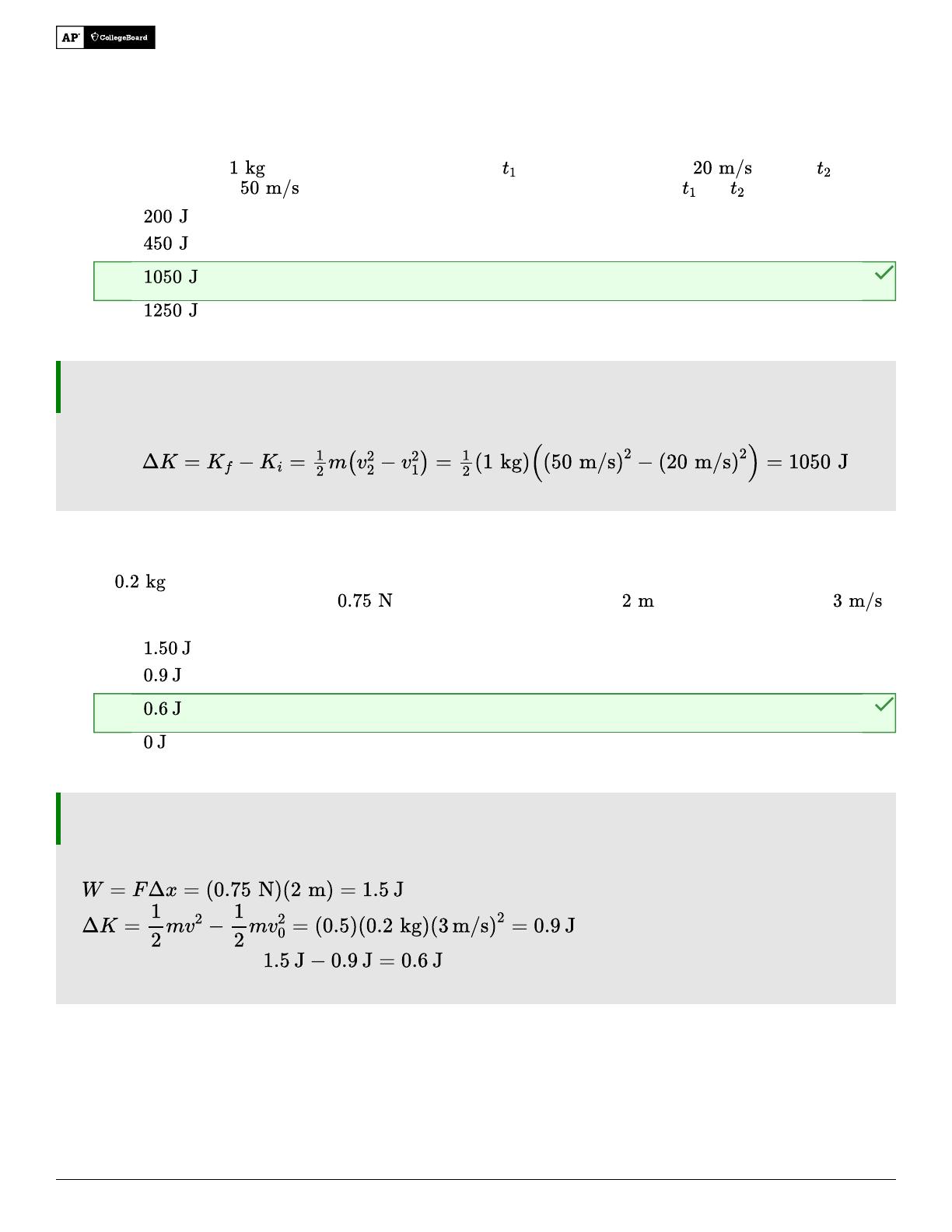
A hawk with mass dives straight downward. At time , the hawk has a speed of . At time , the
hawk has a speed of
. The change in the kinetic energy of the hawk between and is most nearly
(A)
(B)
(C)
(D)
Answer C
Correct. The change in kinetic energy is equal to the difference between the final and initial kinetic
energy.
2.
A block is initially at rest on a rough, horizontal tabletop. A student then pulls the block across the tabletop
with a constant horizontal force of
. After being pulled a distance of , the speed of the block is .
The amount of energy dissipated by friction between the block and the tabletop is most nearly
(A)
(B)
(C)
(D)
Answer C
Correct. The student does positive work on the block. The magnitude of the work done is
. The increase in the kinetic energy of the block is
. Therefore, friction dissipated an
amount of energy equal
.
AP PHYSICS 1 Scoring Guide
Unit 3 Progress Check: MCQ
AP Physics 1
Page 1 of 13
3.
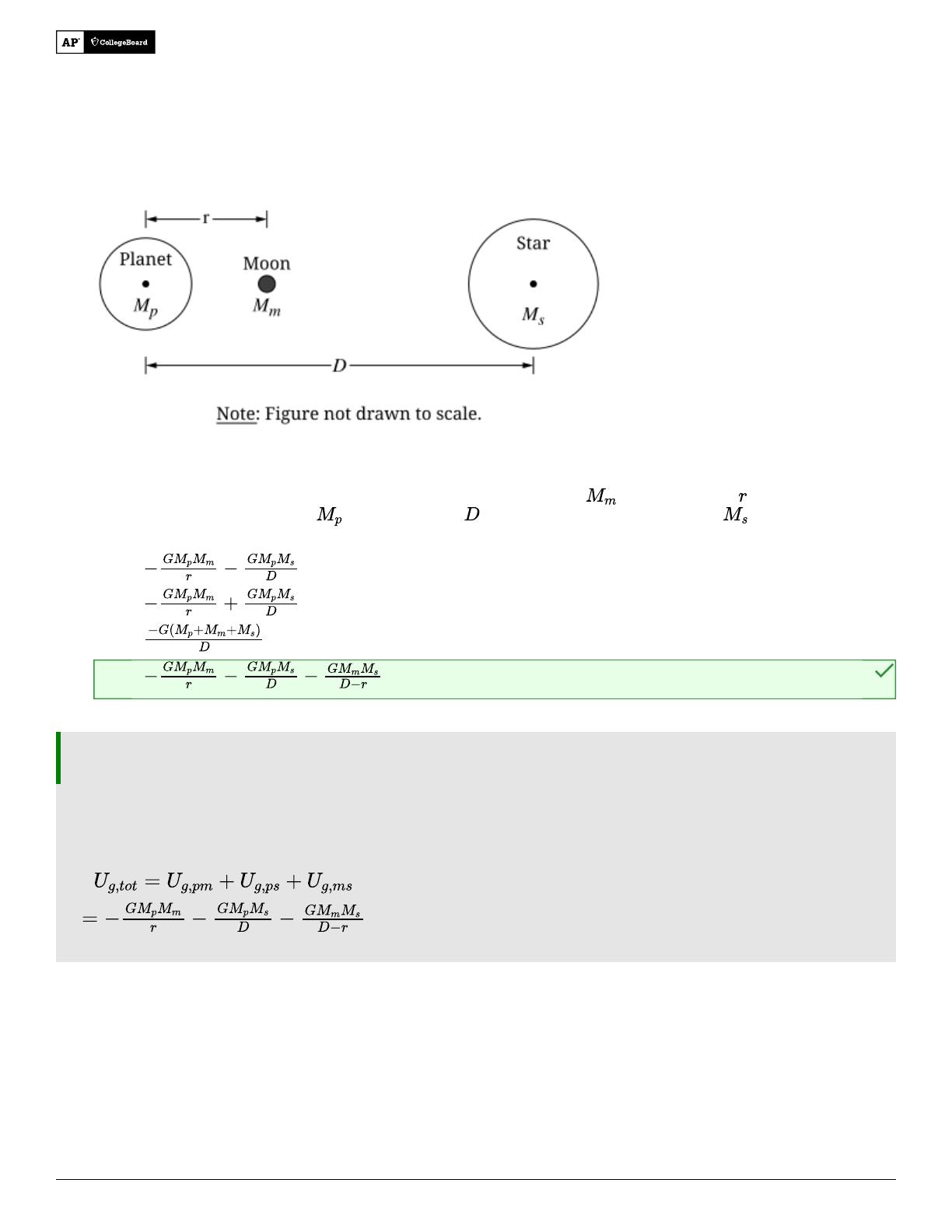
A planet, a moon, and a star are aligned as shown. The moon has mass and is a distance from the center of
the planet. The planet has mass and is a distance from the center of the star of mass . Which of the
following is a correct expression for the total gravitational potential energy of this three-body system?
(A)
(B)
(C)
(D)
Answer D
Correct. The total gravitational potential energy is the sum of the potential energy between each pair of
objects. The gravitational potential energy is proportional to the product of the masses of the two objects
and inversely proportional to the distance between the centers of the objects.
.
Scoring Guide
Unit 3 Progress Check: MCQ
Page 2 of 13
AP Physics 1
4.
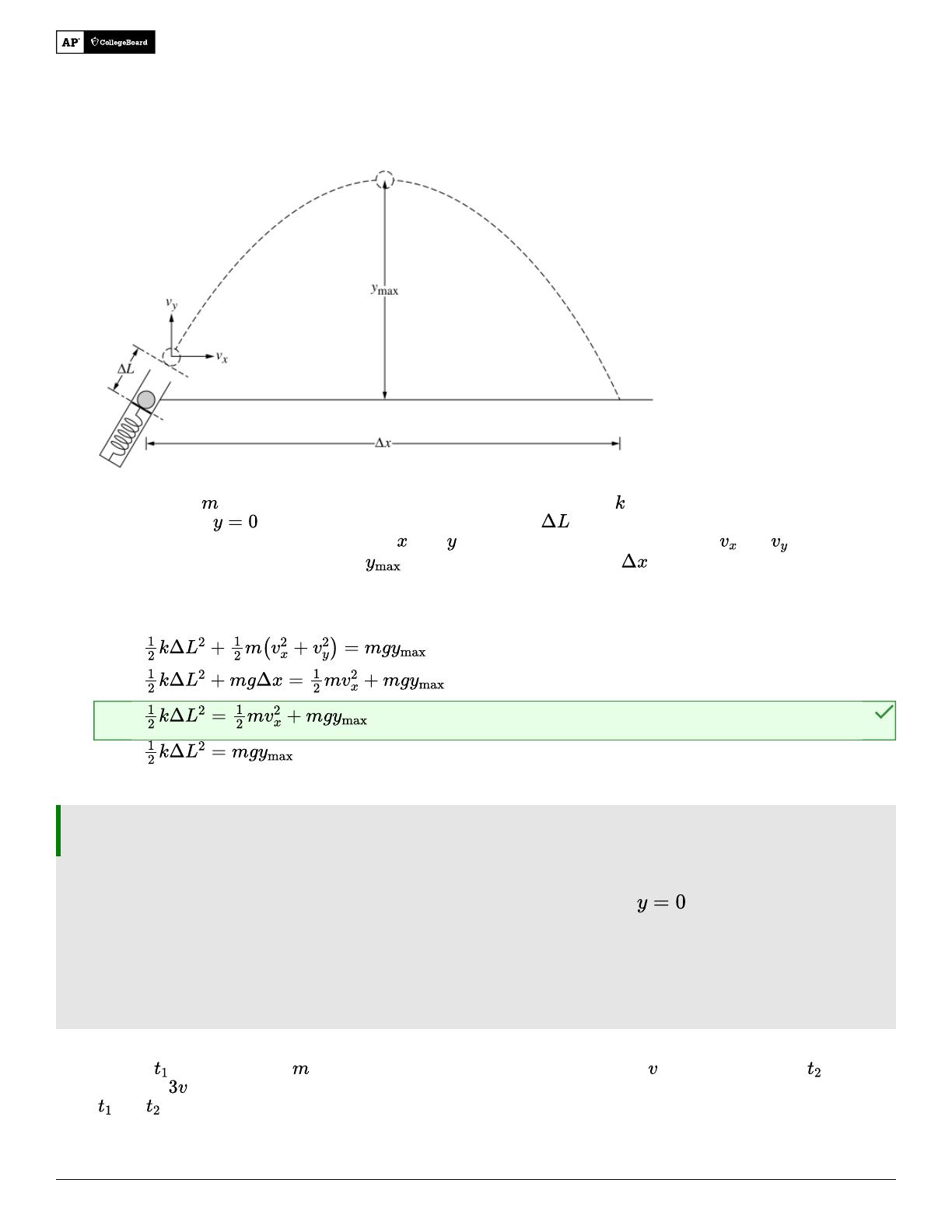
A ball of mass is loaded into a launcher with a spring of spring constant . The ball is pushed down until it is at a
vertical position , and the spring is compressed a distance , as shown. The ball is then released from rest.
Immediately after leaving the launcher, the
- and -components of the ball’s velocity are and , respectively.
The ball reaches a maximum height of
and lands a horizontal distance away from its initial position.
Energy losses due to friction are negligible. Which of the following is a correct conservation of energy equation that
compares the total mechanical energy of the ball-spring-Earth system immediately before the ball is launched to the
total mechanical energy of the ball-spring-Earth system the moment the ball reaches its maximum height?
(A)
(B)
(C)
(D)
Answer C
Correct. The left side of this equation represents the total mechanical energy of the ball-spring-Earth
system when the spring is compressed. The ball is at a vertical position of
, so the gravitational
potential energy is taken to be zero, and the ball is at rest so there is no kinetic energy. The right side of
the equation represents the mechanical energy of the ball-spring-Earth system when the ball at its highest
point, which includes the gravitational potential energy and the kinetic energy of the horizontal motion.
5.
At time
, a cart with mass being pushed on a straight, level track has speed . A short time later at , the cart
has speed . Which of the following expressions is equal to the average power delivered to the cart between time
and ?
Scoring Guide
Unit 3 Progress Check: MCQ
AP Physics 1
Page 3 of 13
/ 13
End of Document
332
You May Also Like

FAQs of AP Physics 1 Unit 3 MCQ Scoring Guide

What topics are covered in the AP Physics 1 Unit 3 MCQs?
The AP Physics 1 Unit 3 MCQs cover critical topics such as kinetic energy, gravitational potential energy, and the principles of conservation of energy. Students will encounter questions that test their understanding of how energy transforms and transfers in various physical systems. The guide also addresses the relationships between forces, motion, and energy, which are fundamental to mastering physics concepts. By reviewing these topics, students can solidify their knowledge and prepare effectively for the AP exam.
How does the scoring guide help students prepare for the AP exam?
The scoring guide aids students by providing correct answers along with detailed explanations for each question. This approach allows students to understand not only what the right answer is but also why it is correct, reinforcing their grasp of the material. By reviewing the rationales, students can identify areas where they may need further study or clarification. This comprehensive feedback is crucial for effective exam preparation, enabling students to approach the AP Physics exam with confidence.
What is the significance of understanding kinetic and potential energy in physics?
Understanding kinetic and potential energy is fundamental in physics as these concepts explain how energy is stored and transformed in physical systems. Kinetic energy relates to the motion of objects, while potential energy is associated with their position or configuration. Mastery of these concepts allows students to analyze real-world scenarios, such as roller coasters or pendulums, where energy conversion occurs. This knowledge is essential for solving problems in mechanics and is a core component of the AP Physics curriculum.
What types of questions can students expect in the Unit 3 MCQs?
Students can expect a variety of question types in the Unit 3 MCQs, including conceptual questions that assess understanding of energy principles, calculation-based questions requiring numerical problem-solving, and application questions that involve real-world scenarios. The questions are designed to challenge students' critical thinking and analytical skills, ensuring they can apply their knowledge in different contexts. This diversity in question types prepares students for the format and rigor of the AP Physics exam.
How can students use the scoring guide to improve their physics skills?
Students can use the scoring guide to improve their physics skills by systematically reviewing each question and its explanation. By identifying patterns in their mistakes and understanding the correct reasoning, students can target specific areas for improvement. Additionally, practicing with the MCQs enhances their test-taking strategies and time management skills, which are crucial for success on the AP exam. Regular review of the guide can lead to increased confidence and better performance in physics.

Related of AP Physics 1 Unit 3 MCQ Scoring Guide