AP Studio Art 3D Summer Assignment

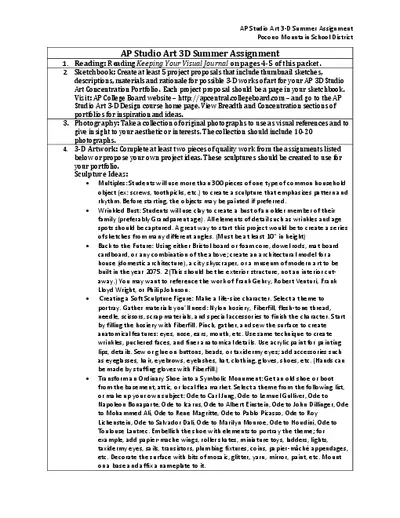
AP Studio Art 3D Summer Assignment

The AP Studio Art 3D Summer Assignment provides high school students with a comprehensive guide to developing their 3D art skills. This assignment includes project proposals, photography tasks, and detailed sculpture ideas aimed at enhancing creativity and technical abilities. Students are encouraged to explore various materials and techniques, such as creating soft sculptures, architectural models, and aesthetic objects from found items. The guide also emphasizes the importance of maintaining a visual journal to document artistic growth and self-discovery. Ideal for AP Studio Art students preparing for their portfolios, this assignment fosters both artistic expression and critical thinking.

Key Points

  • Includes project proposals for 3D artworks, emphasizing creativity and technical skills.
  • Features detailed sculpture ideas like creating a wrinkled bust and transforming ordinary objects.
  • Encourages students to maintain a visual journal for documenting artistic development.
  • Provides guidance on photography tasks to capture aesthetic interests and inspirations.
43
/ 5
AP Studio Art 3-D Summer Assignment
Pocono Mountain School District
AP Studio Art 3D Summer Assignment
1. Reading: Reading Keeping Your Visual Journal on pages 4-5 of this packet.
2. Sketchbook: Create at least 5 project proposals that include thumbnail sketches,
descriptions, materials and rationale for possible 3-D works of art for your AP 3D Studio
Art Concentration Portfolio. Each project proposal should be a page in your sketchbook.
Visit: AP College Board website http://apcentral.collegeboard.com and go to the AP
Studio Art 3-D Design course home page. View Breadth and Concentration sections of
portfolios for inspiration and ideas.
3. Photography: Take a collection of original photographs to use as visual references and to
give insight to your aesthetic or interests. The collection should include 10-20
photographs.
4. 3-D Artwork: Complete at least two pieces of quality work from the assignments listed
below or propose your own project ideas. These sculptures should be created to use for
your portfolio.
Sculpture Ideas:
Multiples: Students will use more than 300 pieces of one type of common household
object (ex: screws, toothpicks, etc.) to create a sculpture that emphasizes pattern and
rhythm. Before starting, the objects may be painted if preferred.
Wrinkled Bust: Students will use clay to create a bust of an older member of their
family (preferably Grandparent age). All elements of detail such as wrinkles and age
spots should be captured. A great way to start this project would be to create a series
of sketches from many different angles. (Must be at least 10” in height)
Back to the Future: Using either Bristol board or foam core, dowel rods, mat board
cardboard, or any combination of the above; create an architectural model for a
house (domestic architecture), a city skyscraper, or a museum of modern art to be
built in the year 2075. 2 (This should be the exterior structure, not an interior cut-
away.) You may want to reference the work of Frank Gehry, Robert Venturi, Frank
Lloyd Wright, or Philip Johnson.
Creating a Soft Sculpture Figure: Make a life-size character. Select a theme to
portray. Gather materials you’ll need: Nylon hosiery, Fiberfill, flesh-tone thread,
needle, scissors, scrap materials, and special accessories to finish the character. Start
by filling the hosiery with Fiberfill. Pinch, gather, and sew the surface to create
anatomical features: eyes, nose, ears, mouth, etc. Use same technique to create
wrinkles, puckered faces, and finer anatomical details. Use acrylic paint for painting
lips, details. Sew or glue on buttons, beads, or taxidermy eyes; add accessories such
as eyeglasses, hair, eyebrows, eyelashes, hat, clothing, gloves, shoes, etc. (Hands can
be made by stuffing gloves with Fiberfill.)
Transform an Ordinary Shoe into a Symbolic Monument: Get an old shoe or boot
from the basement, attic, or local flea market. Select a theme from the following list,
or make up your own subject: Ode to Carl Jung, Ode to Lemuel Gulliver, Ode to
Napoleon Bonaparte, Ode to Icarus, Ode to Albert Einstein, Ode to John Dillinger, Ode
to Mohammed Ali, Ode to Rene Magritte, Ode to Pablo Picasso, Ode to Roy
Lichenstein, Ode to Salvador Dali, Ode to Marilyn Monroe, Ode to Houdini, Ode to
Toulouse Lautrec. Embellish the shoe with elements to portray the theme; for
example, add papier-mache wings, roller skates, miniature toys, ladders, lights,
taxidermy eyes, sails, transistors, plumbing fixtures, coins, papier-mâché appendages,
etc. Decorate the surface with bits of mosaic, glitter, yarn, mirror, paint, etc. Mount
on a base and affix a nameplate to it.

AP Studio Art 3-D Summer Assignment
Pocono Mountain School District
Creating an Aesthetic Object from an Abandoned Derelict: Find an interesting object
from the garage, attic, flea market, auction, or second-hand store. Transform the
object by covering its entire surface with textural materials: mosaic, pebbles, glass,
mirrors, feathers, flocking, yarn, paper, sand, photos, rope, coins, marble or granite
chips, smaller objects, etc. Do this by using white glue: Spread glue on the surface,
then sprinkle fine-particled materials such as sand, marble dust, or sawdust on it.
(Use tile cement to attach heavier materials.)
Creating a Surreal Portrait: Get a Styrofoam wig head from a department store or
fashion a head from wadded up newspaper that has been taped to form the
approximate shape of a head. Transform it: Add cloth, leather, buttons, rope,
mechanical gadgets, bottle caps, wool, hat, paint, etc. 3
Natural Container Using only natural materials (twigs, grasses, pods, stones, leaves)
and twine or string, create a container for an object that has special meaning for you.
The container must be at least 10 inches in one of its dimensions.
Environmental Installation: Make a temporary environmental installation addressing
any of the following: time, viewpoint, pathways, celestial events, social issues.
Document in photographs and drawings. Look up Earthwork Artist Robert Smithson.
Altered Books: Students will acquire an old book from the library and make it into
something new. All parts of the book can be ripped, cut, folded or altered in any
other way in order to create a new story for the object.
5. Research: Choose an artist from the list below and research their work. Create an
informational spread of the artist in your sketchbook. Include notes on artist’s work, how
and why they created work, examples of their work- photos if accessible.
Magdalena Abakanowicz, Ana Mendieta, Robert Arneson, Joan Miro, Jean Arp,
Henry Moore, Louise Nevelson, Christian Boltanski, Isamu Noguchi, Claes
Oldenburg, Marcel Duchamp, Andy Goldsworthy, Richard Serra, Charles Simonds,
Ann Hamilton, Kiki Smith, Eva Hesse, Robert Smithson, Barbara Hepworth, James
Turrell, Rebecca Horn, Peter Voulkos, Jeff Koons, Fred Wilson, Maya Lin
AP Studio Art 3-D Summer Assignment
Pocono Mountain School District
Keeping Your Visual Journal
The use of personal journals full of writing and drawing has had powerful and far-reaching
effects. Apart from improving writing skills, journals also work to change your enduring
attitudes, values and sense of personal identity. Ideas, feelings and insights, kept in journals
offer us not only a clue to the richness of our imagination, but insight into our very being.
15 Reasons Why Artists Keep Visual Journals
1. Keeping a visual journal helps the artist develop a sense of selfdiscipline. By drawing in your
journal everyday you are developing the habit of creativity. The drawings can be ever so simple
and as time goes by you will have developed a repertoire and a visual source book. When the
time comes to design a long term drawing, a painting or sculpture you will have a wealth of
ideas available and you will have developed your skills so that drawing up your design is just a
matter of applying what you have learned.
2. The chronological nature of the journal means that you are automatically recording your
personal improvement. By recording trouble spots that need attention you are creating a path
for yourself to follow. Because the internet is such a rich source of instruction and example you
should put aside time to go online to find out what the solution to your artistic problems may
be. Once you have collected a variety of examples and ideas use them to work out a personal
solution by trying out all that you have seen. This process will nurture your artistic development
and help you develop a sense of direction.
3. A journal can become for you a ‘place’ where you can work out what themes are developing
on the journey. As issues, questions and ideas develop ‘go with them’ and let them give you
direction. Themes are good because they give you a dialogue and point of interest. This can be
a good starting point for discussions with other artists and fellow students.
4. It is always good when you are presenting your work to be able to fit it into a theme. Many
exhibitions are grouped in this way. The working out of a theme also gives the artist a sense of
completion when that thematic response has been followed to its logical conclusion.
5. Style is a process of evolution. When you begin keeping your journal you may not even know
what your preferred style is. As you develop on a daily basis a personal style will emerge.
Dialogue with that style. Ask yourself why you have gone in this direction? 5 AP 2-D Art and
Design Summer Assignments Pocono Mountain School District Does it make it easier? Can you
see patterns and relationships? Do you know what is influencing you? Write you’re self-
questioning down in your journal as you go it will make interesting reading in years to come.
/ 5
End of Document
43
You May Also Like

FAQs of AP Studio Art 3D Summer Assignment

What types of projects are included in the AP Studio Art 3D Summer Assignment?
The AP Studio Art 3D Summer Assignment includes a variety of projects such as creating a wrinkled bust from clay, designing an architectural model for a futuristic building, and transforming an ordinary shoe into a symbolic monument. Each project encourages students to explore different materials and artistic concepts, allowing for a diverse range of creative expression. Additionally, students can propose their own project ideas, fostering individuality in their artistic journey.
How does maintaining a visual journal benefit AP Studio Art students?
Maintaining a visual journal helps AP Studio Art students develop self-discipline and document their artistic growth over time. By regularly sketching and writing in their journals, students can track their progress, explore emerging themes, and experiment with new techniques in a safe space. This practice not only enhances creativity but also serves as a valuable resource for future projects, making it easier to generate ideas and refine their artistic style.
What is the significance of the photography task in the assignment?
The photography task in the AP Studio Art 3D Summer Assignment is significant as it encourages students to capture original images that reflect their aesthetic interests and inspirations. By taking 10-20 photographs, students can develop a visual reference library that informs their artistic decisions and enhances their portfolio. This task also helps students to observe the world around them more critically, fostering a deeper understanding of composition, light, and form in their artwork.
What are some examples of sculpture ideas provided in the assignment?
Examples of sculpture ideas in the AP Studio Art 3D Summer Assignment include creating a soft sculpture figure that embodies a chosen theme, and constructing an aesthetic object from a found item by covering it with various textural materials. Another idea is to create a sculpture using over 300 pieces of a common household object to emphasize pattern and rhythm. These projects are designed to challenge students' creativity and technical skills while allowing for personal expression.

Related of AP Studio Art 3D Summer Assignment