AP Studio Art: Summer Work and Contract Welcome to AP Art!

AP Studio Art: Summer Work and Contract Welcome to AP Art!

AP Studio Art provides a comprehensive summer work and contract guide for students enrolled in the course. It outlines the requirements for both the Drawing and 3D portfolios, emphasizing the importance of exploring various artistic concepts such as observation, contour, and abstraction. Students are encouraged to visit art museums for inspiration and to create sketches based on twelve specified concepts. Additionally, the guide includes instructions for writing an artist statement and developing sustained investigation ideas for the final portfolio. This resource is essential for AP Art students preparing for their portfolios and artistic growth.

Key Points

  • Outlines requirements for AP Drawing and 3D portfolios
  • Encourages museum visits for sketching and inspiration
  • Includes twelve artistic concepts for student sketches
  • Guides students in writing an artist statement
  • Suggests ideas for sustained investigation in final portfolios
416
/ 3
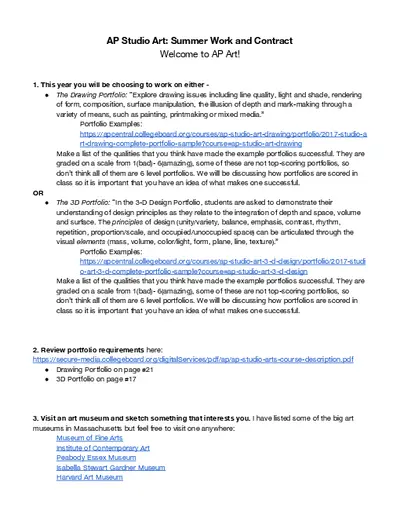
AP Studio Art: Summer Work and Contract
Welcome to AP Art!
1. This year you will be choosing to work on either -
The Drawing Portfolio:
“Explore drawing issues including line quality, light and shade, rendering
of form, composition, surface manipulation, the illusion of depth and mark-making through a
variety of means, such as painting, printmaking or mixed media.”
Portfolio Examples:
https://apcentral.collegeboard.org/courses/ap-studio-art-drawing/portfolio/2017-studio-a
rt-drawing-complete-portfolio-sample?course=ap-studio-art-drawing
Make a list of the qualities that you think have made the example portfolios successful. They are
graded on a scale from 1(bad)- 6(amazing), some of these are not top-scoring portfolios, so
don’t think all of them are 6 level portfolios. We will be discussing how portfolios are scored in
class so it is important that you have an idea of what makes one successful.
OR
The 3D Portfolio:
“In the 3-D Design Portfolio, students are asked to demonstrate their
understanding of design principles as they relate to the integration of depth and space, volume
and surface. The principles
of design (unity/variety, balance, emphasis, contrast, rhythm,
repetition, proportion/scale, and occupied/unoccupied space) can be articulated through the
visual elements
(mass, volume, color/light, form, plane, line, texture).”
Portfolio Examples:
https://apcentral.collegeboard.org/courses/ap-studio-art-3-d-design/portfolio/2017-studi
o-art-3-d-complete-portfolio-sample?course=ap-studio-art-3-d-design
Make a list of the qualities that you think have made the example portfolios successful. They are
graded on a scale from 1(bad)- 6(amazing), some of these are not top-scoring portfolios, so
don’t think all of them are 6 level portfolios. We will be discussing how portfolios are scored in
class so it is important that you have an idea of what makes one successful.
2. Review portfolio requirements here:
https://secure-media.collegeboard.org/digitalServices/pdf/ap/ap-studio-arts-course-description.pdf
Drawing Portfolio on page #21
3D Portfolio on page #17
3. Visit an art museum and sketch something that interests you. I have listed some of the big art
museums in Massachusetts but feel free to visit one anywhere:
Museum of Fine Arts
Institute of Contemporary Art
Peabody Essex Museum
Isabella Stewart Gardner Museum
Harvard Art Museum

Mass MoCA
deCordova
4. Do one sketch based on each the following 12 concepts. These will become the basis for your
Breadth section of your final portfolio, so put some time and thought into what you could turn into a
completed artwork. I have included links to relevant sites and articles for each concept:
Observation (http://ivantirado.com/observation-and-perception/)
Contour (https://www.thoughtco.com/what-is-contour-line-in-drawing-1123046)
Value (https://www.thoughtco.com/what-is-value-in-art-182474)
Abstraction (https://www.artistsnetwork.com/art-inspiration/what-is-abstract-art/)
Rhythm/movement (https://www.thoughtco.com/rhythm-definition-in-art-182460)
Balance (https://www.shutterstock.com/blog/4-types-of-balance-in-art-and-why-you-need-them)
Unity (https://www.widewalls.ch/unity-in-art/)
Form (https://www.thoughtco.com/definition-of-form-in-art-182437)
Clarity (https://signalvnoise.com/posts/210-simplicity-clarity-being-understood-mark-rothko-etc)
Envision (https://www.vocabulary.com/dictionary/envision)
Investigate (https://consiliumeducation.com/itm/2016/10/26/visual-investigations-across-the-curriculum/)
Challenge (http://creativethinking.net/the-art-of-framing-challenges-creatively/#sthash.hC8lLrZl.dpbs)
5. Write an Artist Statement – this should be a paragraph that sums up who you are and why you
make art.
This is mine; “Everything I create stems from a passion for art in all its forms and a deep-seated belief in
the positive impact of conscientious design. I work and make art wholeheartedly and thoroughly enjoy
trying something new. I thrive on the challenge of bringing an idea to life using whatever media best
supports that concept. It is the liberation of learning how to successfully manipulate a new material that
excites me and keeps me moving forward. Having seen how art can enlighten and empower people, I
am a self-proclaimed optimist.”
There are a wide range of approaches when writing an Artist Statement, so I suggest you do
some Google searching to read through others.
https://theabundantartist.com/how-to-write-an-artists-statement-that-doesnt-suck/
https://www.artspace.com/magazine/interviews_features/art-bytes/dont-say-deleuze-ho
w-to-write-a-good-artist-statement-54662
http://www.artbusiness.com/artstate.html
6. Come up with 3 Sustained Investigation (Area of Concentration) ideas/concepts that you are
considering focusing on. You will need to be able to investigate a central idea over the course of
12-16 artworks that show growth or progression. You will also need a list of what those 12-16 pieces
would be within each of your 3 ideas.
I have read and understand the commitment of taking AP Studio Art:
Student Signature
Parent/Guardian Signature:
Date:
/ 3
End of Document
416
You May Also Like

FAQs of AP Studio Art: Summer Work and Contract Welcome to AP Art!

What are the key components of the AP Studio Art portfolio?
The AP Studio Art portfolio consists of two main sections: the Drawing Portfolio and the 3D Design Portfolio. Each portfolio requires students to demonstrate their understanding of artistic principles through a variety of works. The Drawing Portfolio focuses on issues such as line quality, light and shade, and composition, while the 3D Design Portfolio emphasizes depth, space, and volume. Students must create a breadth section with sketches based on twelve specified concepts, showcasing their artistic range and growth.
How can students develop their artist statement for AP Studio Art?
An artist statement for AP Studio Art should reflect the student's personal artistic philosophy and motivations. It should summarize their passion for art, the media they enjoy working with, and the concepts they wish to explore. Students are encouraged to articulate how their experiences and challenges in creating art have shaped their approach. The statement serves as a way to connect their portfolio pieces with their overall artistic journey, making it a crucial element of their presentation.
What are the twelve concepts students must sketch for their portfolio?
Students are required to create sketches based on twelve artistic concepts, including observation, contour, value, abstraction, rhythm/movement, balance, unity, form, clarity, envision, investigate, and challenge. Each concept encourages students to explore different aspects of art and develop their skills in various techniques. These sketches will form the basis of the breadth section of their final portfolio, allowing them to demonstrate their understanding and application of these fundamental ideas.
What is the purpose of visiting art museums for AP Studio Art students?
Visiting art museums serves multiple purposes for AP Studio Art students. It provides an opportunity to observe and analyze a wide range of artistic styles and techniques firsthand. Students can find inspiration for their own work by sketching pieces that resonate with them. Engaging with art in a museum setting also helps students develop critical thinking skills as they reflect on the context and meaning behind various artworks, which can inform their own artistic practice.

Related of AP Studio Art: Summer Work and Contract Welcome to AP Art!