Basic Principle Of Chemistry Overview

Basic Principle Of Chemistry Overview

Basic Principles of Chemistry provides an in-depth exploration of essential chemistry concepts, including organic and inorganic chemistry, physical chemistry, and analytical methods. The content is tailored for students and educators seeking a comprehensive understanding of chemical principles, measurements, and significant figures. Key topics include the laws of chemical combination, atomic theory, and the mole concept. This resource is ideal for high school and college-level chemistry courses, offering valuable insights for exam preparation and practical applications in the field of chemistry.

Key Points

  • Explains the branches of chemistry, including organic, inorganic, and physical chemistry.
  • Covers essential concepts such as atomic theory, the mole concept, and significant figures.
  • Details the laws of chemical combination, including conservation of mass and definite proportions.
  • Includes practical applications of chemistry in industrial and analytical contexts.
83
/ 31
BASIC PRINCIPLES OF CHEMISTRY
Page1
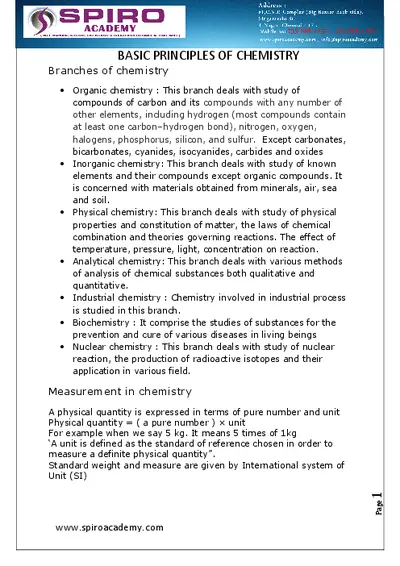
Branches of chemistry
Organic chemistry : This branch deals with study of
compounds of carbon and its compounds with any number of
other elements, including hydrogen (most compounds contain
at least one carbonhydrogen bond), nitrogen, oxygen,
halogens, phosphorus, silicon, and sulfur. Except carbonates,
bicarbonates, cyanides, isocyanides, carbides and oxides
Inorganic chemistry: This branch deals with study of known
elements and their compounds except organic compounds. It
is concerned with materials obtained from minerals, air, sea
and soil.
Physical chemistry: This branch deals with study of physical
properties and constitution of matter, the laws of chemical
combination and theories governing reactions. The effect of
temperature, pressure, light, concentration on reaction.
Analytical chemistry: This branch deals with various methods
of analysis of chemical substances both qualitative and
quantitative.
Industrial chemistry : Chemistry involved in industrial process
is studied in this branch.
Biochemistry : It comprise the studies of substances for the
prevention and cure of various diseases in living beings
Nuclear chemistry : This branch deals with study of nuclear
reaction, the production of radioactive isotopes and their
application in various field.
Measurement in chemistry
A physical quantity is expressed in terms of pure number and unit
Physical quantity = ( a pure number ) × unit
For example when we say 5 kg. It means 5 times of 1kg
‘A unit is defined as the standard of reference chosen in order to
measure a definite physical quantity”.
Standard weight and measure are given by International system of
Unit (SI)
www.spiroacademy.com
BASIC PRINCIPLES OF CHEMISTRY
Page2
Basic physical
quantity
Symbol of
quantity
Name of SI unit
Symbol of SI
unit
Length
l
metre
m
Mass
m
kilogram
kg
Time
t
second
s
Electric current
I
ampere
A
Thermodynamic
temperature
T
kelvin
K
Amount of
substance
n
mole
mol
Luminous
Intensity
I
v
candela
Cd
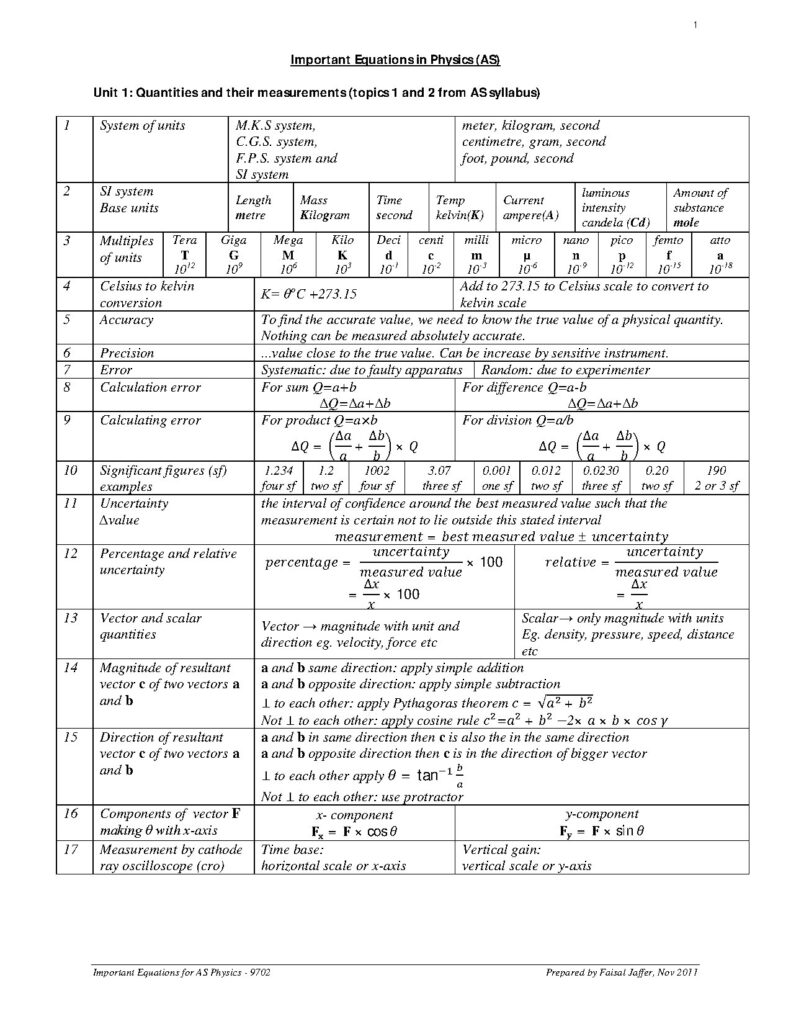
Some time Sub-multiple and Multiples are used to reduce and
enlarge the size of different units
Sub multiples
Multiples
Symbol
Prefix
Symbol
d
deca
da
c
hecto
h
m
kilo
k
μ
mega
M
n
giga
G
p
tera
T
f
peta
P
a
exa
E
Following convention is followed in writing a unit or its symbol
1. The symbols of the units are never expressed in plural form.
For example, we write 15 cm and not 15 cms.
2. If a unit is named after the name of a person, it is not written
with capital letter. For example, we write newton and not
Newton
3. The symbol of the unit named after the name of a person is
expressed in capital letter. For example, the symbol for unit
newton is N and not n. Symbols of the other units are not
written in capital letters. For example, symbol for unit meter is
m and not M
4. Not more than one solidus is used. For example 1 poise is
expressed as
www.spiroacademy.com
BASIC PRINCIPLES OF CHEMISTRY
Page3
1g/s cm or 1 g s
-1
cm
-1
and not 1g/s/cm.
Some derived units
a) Area = length × breadth
= m × m = m
2
b) Volume = length × breadth × height
= m × m× m =m
3
c) Density = mass/ volume
= kg/ m
3
= kg m
3
d) Speed = distance / time
= m/s = m s
-1
e) Acceleration = change in velocity / time
= m s
-1
/s = m s
-2
f) Force = mass × acceleration
= kg m s
-2
g) Pressure = force per unit area
= kg m s
-2
/ m
2
= kg m
-1
s
-2
or N m
-2
( pascal Pa)
h) Energy = force × distance travelled
= kg m s
-2
× m
= kg m
2
s
-2
( joule J)
Some conversions
a) Temperature
Degree Centigrade = Kelvin 273.15
o
C = K -273.15
󰇛
󰇜

b) Volume
1 litre (lit or L) = 1000 cm
3
1 L = (10 cm)
3
1 L = (10 ×10
-2
m)
3
1 L = 10
3
× 10
-6
m
3
1 L = 10
-3
m
3
OR 1m
3
= 1000 L
Also
www.spiroacademy.com
/ 31
End of Document
83
You May Also Like

FAQs of Basic Principle Of Chemistry Overview

What are the main branches of chemistry covered?
The document outlines several branches of chemistry, including organic chemistry, which focuses on carbon compounds; inorganic chemistry, which deals with non-organic substances; physical chemistry, which examines the physical properties of matter; and analytical chemistry, which involves the analysis of chemical substances. Each branch is described in terms of its scope and significance in the study of chemistry.
What is the significance of the mole concept in chemistry?
The mole concept is fundamental in chemistry as it provides a bridge between the atomic scale and macroscopic measurements. It defines a mole as 6.022 x 10^23 particles, allowing chemists to quantify substances in reactions. Understanding the mole concept is crucial for stoichiometry, which involves calculating the amounts of reactants and products in chemical reactions.
How does the document explain significant figures?
Significant figures are crucial for indicating the precision of measurements in chemistry. The document outlines rules for counting significant figures, such as considering all non-zero digits as significant and recognizing that leading zeros are not significant. It also discusses how to round numbers based on the significance of digits, which is essential for accurate reporting of experimental data.
What laws of chemical combination are discussed?
The document discusses several key laws of chemical combination, including the law of conservation of mass, which states that mass is neither created nor destroyed in a chemical reaction. It also covers the law of definite proportions, which asserts that a chemical compound always contains the same elements in fixed proportions by mass, and the law of multiple proportions, which describes how elements can combine in different ratios to form various compounds.

Related of Basic Principle Of Chemistry Overview