CH142 S26 Exam 3 Sample Key

CH142 S26 Exam 3 Sample Key

CH142 S26 Exam 3 Sample Key provides detailed solutions and explanations for various chemistry problems relevant to the course. This key covers topics such as coordination complexes, solubility, titration, and buffer capacity, which are essential for students preparing for exams in introductory chemistry. It includes calculations related to Ksp values and the behavior of acids and bases, making it a valuable resource for students seeking to enhance their understanding of chemical principles. Ideal for CH142 students looking to review key concepts and practice problem-solving skills.

Key Points

  • Includes solutions for coordination complex problems and their properties.
  • Covers solubility calculations for compounds like CaF2 in different conditions.
  • Explains the titration process for weak acids and bases, including pH changes.
  • Discusses buffer capacity and its implications for biochemical applications.
40
/ 6
page 9
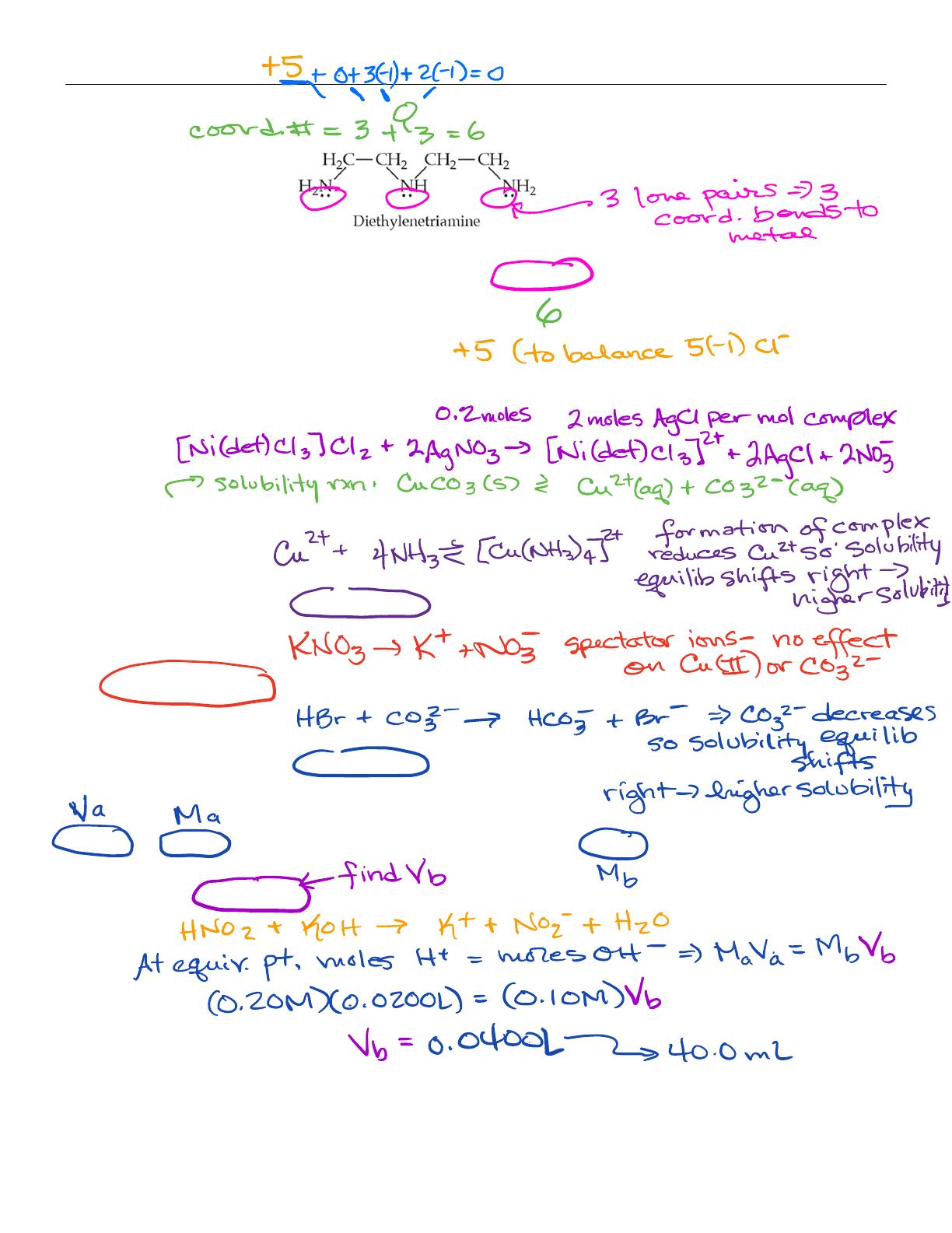
A nickel complex has the formula [Ni(det)Cl
3
]Cl
2
, where det = diethylenetriamine (shown below):
(a) “det” is likely to be a [monodentate / bidentate / tridentate / hexadentate] ligand. (circle one)
(b) What is the coordination number of the complex? _________________
(c) What is the oxidation state of the metal? ______________
(d) If a solution containing 0.1 moles of this complex is mixed with excess AgNO
3
, approximately how
many moles of AgCl will precipitate? _____________
_______________________________________________________________________________________
What happens to the molar solubility of a solution of copper(II) carbonate when each of the following is
added? (circle one for each)
(a) Ammonia?
Little to no change / it will increase / it will decrease / need more information
(b) Potassium nitrate?
Little to no change / it will increase / it will decrease / need more information
(c) Hydrobromic acid?
Little to no change / it will increase / it will decrease / need more information
_______________________________________________________________________________________
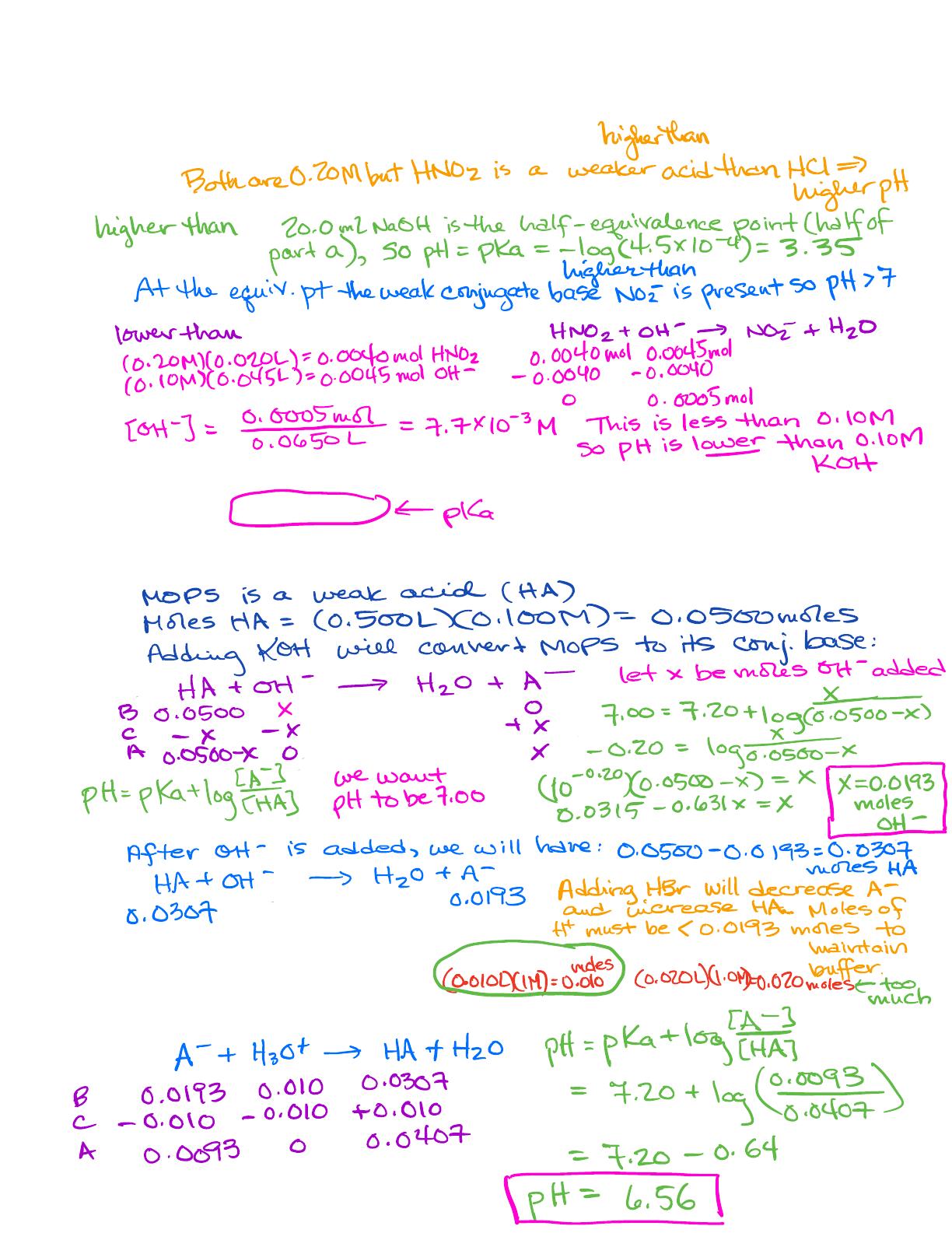
20.0 mL of a 0.20 M solution of nitrous acid (HNO
2
) is titrated with 0.10 M potassium hydroxide titrant. The
K
a
of nitrous acid is 4.5 x 10
–4
.
(a) How many mL of KOH solution must be added to reach the equivalence point?
__________________
(continued on the next page)
page 10
In each of the blanks below, enter ‘higher than’, ‘lower than’, or ‘equal to’:
(b) The pH of the nitrous acid solution before any KOH is added is ____________ the pH of a 0.20 M
solution of HCl.
(c) The pH of the nitrous acid solution after 20.0 mL of the KOH solution has been added is
____________ 3.3.
(d) The pH of the titration mixture at the equivalence point is ______________ 7.0.
(e) The pH of the nitrous acid solution after 45.0 mL of the KOH solution has been added is
_____________ the pH of a 0.10 M solution of KOH.
_______________________________________________________________________________________
The molecule 3-(N-morpholino)propanesulfonic acid (MOPS) is commonly used for buffer solutions in
biochemistry given its pK
a
value of 7.20.
(a) If you had 500. mL of a 0.100 M solution of MOPS, how many moles of KOH would you need to
add to achieve a final pH of 7.00? (you may assume constant volume)
(b) For the buffer from part (a), what is the maximum buffer capacity for 1.0 M HBr? (circle answer)
10 mL 20 mL 30 mL
(c) What would be the final pH if the quantity of 1.0 M HBr you selected in part (b) is added to the
buffer from part (a)?
page 11
_______________________________________________________________________________________
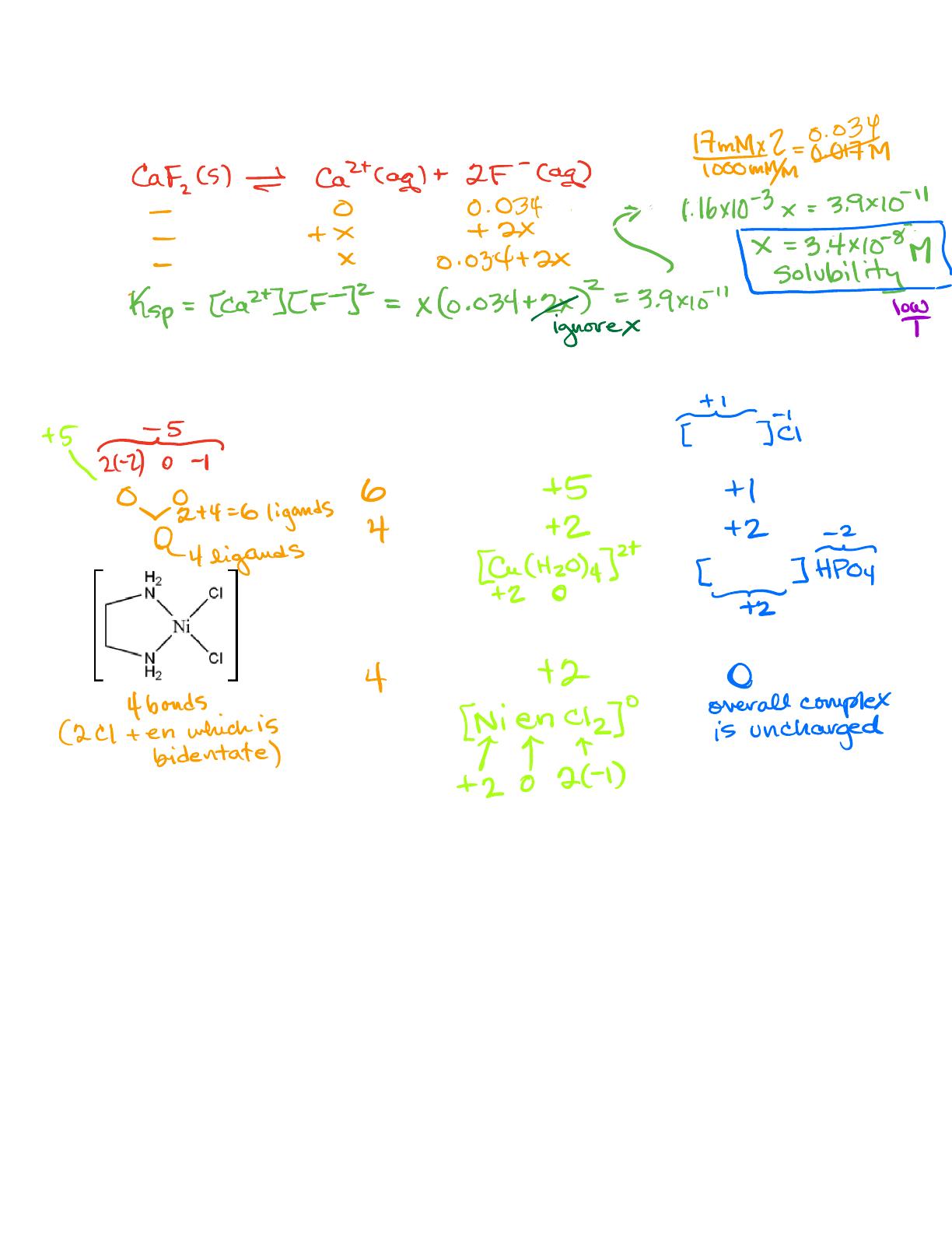
What is the solubility of CaF
2
(K
sp
= 3.9 x 10
11
) in 17 mM magnesium fluoride?
_______________________________________________________________________________________
_______________________________________________________________________________________
Give the coordination number, oxidation state for the transition metal, and overall charge for each of the
following coordination complexes.
Coordination Number Oxidation State Complex Charge
_____ _____ _____ a) [CrO
2
(NH
3
)
4
]Cl
b) [Cu(H
2
O)
4
]HPO
4
_____ _____ _____
c)
_____ _____ _____
_______________________________________________________________________________________
What is the solubility of CaF
2
(K
sp
= 3.9 x 10
11
) in 17 mM magnesium fluoride?
/ 6
End of Document
40
You May Also Like

FAQs of CH142 S26 Exam 3 Sample Key

What types of problems are included in the CH142 S26 Exam 3 Sample Key?
The CH142 S26 Exam 3 Sample Key includes a variety of chemistry problems related to coordination complexes, solubility, titration, and buffer capacity. Each problem is accompanied by detailed solutions that illustrate the step-by-step approach to solving complex chemistry questions. This resource is particularly useful for students preparing for exams, as it reinforces key concepts and provides practice with real exam-style questions.
How does the sample key address coordination complexes?
The sample key provides insights into the properties of coordination complexes, including their coordination numbers, oxidation states, and overall charges. It explains how ligands interact with metal ions and the significance of these interactions in determining the stability and reactivity of the complexes. Students can learn to identify different types of ligands and their effects on the metal's electronic configuration.
What is the significance of Ksp in the context of solubility?
Ksp, or the solubility product constant, is crucial for understanding the solubility of ionic compounds in solution. The sample key discusses how to calculate the solubility of compounds like CaF2 using their Ksp values. It emphasizes the relationship between the solubility of a compound and the concentrations of its ions in a saturated solution, which is essential for predicting precipitation reactions.
What titration concepts are covered in the sample key?
The sample key covers titration concepts, specifically the titration of weak acids with strong bases. It explains how to determine the equivalence point and the resulting pH changes during the titration process. Students will learn to calculate the volume of titrant needed to reach the equivalence point and understand the implications for buffer solutions.
How does the key explain buffer capacity?
Buffer capacity is a measure of a buffer solution's ability to resist changes in pH upon the addition of acids or bases. The sample key discusses the factors that influence buffer capacity, including the concentrations of the weak acid and its conjugate base. It provides examples of how to calculate the maximum buffer capacity and the expected pH changes when strong acids are added to buffer solutions.

Related of CH142 S26 Exam 3 Sample Key