Charging Objects Permanently by Induction
An object can be permanently charged by induction by grounding the
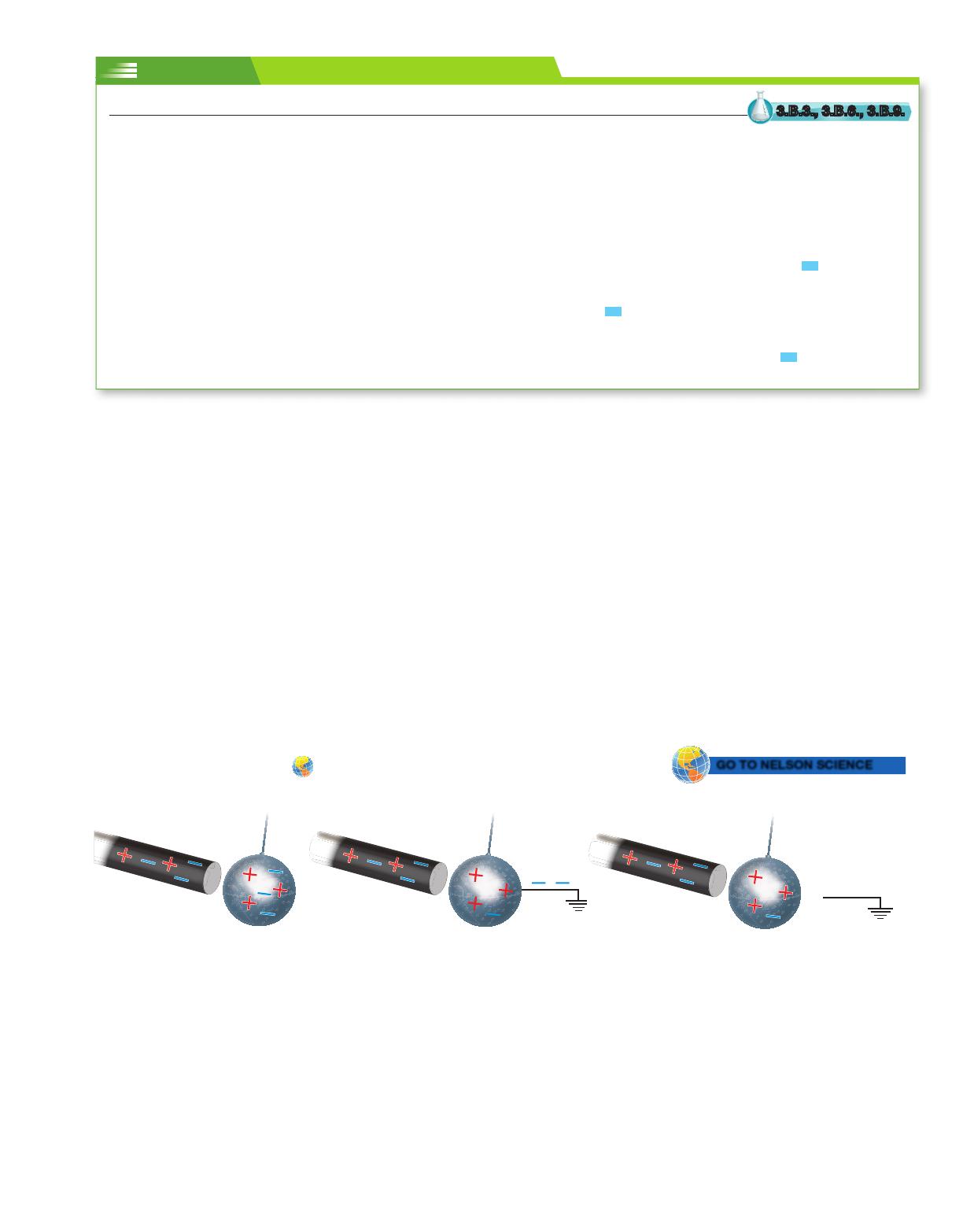
object. For example, consider a negatively charged ebonite rod and a neutral
pith ball. When the rod is brought near but not touching the pith ball, the
electrons in the pith ball are repelled by the electrons in the rod. As a result,
the side of the pith ball closest to the rod becomes temporarily positively
charged, while the side farthest from the rod becomes temporarily negatively
charged (Figure 3(a)). If you then ground the negatively charged side with
your hand, some of the electrons travel from the pith ball into your hand,
and the pith ball is left with a positive charge. You could also remove the
electrons by connecting a conducting wire to the ground (Figure 3(b)).
When the conducting wire is disconnected from the pith ball, the pith ball
is left with a permanent positive charge (Figure 3(c)). For the charge to
be permanent, the ground must be disconnected or removed before the
charged object is removed.
Charging by induction always results in two objects with opposite
charges. Th e object that induces the charge keeps its original charge, while
the object whose charge was induced receives the opposite charge.
To learn more about charging by
induction,
GO TO NELSON SCIENCE
FN C11-F22a-UDOS9SB
Creative Freelancers
Sam Laterza
Second Pass
CO
Pass
Approved
Not Approved
Ontario Science 9 SB
0-17-635529-7
FN C11-F22b-UDOS9SB
Creative Freelancers
Sam Laterza
Second Pass
CO
Pass
Approved
Not Approved
Ontario Science 9 SB
0-17-635529-7
FN C11-F22c -UDOS9SB
Creative Freelancers
Sam Laterza
Second Pass
CO
Pass
Approved
Not Approved
Ontario Science 9 SB
0-17-635519-7
(a) (b) (c)
Figure 3 (a) When a negatively charged ebonite rod is brought near a neutral pith ball, the
electrons in the pith ball are repelled and it becomes temporarily negatively charged on its right
side. (b) Attaching a ground wire to the pith ball conducts the repelled electrons on the right side
into the ground. (c) After removing the ground wire, the pith ball remains permanently positively
charged.
SKILLS: Predicting, Observing, Communicating
You have read about charge interactions between solid objects.
In this activity, you will observe charge interactions between a
solid and a liquid.
Equipment and Materials: faucet; balloon
1. Blow up the balloon.
2. Run a gentle stream of water from a faucet. Place the balloon
beside, but not touching, the stream of water. Record your
observations in a diagram.
3. Rub the balloon against your hair to charge it.
4. Predict what you think will happen when you bring the charged
balloon near, but not touching, the stream of water. Test your
predictions and use a diagram to record your observations.
5. Try moving the charged balloon to the other side of the
stream of water. Does the same thing happen?
A. Does your observation from step 2 prove that both the
balloon and the water are neutral? Explain.
T/I
B. Use your knowledge of electrons to explain your observations
in step 4.
T/I
C. Predict whether it is possible to bend water away from a
charged object. Explain your reasoning.
T/I
TTRY THIS
BENDING WATER
SKILLS HANDBOOK
3.B.3., 3.B.6., 3.B.9.
11.6 Charging by Induction 487
NEL
6646_Sci9_ch11_pp478-501.indd 487 8/3/09 2:20:47 PM




