Course Map/Pacing Guide AP ART

Course Map/Pacing Guide AP ART

The AP Art and Design Course Map outlines a structured pacing guide for students preparing their portfolios for the AP exam. It includes essential units such as Introduction to Portfolio Prep, Inquiry and Investigation, and Art History and Culture. This guide emphasizes hands-on participation and critical thinking, enabling students to explore the creative process and critique methodologies. Designed for high school students, it provides a comprehensive framework for developing artistic skills and understanding the role of visual arts in culture. The pacing guide spans 36 weeks, ensuring thorough preparation for the AP Art and Design exam.

Key Points

  • Covers five key units including Portfolio Prep and Art History over 36 weeks.
  • Emphasizes inquiry-based learning and artistic experimentation.
  • Includes essential questions guiding students' artistic investigations.
  • Focuses on critique methodologies to enhance students' analytical skills.
304
/ 4
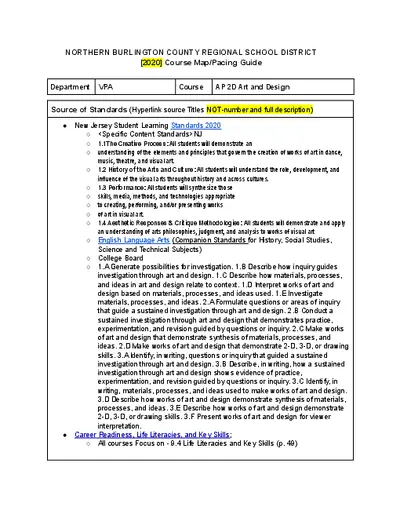
NORTHERN BURLINGTON COUNTY REGIONAL SCHOOL DISTRICT
[2020] Course Map/Pacing Guide
Department
VPA
Course
AP 2D Art and Design
Source of Standards (Hyperlink source Titles NOT-number and full description)
New Jersey Student Learning Standards 2020
<Specific Content Standards>NJ
1.1The Creative Process: All students will demonstrate an
understanding of the elements and principles that govern the creation of works of art in dance,
music, theatre, and visual art.
1.2 History of the Arts and Culture: All students will understand the role, development, and
influence of the visual arts throughout history and across cultures.
1.3 Performance: All students will synthesize those
skills, media, methods, and technologies appropriate
to creating, performing, and/or presenting works
of art in visual art.
1.4 Aesthetic Responses & Critique Methodologies: All students will demonstrate and apply
an understanding of arts philosophies, judgment, and analysis to works of visual art
English Language Arts (Companion Standards for History, Social Studies,
Science and Technical Subjects)
College Board
1.A Generate possibilities for investigation. 1.B Describe how inquiry guides
investigation through art and design. 1.C Describe how materials, processes,
and ideas in art and design relate to context. 1.D Interpret works of art and
design based on materials, processes, and ideas used. 1.E Investigate
materials, processes, and ideas. 2.A Formulate questions or areas of inquiry
that guide a sustained investigation through art and design. 2.B Conduct a
sustained investigation through art and design that demonstrates practice,
experimentation, and revision guided by questions or inquiry. 2.C Make works
of art and design that demonstrate synthesis of materials, processes, and
ideas. 2.D Make works of art and design that demonstrate 2-D, 3-D, or drawing
skills. 3.A Identify, in writing, questions or inquiry that guided a sustained
investigation through art and design. 3.B Describe, in writing, how a sustained
investigation through art and design shows evidence of practice,
experimentation, and revision guided by questions or inquiry. 3.C Identify, in
writing, materials, processes, and ideas used to make works of art and design.
3.D Describe how works of art and design demonstrate synthesis of materials,
processes, and ideas. 3.E Describe how works of art and design demonstrate
2-D, 3-D, or drawing skills. 3.F Present works of art and design for viewer
interpretation.
Career Readiness, Life Literacies, and Key Skills;
All courses Focus on - 9.4 Life Literacies and Key Skills (p. 49)

Sequence- Unit Titles and Number of weeks per unit (total = 18 semester/ 36 year)
Unit 1: Introduction to AP Art and Design Portfolio Prep, 4 weeks
Unit 2: Inquiry and Investigation, 8 weeks
Unit 3: Making Art through Practice, Experimentation and Revision, 12 weeks
Unit 4: Critique, 4 weeks
Unit 5: Art History and Culture, 5 weeks
Reflection: End of the year art show exhibition, 3 weeks
Enduring Understanding (link to guide)
1. Art is a form of visual communication expressing the thoughts of the artist, their
reaction to their life experiences or in reaction to events within their world or
imagination
2. Active/hands on participation in the arts lead to a comprehensive understanding of
the imaginative and creative process.
3. Learning about the elements and principles enables the student to make
comparisons about how the elements and principles may be similarly employed by
the performing arts.
4. The critical process of observing, describing, analyzing, interpreting and evaluating
leads to informed judgments regarding the relative merits of artworks
5. The relationship of the arts and culture is mutually dependent; culture affects the
arts and the arts reflect and preserve culture.
Essential Questions (link to guide)
1. What informs why and how artists and designers make art?
2. How can I create a portfolio for college?
3. What are colleges looking for in a portfolio?
4. What should I submit in my Quality portfolio section?
5. How can I incorporate the elements and principles of design in every piece of art
that I accomplish?
6. How do artists determine what resources and criteria are needed to formulate
artistic investigations?
7. What informs why, how, and what artists and designers make?
8. How do artists and designers create works of art or design that effectively
communicate their message?
9.What role does persistence play in revising, refining, and developing work?
10. How can an artist manipulate elements and principles to convey meaning in art?
11. How can I produce a range of conceptual approaches to 2-D Design?
12. How does critiquing the work of other artists influence the way we make our own
art?
13. How do we critique in a way that is both positive and respectful?
14. Does art define culture or does culture define art?
15. How can art history be an inspiration to a new idea?
16. How can art empower an artist, a community or a nation?
Reporting Student Progress (link to pyramid)
All courses follow a balanced assessment system with Practice, Assessments, Evaluations.
Each category includes formative, summative and alternative assessments.
Summative:
Writing assignments: Essays, reflections, reactions, criticisms, critiques, assessments,
summarizations, reviews, and analysis.
Portfolio Evaluation grade
Portfolio presentation and review by teacher and class
Projects/ Assignments
Artwork analysis either written or oral
Sketchbook assessment grade at the end of each quarter
Participation in formal class critiques at the end of each project
Process critiques periodically throughout the project’s progression
Teacher created AP rubric for project assessments
Teacher/student individual/group critiques
A.P. Art Exhibition Display
Formative:
Periodic performance based tasks including daily sketches and warm up exercises
Artist and techniques review activity designed to assess student knowledge of unit being
studied
Periodic assessments that include sketchbook assessments on a particular element or
principle of design
Peer assessment critiques, self critiques, teacher critique, sketches, and class discussions.
Homework assignments throughout the year
Short answer responses to a particular artist or movement pertaining to the subject or unit
being taught
Analysis of student results to guide instructional planning and delivery
Writing assignments and essays
Self-assessment worksheets
Critiques and assessments periodically throughout the unit to refocus and strengthen project
objectives.
/ 4
End of Document
304
You May Also Like

FAQs of Course Map/Pacing Guide AP ART

What are the main units covered in the AP Art and Design Course Map?
The AP Art and Design Course Map includes five main units: Introduction to AP Art and Design Portfolio Prep, Inquiry and Investigation, Making Art through Practice, Experimentation and Revision, Critique, and Art History and Culture. Each unit is designed to build on the previous one, allowing students to develop their artistic skills progressively. The course spans 36 weeks, ensuring that students have ample time to explore each topic in depth.
How does the AP Art and Design guide support student portfolio development?
The guide provides a structured approach to portfolio development, emphasizing the importance of inquiry and investigation in art-making. Students are encouraged to generate questions that guide their artistic process and to document their practice, experimentation, and revisions. This reflective practice is crucial for creating a cohesive portfolio that meets AP standards and showcases their artistic growth.
What role does critique play in the AP Art and Design curriculum?
Critique is a fundamental component of the AP Art and Design curriculum, allowing students to engage in constructive feedback sessions. Through formal class critiques and process critiques, students learn to analyze and evaluate their work and that of their peers. This practice not only enhances their critical thinking skills but also fosters a collaborative learning environment where students can grow as artists.
What essential questions guide the inquiry process in AP Art and Design?
The AP Art and Design Course Map includes essential questions that guide students' inquiry into the artistic process. Questions such as 'What informs why and how artists and designers make art?' and 'How can I create a portfolio for college?' encourage students to reflect on their motivations and the context of their work. These questions help students to develop a deeper understanding of their artistic practice and the impact of art on culture.

Related of Course Map/Pacing Guide AP ART