
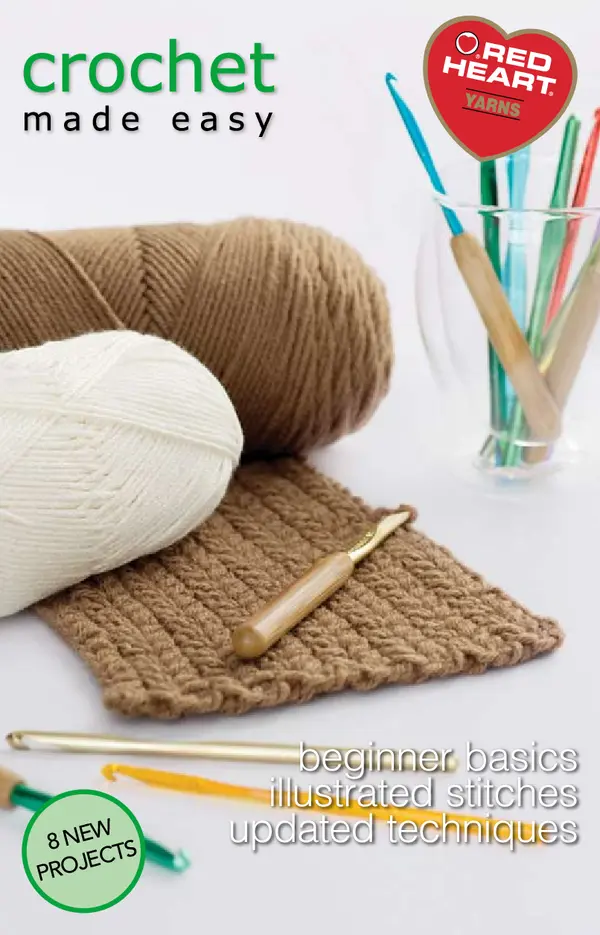
Crochet Made Easy

beginner basics
illustrated stitches
updated techniques
8 NEW
PROJECTS

Crochet Made Easy
Using this Book
Crochet Made Easy is written for beginners, and features easy-to-
understand diagrams and step-by-step instructions to illustrate crochet
stitches and techniques. When you have mastered the basic techniques,
try the projects included at the back of this book—they're designed
especially for beginners!
Products
All of the projects in this book were designed and made with products from
Coats & Clark—Red Heart yarns and Aunt Lydia's threads.
General information is included about yarn, thread and crochet hooks. We
recommend reading through the book to become familiar with terminology
before picking up your hook and yarn. When you're ready, use a Medium
Worsted Weight yarn (size 4 on chart at right) and a 5 mm (US-H-8) or 5.5 mm
(US-I-9) hook to learn to crochet.
Diagrams and Instructions
Diagrams are shown for right-handers. Because of space limitations, it is not
possible to show left-handed diagrams. If you are a left-hander and are hav-
ing trouble understanding the diagrams, try tracing the diagrams and then
turning the tracing paper over and looking at the reversed image. When read-
ing instructions, substitute "left" for "right" and "right" for "left" where it appears.
The abbreviation and its accompanying symbol are shown with the instruc-
tions for each stitch.
Distributed in the USA by Coats & Clark, Greer SC 29650
Visit www.redheart.com for more
information and inspiration!
We also recommend these sites.
For additional patterns: www.coatsandclark.com
For magazine information: www.crochettoday.com
For television show information: www.knitandcrochettoday.com

1
www.redheart.com
Learn to Crochet
Yarn
Yarns are available in a variety of weights. Weight refers to the thickness of the strand
and fiber contents. Yarn comes in either a long center-pull skein or a ball. The weight of
the skein or ball and the total yardage is determined by the weight of the strand of yarn.
There are six standard yarn weight groups determined by the Craft Yarn Council of
America, and the weights are denoted with a number and symbol.
Keep the ball bands from yarn to use as reference. Pin the band to the gauge swatch
and keep them both together with any remaining yarn from the project. Also include
spare buttons and any extra trim used in the project, and tuck everything in a labeled
zip-close plastic bag. This way, you'll be able to check the washing instructions of the
yarn, and you'll always have extra materials on hand for repairs.