DEIB Explorer Assessment by Harvard University

DEIB Explorer Assessment by Harvard University

The DEIB Explorer Assessment developed by Harvard University helps individuals evaluate their understanding of diversity, equity, inclusion, and belonging (DEIB). This assessment focuses on critical reflections related to racism and colorism, emphasizing their impact on social mobility and representation within communities of color. Participants gain insights into systemic racism and the importance of allyship and antiracist actions. Ideal for educators, students, and professionals seeking to enhance their DEIB knowledge and skills, this resource provides a framework for ongoing learning and personal growth.

Key Points

  • Explores the concept of colorism and its effects on communities of color.
  • Assesses personal beliefs and knowledge related to diversity, equity, inclusion, and belonging.
  • Highlights the importance of allyship and antiracist actions in addressing systemic racism.
  • Encourages ongoing learning and reflection on personal biases and privileges.
  • Provides resources for understanding structural racism in various institutions.
77
/ 4
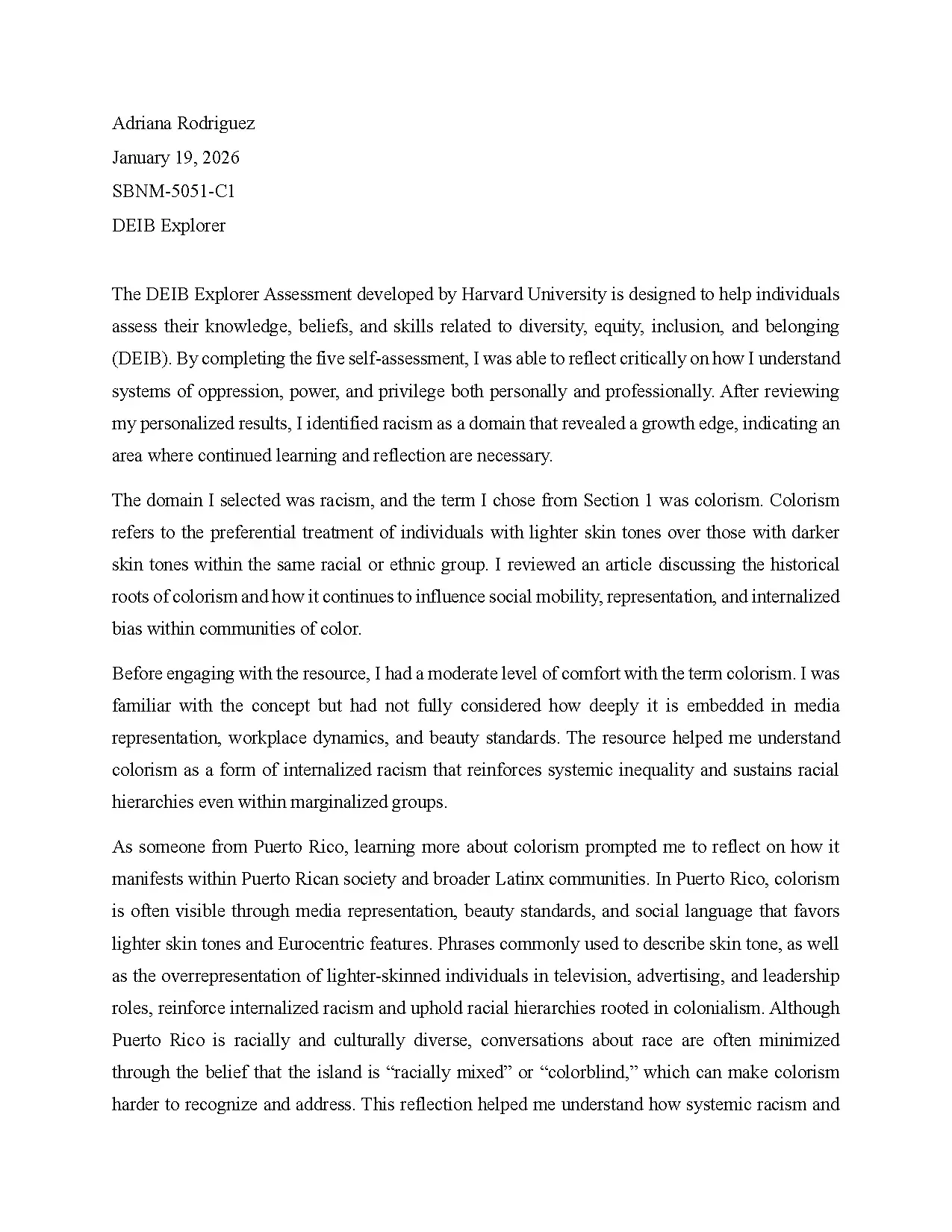
Adriana Rodriguez
January 19, 2026
SBNM-5051-C1
DEIB Explorer
The DEIB Explorer Assessment developed by Harvard University is designed to help individuals
assess their knowledge, beliefs, and skills related to diversity, equity, inclusion, and belonging
(DEIB). By completing the five self-assessment, I was able to reflect critically on how I understand
systems of oppression, power, and privilege both personally and professionally. After reviewing
my personalized results, I identified racism as a domain that revealed a growth edge, indicating an
area where continued learning and reflection are necessary.
The domain I selected was racism, and the term I chose from Section 1 was colorism. Colorism
refers to the preferential treatment of individuals with lighter skin tones over those with darker
skin tones within the same racial or ethnic group. I reviewed an article discussing the historical
roots of colorism and how it continues to influence social mobility, representation, and internalized
bias within communities of color.
Before engaging with the resource, I had a moderate level of comfort with the term colorism. I was
familiar with the concept but had not fully considered how deeply it is embedded in media
representation, workplace dynamics, and beauty standards. The resource helped me understand
colorism as a form of internalized racism that reinforces systemic inequality and sustains racial
hierarchies even within marginalized groups.
As someone from Puerto Rico, learning more about colorism prompted me to reflect on how it
manifests within Puerto Rican society and broader Latinx communities. In Puerto Rico, colorism
is often visible through media representation, beauty standards, and social language that favors
lighter skin tones and Eurocentric features. Phrases commonly used to describe skin tone, as well
as the overrepresentation of lighter-skinned individuals in television, advertising, and leadership
roles, reinforce internalized racism and uphold racial hierarchies rooted in colonialism. Although
Puerto Rico is racially and culturally diverse, conversations about race are often minimized
through the belief that the island is “racially mixed” or “colorblind,” which can make colorism
harder to recognize and address. This reflection helped me understand how systemic racism and
privilege can exist even within my own ethnic community, and how internalized bias can shape
perceptions of beauty, intelligence, and social worth.
For Section 2, I selected the belief statement: “Racism is not pervasive in the United States today.”
I disagreed with this statement. I reviewed a resource that examined how structural racism
continues to operate through institutions such as education, healthcare, housing, and the criminal
justice system. The resource reinforced my understanding that racism is not limited to individual
prejudice, but is deeply embedded in systems of power, institutional policies, and implicit bias.
This helped me further distinguish between interpersonal racism and systemic oppression and
understand why equity-focused solutions, not just equality, are necessary to address racial
disparities.
One key insight I gained from this assessment was recognizing the difference between being
“aware” of DEI issues and being actively skilled in addressing them. While I value diversity and
inclusion, I realized I still have growth to do in translating awareness into allyship and antiracist
action. Another important realization was identifying moments where I may unintentionally
benefit from privilege, even as someone from a marginalized ethnic background, particularly in
spaces like athletics or higher education.
I bring strong cultural competence, empathy, and communication skills to DEI efforts. As a former
collegiate athlete and current coach, I have experience working with individuals from diverse
racial, cultural, and socioeconomic backgrounds. I understand the importance of intersectionality,
recognizing that race, gender, ethnicity, and ability intersect to shape lived experiences. I also value
inclusive leadership and strive to create environments of belonging where individuals feel
respected and heard.
To contribute more effectively, I need to continue developing skills related to antiracism, bystander
intervention, and addressing microaggressions in real time. I also want to deepen my understanding
of how organizational systems and policies can either reinforce or dismantle inequity.
Strengthening my ability to engage in uncomfortable conversations around race and racism is an
important next step.
To expand my diversity understanding, I will:

1. Engage consistently with DEI-related readings, podcasts, and training opportunities to
strengthen my knowledge base.
2. Practice speaking up when I observe bias or exclusion, moving from passive support to
active allyship.
3. Reflect regularly on my own assumptions and behaviors to reduce implicit bias and support
equity-driven change in team and professional settings.
The DEIB Explorer Assessment provided valuable insight into my strengths and growth areas
related to diversity, equity, inclusion, and belonging. By examining racism through the lenses of
colorism, belief systems, and structural inequality, I gained a deeper understanding of both societal
systems and my personal responsibility within them. Continued reflection, learning, and action
will be essential as I work to contribute meaningfully to inclusive and equitable environments.
/ 4
End of Document
77
You May Also Like

FAQs of DEIB Explorer Assessment by Harvard University

What is colorism and how does it affect communities?
Colorism refers to the preferential treatment of individuals with lighter skin tones over those with darker skin tones within the same racial or ethnic group. This phenomenon can significantly impact social mobility, representation, and self-perception within marginalized communities. In many cultures, including Puerto Rican society, colorism is perpetuated through media representation and beauty standards that favor lighter skin. Understanding colorism is crucial for addressing internalized racism and fostering equity within diverse groups.
How does the DEIB Explorer Assessment help individuals?
The DEIB Explorer Assessment aids individuals in evaluating their understanding of diversity, equity, inclusion, and belonging. By reflecting on personal beliefs and experiences related to racism and colorism, participants can identify areas for growth and improvement. The assessment emphasizes the importance of recognizing systemic racism and encourages actionable steps towards allyship and antiracist practices. This resource is particularly valuable for educators and professionals aiming to create inclusive environments.
What insights can be gained from the DEIB Explorer Assessment?
Participants can gain valuable insights into their own biases and privileges through the DEIB Explorer Assessment. It distinguishes between interpersonal racism and systemic oppression, highlighting the need for equity-focused solutions. The assessment encourages individuals to engage in uncomfortable conversations about race and racism, fostering a deeper understanding of how these issues manifest in various contexts. This reflective process is essential for personal growth and effective engagement in DEIB efforts.
What role does allyship play in addressing racism?
Allyship plays a critical role in combating racism by encouraging individuals to actively support marginalized communities. The DEIB Explorer Assessment emphasizes the transition from awareness to action, urging participants to practice speaking up against bias and exclusion. Effective allyship involves recognizing one's own privileges and using them to advocate for equity and justice. By fostering inclusive environments, allies can help dismantle systemic barriers and promote belonging for all individuals.

Related of DEIB Explorer Assessment by Harvard University