eBay Machine Learning Hackathon Dataset Analysis

eBay Machine Learning Hackathon Dataset Analysis

The eBay Machine Learning Hackathon dataset analysis focuses on two primary datasets, including 2 million testing records and 5,000 training records. It outlines the process of combining multi-token entities for Named Entity Recognition (NER) tasks, specifically targeting aspects like product names and manufacturers. The analysis emphasizes the importance of preparing data for fine-tuning German language models with Spacy. This resource is essential for data scientists and machine learning practitioners interested in e-commerce applications and NER methodologies.

Key Points

  • Analyzes two datasets for eBay's machine learning hackathon, including 2M testing records and 5K training records.
  • Explains the process of combining multi-token entities for effective Named Entity Recognition (NER).
  • Details the use of Spacy's German models for fine-tuning on specific categories like product and manufacturer.
  • Provides insights into preparing data for machine learning applications in e-commerce.
154
/ 2
UNDERSTANDING THE DATASET AND THE CORE TASK
1. Dataset
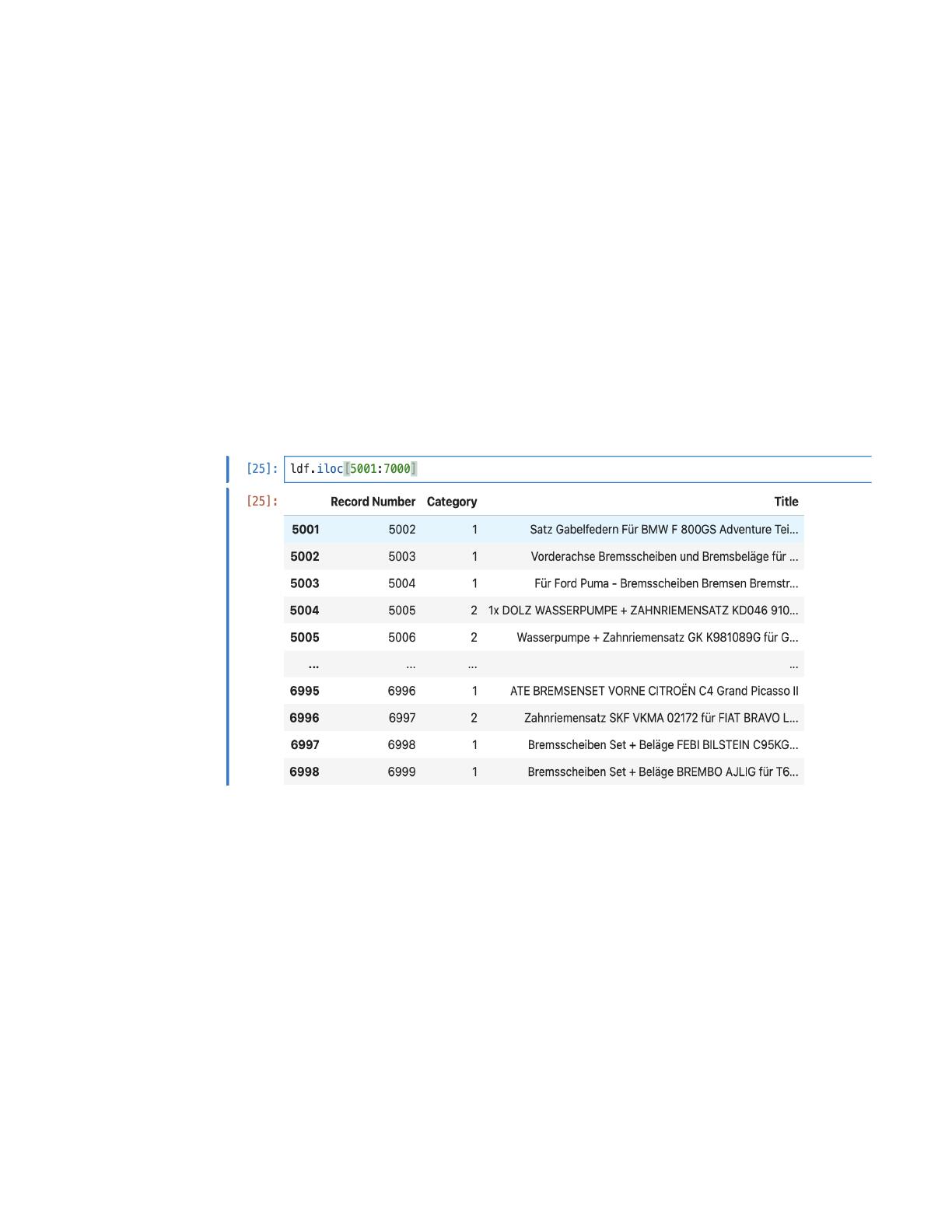
We have two primary data sets, which are the testing data containing 2M
records and the training data containing 5,000 records.
2. Training Dataset
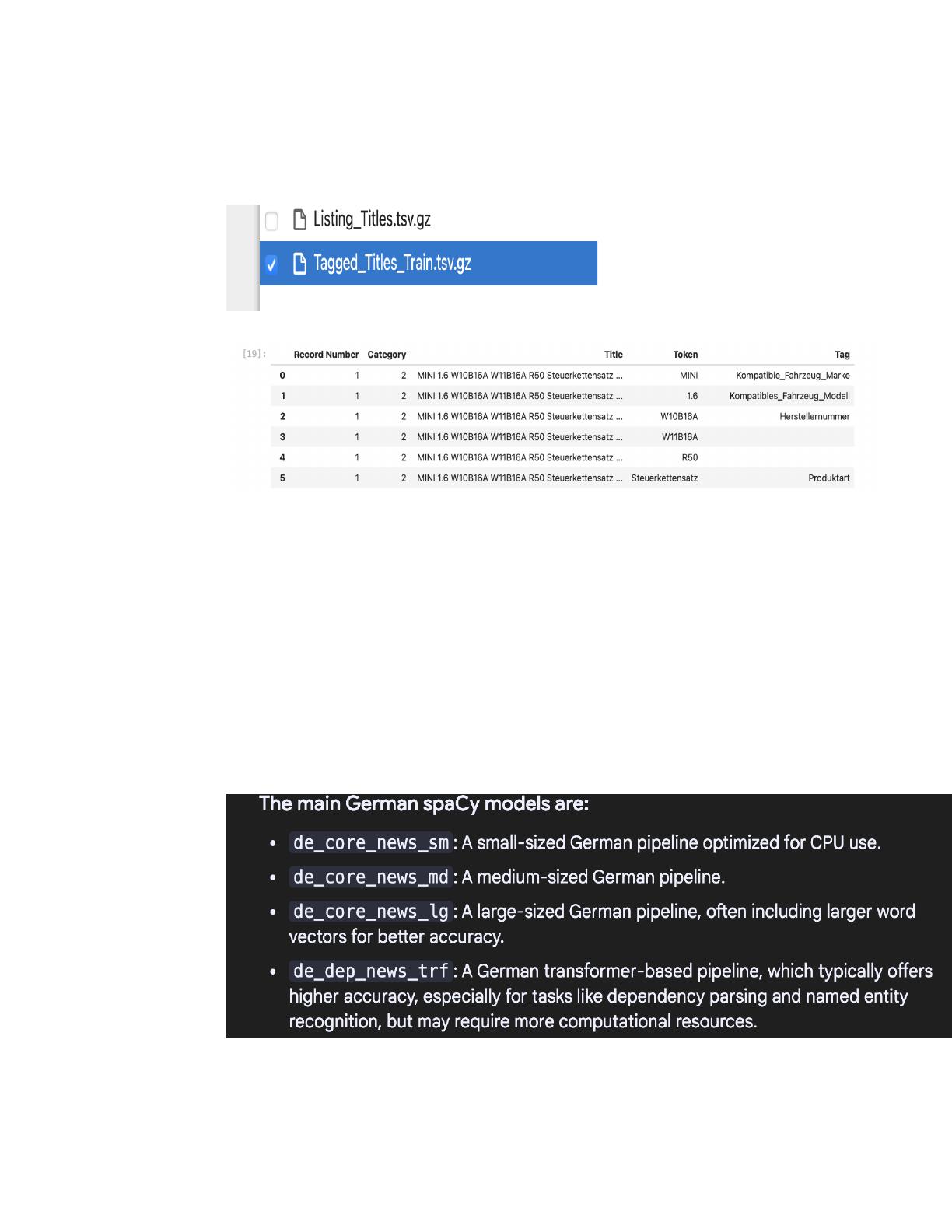
It’s formatted so that each token has its own row. If a token has an empty tag, it
belongs to the same semantic entity as the token before it, and it must be
combined with these tokens to form the complete "aspect value". (I sense this is
where the core cleaning task lies/ the start of the core task). e.g index 3 and
4 don't have tags, meaning these tokens(W11B161 and R50) are part of the
previous token with tag(W10B16A at index 2). So we should combine them
W10B16A W11B161 R50 and assign a single tag Herstellernummer to them.
Once we’ve processed the data and combined multi-token entities, we’ll prepare
it in a format suitable for an NER model. Spacy has a couple of pretrained
German models that we can finetune to learn these new categories specific to
our project. (like make, manufacturer)
3. Submission
We are only submitting the model's output result, which is tab-separated data,
with each line containing the item title's record number, category ID, the aspect
name (tag), and the aspect value (the extracted phrase)
NB: Each record in the submission should be a semantic entity, meaning
we should combine multi-token phrases to form a single complete aspect
value. ( The model should be able to identify and do that lol)
Eg” iPhone 16 is the best of Apple Inc.”
The model should combine iPhone and 16 as iPhone 16 and assign a tag like
Product.
The model should combine Apple and Inc as Apple Inc. and assign ORG
4. EVALUATION.
They gave a specific range for us to evaluate the model on, which is from 5001 to
30000 of the testing data. We will run the model against this range and submit
the results.
/ 2
End of Document
154
You May Also Like

FAQs of eBay Machine Learning Hackathon Dataset Analysis

What are the main datasets used in the eBay hackathon analysis?
The analysis utilizes two main datasets: a testing dataset containing 2 million records and a training dataset with 5,000 records. The training dataset is formatted to allow each token to have its own row, facilitating the identification and combination of multi-token entities. This structure is crucial for preparing the data for Named Entity Recognition tasks, enabling the extraction of meaningful aspects from product titles.
How does the dataset support Named Entity Recognition (NER)?
The dataset is structured to facilitate Named Entity Recognition by allowing the combination of multi-token phrases into single semantic entities. For example, tokens without tags are grouped with preceding tokens to form complete aspect values, such as combining 'iPhone' and '16' into 'iPhone 16'. This approach ensures that the NER model can accurately identify and categorize these entities, which is essential for tasks like product classification and information extraction.
What machine learning models are suggested for use with this dataset?
The analysis suggests using Spacy's pretrained German language models for fine-tuning on specific categories relevant to the eBay dataset. These models are designed to improve the accuracy of Named Entity Recognition tasks by adapting to the unique terminology and structure found in e-commerce data. Fine-tuning these models on the provided datasets enhances their ability to identify product names, manufacturers, and other relevant aspects.
What is the significance of combining multi-token entities in this analysis?
Combining multi-token entities is significant because it allows for more accurate representation of complex product names and organizations within the dataset. For instance, phrases like 'Apple Inc.' or 'iPhone 16' need to be treated as single entities to ensure that the NER model can correctly classify them. This process reduces ambiguity and improves the overall performance of machine learning models in extracting relevant information from product titles.
What evaluation metrics are used for the model's performance?
The evaluation of the model's performance is based on its ability to accurately identify and classify entities within a specified range of the testing dataset, specifically from records 5001 to 30000. Metrics such as precision, recall, and F1-score are typically employed to assess the model's effectiveness in recognizing the correct entities and minimizing false positives. These metrics are crucial for ensuring the reliability of the NER system in real-world applications.

Related of eBay Machine Learning Hackathon Dataset Analysis