This document provides a comprehensive chapter-by-chapter summary of ‘Lord of the Flies’, a novel by William Golding published in 1954. It explores the themes of human nature, civilization versus savagery, and the inherent darkness within humanity. The summary details the major characters, including Ralph, Piggy, Jack, and Simon, and their symbolic roles within the narrative. It also discusses the historical context of the novel, reflecting post-World War II sentiments. The structure of the document is organized into sections that cover the introduction, major characters, key chapters, themes, and symbols. This study guide serves as an educational resource for students and readers seeking to understand the complex themes and character dynamics in Golding’s work.
/ 12

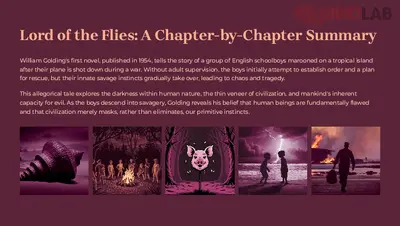
Lord of the Flies: A Chapter-by-Chapter Summary
William Golding's first novel, published in 1954, tells the story of a group of English schoolboys marooned on a tropical island
after their plane is shot down during a war. Without adult supervision, the boys initially attempt to establish order and a plan
for rescue, but their innate savage instincts gradually take over, leading to chaos and tragedy.
This allegorical tale explores the darkness within human nature, the thin veneer of civilization, and mankind's inherent
capacity for evil. As the boys descend into savagery, Golding reveals his belief that human beings are fundamentally flawed
and that civilization merely masks, rather than eliminates, our primitive instincts.

Introduction and Historical
Context
William Golding
Raised to be a scientist but
drawn to literature, Golding's
experiences in World War II,
including the D-Day landing at
Normandy, profoundly
influenced his dark view of
human nature. He won the
Nobel Prize for Literature in
1983.
Historical Context
Written in the aftermath of
World War II, the novel reflects
a new pessimism about
humanity's inherent goodness.
The references to an atom
bomb and "the Reds" place the
story in the early Cold War era.
Literary Significance
Golding subverts the adventure story genre by showing boys who,
rather than civilizing their island paradise, descend into savagery.
Unlike
Robinson Crusoe
or
Swiss Family Robinson
,
Lord of the Flies
suggests humans are inherently barbaric.

Major Characters and Their
Symbolic Roles
Ralph
The largest and most
physically powerful
boy who becomes the
elected leader.
Despite his size, Ralph
shows no desire to
dominate others and
prioritizes rescue and
following rules. He
symbolizes law,
government, and civil
society.
Piggy
The smartest boy but
physically weak due to
obesity and asthma.
He believes
passionately in
civilization and
reasoning but is often
ridiculed by the
others. Piggy
symbolizes science
and rationality.
Jack
The head of his chorus
who becomes leader
of the hunters. Jack
loves power and
dominance, becoming
increasingly savage as
the story progresses.
He symbolizes
mankind's love of
power and the savage
instinct within all
humans.
Simon
A dreamy, dark-haired
boy prone to fainting
spells. The most
insightful and
spiritually aware of
the boys, Simon
recognizes that the
beast exists within
them all. He
symbolizes the mystic
or prophet who
confronts the darkest
aspects of human
nature.
Loading document...
/ 12
Upload to Download
Every 3 documents you upload earns 1 download credit.
You have uploaded 0 documents. Upload 3 more to earn a download.
Upload Documents
End of Document
87
Report this document
Why are you reporting this content?
Embed document
* The code will be updated based on your changes.
Upload to Print
Every 3 documents you upload earns 1 print/download credit.
You have uploaded 0 documents. Upload 3 more to earn a credit.
Upload Documents