Managing Time and Space in Driver Education

Managing Time and Space in Driver Education

Managing Time and Space focuses on essential driving skills, emphasizing the importance of risk awareness and safe driving practices. It introduces the IPDE process—Identify, Predict, Decide, Execute—critical for making informed driving decisions. The guide explains the Zone Control system, which helps drivers monitor the six zones around their vehicle to enhance safety. Additionally, it covers the significance of orderly visual search patterns and commentary driving for improving driving skills. This resource is designed for new drivers and those seeking to refine their driving techniques.

Key Points

  • Explains the IPDE process for safe driving decisions.
  • Describes the Zone Control system for monitoring vehicle surroundings.
  • Highlights the importance of visual search patterns in driving.
  • Discusses commentary driving as a method for improving awareness.
258
/ 3
Idaho Public Driver Education
Managing Time and Space
IDAHO PUBLIC DRIVER EDUCATION
HOMEWORK PACKET 3
Risk
If cars travelled on tracks and never had to
interact with other vehicles we wouldn’t have
over 30,000 traffic fatalities in the U.S. each year
and we wouldn’t need driver education.
But cars do not travel on independent tracks or
have 100% crash avoidance systems built in - yet
so understanding the risks involved in driving is
essential to staying safe and alive.
Falling into a false sense of security is a big
problem as drivers become more and more
comfortable behind the wheel. Soon, they forget
that they are driving a 2,000 pound rolling missile
and allow their attention to drift to more interesting
things, like a text message or music or video
player.
IPDE
Driving is a very busy activity. It is so much more
than simply stepping on the gas and steering. In
driver education we like to say we could teach a
monkey to drive but it would not be able to have
the focus or make the smart choices required to
be a SAFE and SKILLED driver. This is because
driving is primarily a thinking task.
One of the skills necessary to stay aware of the
ever-changing conditions around you while you
drive is to use “IPDE” (identify, predict, decide,
execute). While driving you must constantly
“identify” important objects and situations that
might affect you, “predict” what might happen,
“decide” how you will react if necessary, and then
“execute” that reaction if necessary.
Since “prediction” is an essential part of the IPDE
proce
ss but you can usually only predict what
you’ve experienced, getting good at IPDE will take
time.
Zone Control
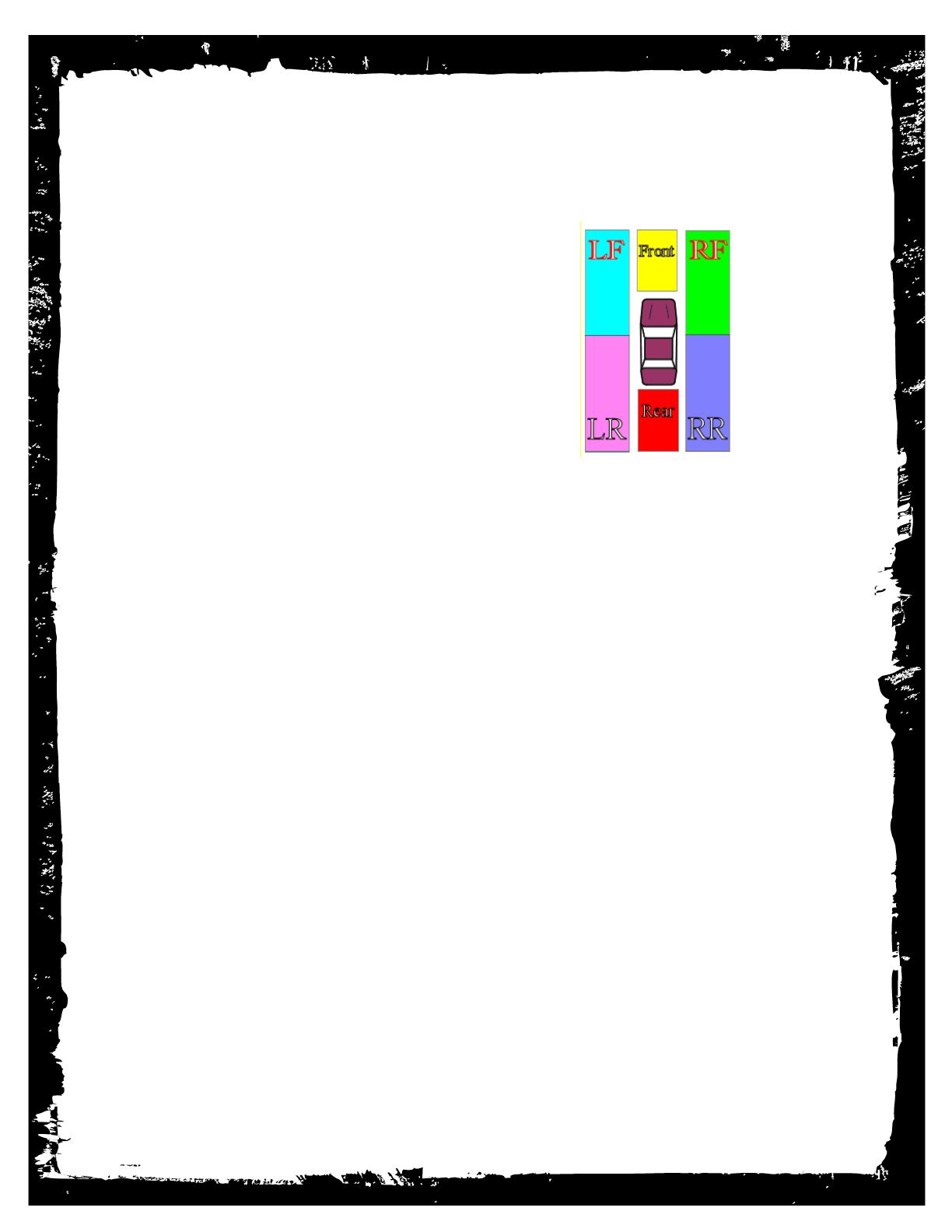
The Zone Control system helps you control the six
areas around your vehicle at all times. Combined
with the IPDE process, you will be able to practice
good visual habits that will help you enjoy low-risk
and low-stress driving.
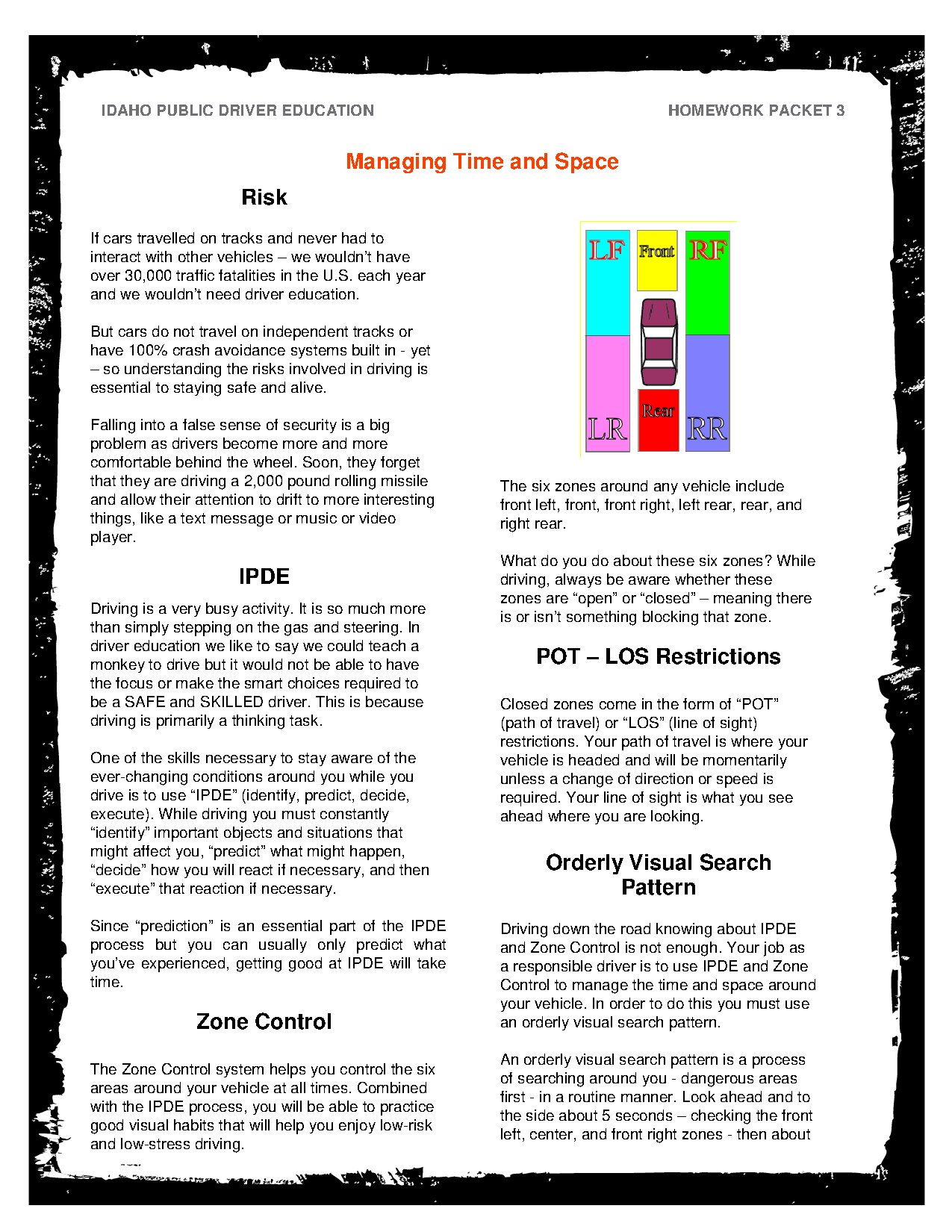
The six zones around any vehicle include
front left, front, front right, left rear, rear, and
right rear.
What do you do about these six zones? While
driving, always be aware whether these
zones are “open” or “closedmeaning there
is or isn’t something blocking that zone.
POT – LOS Restrictions
Closed zones come in the form of “POT”
(path of travel) or “LOS” (line of sight)
restrictions. Your path of travel is where your
vehicle is headed and will be momentarily
unless a change of direction or speed is
required. Your line of sight is what you see
ahead where you are looking.
Orderly Visual Search
Pattern
Driving down the road knowing about IPDE
and Zone Control is not enough. Your job as
a responsible driver is to use IPDE and Zone
Control to manage the time and space around
your vehicle. In order to do this you must use
an orderly visual search pattern.
An orderly visual search pattern is a process
of searching around you - dangerous areas
first - in a routine manner. Look ahead and to
the side about 5 seconds checking the front
left, center, and front right zones - then about

Idaho Public Driver Education
IDAHO PUBLIC DRIVER EDUCATION
HOMEWORK PACKET 3
15 seconds ahead again searching your front
zones and including driveways and intersections
for possible zones that may close. Finally, search
all the way to your “target area” the location
furthest down the road that you are headed for.
You should look for possible hazards a car that
might cross the intersection a car door that
might open or a pedestrian that might turn and
cross the street without looking first. If you always
expect the unexpected you will be prepared.
While checking the front zones is critical to your
safety, checking your rearview and side mirrors
regularly as well is also important! In Idaho about
13% of all crashes occur because one vehicle is
following another too closely and over 4,000
tickets are written for following another too closely.
And remember that motorcycles, bicyclists, and
small vehicles can quickly enter your blind spot
without you seeing it unless you check your rear
zones regularly.
What to Look For
Open zones
Other vehicles
Pedestrians
Road construction
Roadway conditions
Change from multi-lane to single lane
Change in lane width
Parked vehicles
Children playing
Busy intersections
Traffic controls
Hazards
Always
eliminate
hazards if possible, by changing
lanes or choosing a different route. But if you can’t
eliminate a hazard try to
minimize
it. Put more
distance between yourself and the hazard. Slow
down, pay more attention, or even stop.
There will often be more than just one hazard on
the road and you will need to
separate
hazards.
Adjust your speed so you can deal with one
hazard at a time and then decide which hazard
deserves your immediate attention.
When hazards can’t be eliminated, minimized, or
separated, you must compromise space by
giving as much space as possible to the
greatest hazard. In the diagram below, car “D
has a large truck blocking his lane but oncoming
traffic only a few feet to his left.
The driver can’t eliminate the truck or oncoming
car, can’t minimize
either, and doesn’t have
enough time to separate them. So the driver of
car “D” decides that hitting the small car would do
more damage than hitting the parked truck, so he
slows down and drives as close to the parked
truck as he can until the small car go
es by. He
then returns to the center of the lane, lane
position 1.
Commentary Driving
Commentary driving is a way of thinking out loud
while driving. Just talk through what you are
seeing, thinking, and planning to do behind the
wheel. This is a great way to practice IPDE and
Zone Control but more importantly, it helps your
instructor or supervising driver (during the six
months of supervised driving) realize how you are
processing what you are seeing. Often, in driver
education, the instructor has to assume the
student driver is seeing and thinking the same
things she is but assumptions aren’t good
enough when it comes to safety. Help your
instructor out by doing some commentary driving
and asking a lot of questions.
Idaho Public Driver Education
REVIEW QUESTIONS
HOMEWORK PACKET 3
NAME: _______________________________________ DATE: ____________
DIRECTIONS: Answer the following questions based on what you learned from the
homework packet.
1. In your opinion, what is the most important step in the IPDE process. Why?
2. What does “POT” stand for?
3. What percentage of Idaho crashes occur because one vehicle is following another
too closely?
4. If your instructor tells you to “compromise your space here” (he/she will probably
not use this exact wording) what does he/she mean?
5. What is the main purpose of commentary driving?
6. Which is more – the leading cause of teen deaths in America (car crashes at 37%)
or the total of the 2
nd
, 3
rd
, 4
th
, and 5
th
causes of teen deaths in America? By how
much?
/ 3
End of Document
258
You May Also Like

FAQs of Managing Time and Space in Driver Education

What is the IPDE process in driver education?
The IPDE process stands for Identify, Predict, Decide, and Execute. It is a systematic approach that helps drivers assess their surroundings and make informed decisions while driving. By identifying potential hazards, predicting possible outcomes, deciding on a course of action, and executing that decision, drivers can enhance their safety on the road. This process emphasizes the need for constant awareness and quick thinking in dynamic driving environments.
What are the six zones in the Zone Control system?
The Zone Control system identifies six key areas around a vehicle: front left, front, front right, left rear, rear, and right rear. Each zone can be either open or closed, indicating whether there are obstacles that could affect the vehicle's path. By continuously monitoring these zones, drivers can maintain awareness of their surroundings and react appropriately to potential hazards. This proactive approach is essential for safe driving and helps prevent accidents.
How does commentary driving improve driving skills?
Commentary driving involves verbalizing thoughts and observations while driving, which helps reinforce the IPDE process. By articulating what they see and plan to do, drivers can enhance their focus and decision-making skills. This technique also allows instructors or supervising drivers to understand the learner's thought process, facilitating better guidance and feedback. Regular practice of commentary driving can lead to improved situational awareness and safer driving habits.
What are common hazards drivers should look for?
Drivers should be vigilant for various hazards, including other vehicles, pedestrians, road construction, and changing roadway conditions. Recognizing these hazards early allows drivers to take appropriate actions, such as adjusting speed or changing lanes. Additionally, being aware of parked vehicles and children playing near the road can prevent accidents. By anticipating potential dangers, drivers can maintain a safer driving environment for themselves and others.
What is the significance of maintaining space around a vehicle?
Maintaining space around a vehicle is crucial for safe driving, as it allows for reaction time in case of unexpected events. Drivers should aim to keep a safe distance from other vehicles to avoid collisions, especially in high-traffic areas. When faced with multiple hazards, drivers must learn to compromise space by prioritizing the most significant threat. This strategic approach helps minimize risks and enhances overall road safety.

Related of Managing Time and Space in Driver Education