

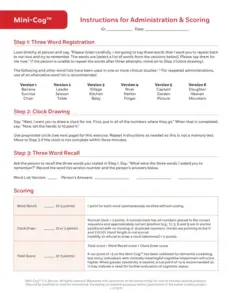
This document Mini-Cog™ provides instructions for administering and scoring the Mini-Cog™ test, a brief cognitive assessment tool used for dementia screening. The test involves three-word registration, clock drawing, and three-word recall, with scoring based on the person’s performance. It includes alternative word lists for repeated administrations and specific criteria for scoring the clock drawing task. The Mini-Cog™ has been validated for dementia screening, with a suggested cut point for identifying cognitive impairment. This concise document offers valuable guidance for healthcare professionals conducting cognitive assessments in clinical and educational settings.
Mini-Cog™
Instructions for Administration & Scoring
Step 1: Three Word Registration
Step 2: Clock Drawing
Step 3: Three Word Recall
Scoring
Look directly at person and say, “Please listen carefully. I am going to say three words that I want you to repeat back
to me now and try to remember. The words are [select a list of words from the versions below]. Please say them for
me now.” If the person is unable to repeat the words after three attempts, move on to Step 2 (clock drawing).
The following and other word lists have been used in one or more clinical studies.
1-3
For repeated administrations,
use of an alternative word list is recommended.
Say: “Next, I want you to draw a clock for me. First, put in all of the numbers where they go.” When that is completed,
say: “Now, set the hands to 10 past 11.”
Use preprinted circle (see next page) for this exercise. Repeat instructions as needed as this is not a memory test.
Move to Step 3 if the clock is not complete within three minutes.
Ask the person to recall the three words you stated in Step 1. Say: “What were the three words I asked you to
remember?” Record the word list version number and the person’s answers below.
Word List Version: _____ Person’s Answers: ___________________ ___________________ ___________________
Version 1
Banana
Sunrise
Chair
Version 4
River
Nation
Finger
Version 2
Leader
Season
Table
Version 5
Captain
Garden
Picture
Version 3
Village
Kitchen
Baby
Version 6
Daughter
Heaven
Mountain
Word Recall: ______ (0-3 points) 1 point for each word spontaneously recalled without cueing.
Clock Draw: ______ (0 or 2 points)
Normal clock = 2 points. A normal clock has all numbers placed in the correct
sequence and approximately correct position (e.g., 12, 3, 6 and 9 are in anchor
positions) with no missing or duplicate numbers. Hands are pointing to the 11
and 2 (11:10). Hand length is not scored.
Inability or refusal to draw a clock (abnormal) = 0 points.
Total Score: ______ (0-5 points)
Total score = Word Recall score + Clock Draw score.
A cut point of <3 on the Mini-Cog™ has been validated for dementia screening,
but many individuals with clinically meaningful cognitive impairment will score
higher. When greater sensitivity is desired, a cut point of <4 is recommended as
it may indicate a need for further evaluation of cognitive status.
Mini-Cog™ © S. Borson. All rights reserved. Reprinted with permission of the author solely for clinical and educational purposes.
May not be modified or used for commercial, marketing, or research purposes without permission of the author (soob@uw.edu).
v. 01.19.16
ID: ______________ Date: ________________________

1. Borson S, Scanlan JM, Chen PJ et al. The Mini-Cog as a screen for dementia: Validation in a population-based
sample. J Am Geriatr Soc 2003;51:1451–1454.
2. Borson S, Scanlan JM, Watanabe J et al. Improving identification of cognitive impairment in primary care. Int J
Geriatr Psychiatry 2006;21: 349–355.
3. Lessig M, Scanlan J et al. Time that tells: Critical clock-drawing errors for dementia screening. Int
Psychogeriatr. 2008 June; 20(3): 459–470.
4. Tsoi K, Chan J et al. Cognitive tests to detect dementia: A systematic review and meta-analysis. JAMA Intern
Med. 2015; E1-E9.
5. McCarten J, Anderson P et al. Screening for cognitive impairment in an elderly veteran population:
Acceptability and results using different versions of the Mini-Cog. J Am Geriatr Soc 2011; 59: 309-213.
6. McCarten J, Anderson P et al. Finding dementia in primary care: The results of a clinical demonstration
project. J Am Geriatr Soc 2012; 60: 210-217.
7. Scanlan J & Borson S. The Mini-Cog: Receiver operating characteristics with the expert and naive raters. Int J
Geriatr Psychiatry 2001; 16: 216-222.
References
Clock Drawing
ID: ______________ Date: ________________________
Mini-Cog™ © S. Borson. All rights reserved. Reprinted with permission of the author solely for clinical and educational purposes.
May not be modified or used for commercial, marketing, or research purposes without permission of the author (soob@uw.edu).
v. 01.19.16