Navitas English Placement Test

Navitas English Placement Test

The Navitas English Placement Test assesses English language proficiency for students entering English courses. It includes sections on vocabulary, reading comprehension, and writing skills, designed to evaluate a student's readiness for academic study in an English-speaking environment. This test is ideal for prospective students aiming to enroll in Navitas English programs and is structured to provide a comprehensive evaluation of language skills. The test format includes multiple-choice questions, written responses, and specific language tasks, ensuring a thorough assessment of each candidate's abilities.

Key Points

  • Evaluates vocabulary, reading, and writing skills for English learners.
  • Structured for students preparing for Navitas English courses.
  • Includes multiple-choice and written response sections.
  • Designed to assess readiness for academic study in English.
218
/ 11
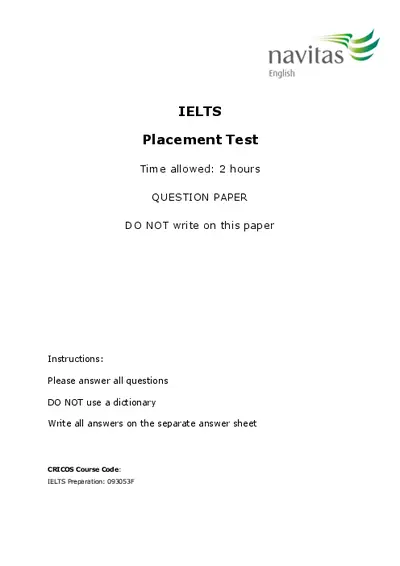
IELTS
Placement Test
Time allowed: 2 hours
QUESTION PAPER
DO NOT write on this paper
Instructions:
Please answer all questions
DO NOT use a dictionary
Write all answers on the separate answer sheet
CRICOS Course Code:
IELTS Preparation: 093053F
.
– 2 –
Section 1 - Vocabulary
For questions 1-10, read the text below. Use the word given in capitals at the end of each line to
form a word that fits in the space in the same line. There is an example at the beginning (0). Write
your answers on the separate answer sheet.
Example: 0 remarkably
MARMALADE
Marmalade is a type of jam made from oranges. It is (0)…. REMARK
popular in Britain, where it is (1) …. eaten on toast at TRADITION
breakfast. However, although it is an (2) …. part of life in DAY
Britain, it is not British.
Marmalade (3) …. came from Portugal and the word comes ORIGIN
from a Portuguese word.
After its (4) …. in Britain in 1945, marmalade was at first eaten ARRIVAL
as an after-dinner sweet. It was often moulded into (5) …. ATTRACT
shapes and then sliced. It was considered a very (6) …. DESIRE
delicacy and an excellent gift and today it is not (7) …. for COMMON
people to give special jars of marmalade as presents.
Marmalade was also used as a (8) …. for coughs and it was TREAT
thought to (9) …. the heart. STRONG
Today, the (10) …. ingredient of marmalade is the Seville BASE
orange, from Spain.
Ā© First Certificate Practice Tests 2, Oxford University Press 1997
.
– 3 –
Section 2 - Reading
Questions 11-24 are based on the reading passage below.
The Risks of Cigarette Smoke
Discovered in the early 1800s and named nicotine, the oily essence now called nicotine is the main
active ingredient of tobacco. Nicotine, however, is only a small component of cigarette smoke,
which contains more than 4,700 chemical compounds, including 43 cancer-causing substances. In
recent times, scientific research has been providing evidence, that years of cigarette smoking
vastly increases the risk of developing fatal medical conditions.
In addition to being responsible for more than 85 per cent of lung cancers, smoking is associated
with cancers of, amongst others, the mouth, stomach and kidneys, and is thought to cause about
14 per cent of leukaemia and cervical cancers. In 1990, smoking caused more than 84,000 deaths,
mainly resulting from such problems as pneumonia, bronchitis and influenza. Smoking, it is
believed, is responsible for 30 per cent of all deaths from cancer and clearly represents the most
preventable cause of cancer in countries like the United States today.
Passive smoking, the breathing in of the side-stream smoke from the burning of tobacco between
puffs or of the smoke exhaled by a smoker, also causes a serious health risk. A report published in
1992 by the US Environmental Protection Agency (EPA) emphasized the health dangers, especially
from side-stream smoke. This type of smoke contains more, smaller particles and is therefore more
likely to be deposited deep in the lungs. On the basis of this report, the EPA has classified
environmental tobacco smoke in the highest risk category for causing cancer.
As an illustration of the health risks, in the case of a married couple where one partner is a smoker
and one a non-smoker, the latter is believed to have a 30 per cent higher risk of death from heart
disease because of passive smoking. The risk of lung cancer also increases over the years of
exposure and the figure jumps to 80 per cent if the spouse has been smoking four packs a day for
20 years. It has been calculated that 17 per cent of cases of lung cancer can be attributed to high
levels of exposure to second hand tobacco smoke during childhood and adolescence.
A more recent study by researchers at the University of California at San Francisco (UCSF) has
shown that second-hand cigarette smoke does more harm to non-smokers than to smokers.
Leaving aside the philosophical question of whether anyone should have to breathe someone else’s
cigarette smoke, the report suggests that the smoke experienced by many people in their daily
lives is enough to produce substantial adverse effects on a person’s heart and lungs.
The report, published in the Journal of the American Medical Association (AMA),
was based on the researchers’ own earlier research but also includes a review of studies over the
past few years. The American Medical Association represents about half of all US doctors and is a
strong opponent of smoking. The study suggests that people who smoke cigarettes are continually
damaging their cardiovascular system, which adapts in order to compensate for the effects of
smoking. It further states that people who do not smoke do not have the benefit of their system
adapting to the smoke inhalation. Consequently, the effects of passive smoking are far greater on
non-smokers than on smokers.
This report emphasizes that cancer is not caused by a single element in cigarette smoke; harmful
effects to health are caused by many components. Carbon monoxide, for example, competes with
oxygen in red blood cells and interferes with the blood’s ability to deliver life-giving oxygen to the

/ 11
End of Document
218
You May Also Like

FAQs of Navitas English Placement Test

What skills does the Navitas English Placement Test assess?
The Navitas English Placement Test assesses key language skills, including vocabulary, reading comprehension, and writing abilities. Each section is designed to evaluate how well students can understand and use English in academic contexts. The vocabulary section tests knowledge of word meanings and usage, while the reading section measures comprehension of various texts. The writing component evaluates the ability to express ideas clearly and effectively in written form, which is crucial for success in English-speaking academic environments.
Who is the target audience for the Navitas English Placement Test?
The target audience for the Navitas English Placement Test includes prospective students who wish to enroll in English language courses offered by Navitas. This test is particularly beneficial for non-native English speakers seeking to improve their language skills before entering academic programs. It helps identify the appropriate level of English instruction needed for each student, ensuring they receive the support necessary to succeed in their studies.
What is the format of the Navitas English Placement Test?
The Navitas English Placement Test is structured into several sections, including vocabulary, reading comprehension, and writing tasks. Each section consists of multiple-choice questions and written responses designed to evaluate a student's language proficiency comprehensively. The test format allows for a thorough assessment of the candidate's abilities, ensuring that the results accurately reflect their readiness for academic study in an English-speaking environment.

Related of Navitas English Placement Test