

This document is a Food Protection Manager practice exam containing 62 multiple-choice questions with answers, covering key food safety topics including temperature control (danger zone of 41°F to 135°F, reheating to 165°F), proper handwashing (15-20 seconds), manual dishwashing procedures (pre-wash, wash, rinse, sanitize, air dry), employee health restrictions (no working with diarrhea), safe food storage and thawing methods, pest management (IPM balancing prevention and control), foodborne illnesses (salmonellosis, norovirus, trichinosis, anisakiasis, scombroid poisoning, Vibrio), FIFO product rotation, proper chemical storage, shellstock tag retention (90 days), equipment clearance requirements (6 inches from floor), and regulatory agency roles (CDC for foodborne outbreaks, USDA for meat/poultry inspection), all designed to help candidates prepare for the food protection manager certification exam.
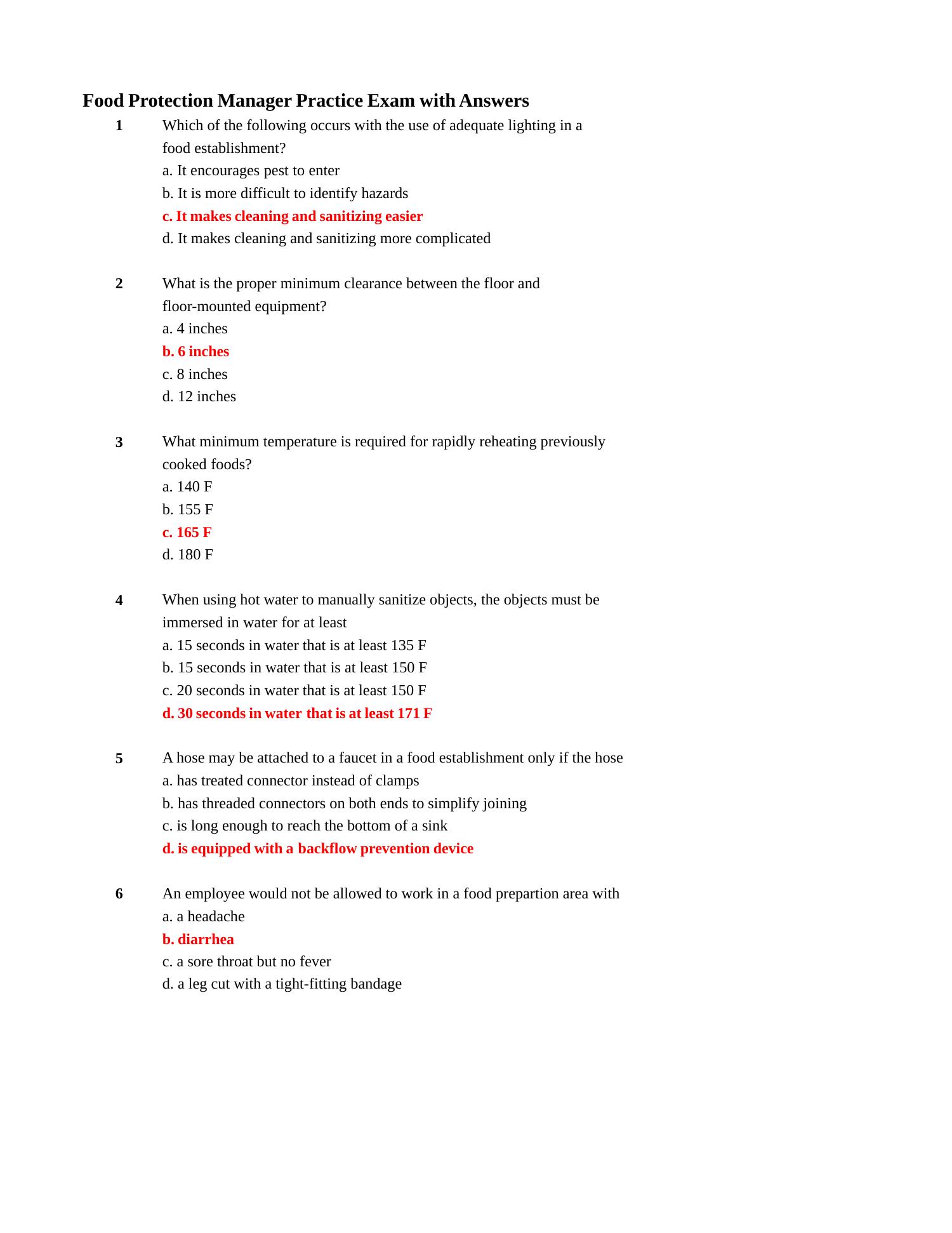
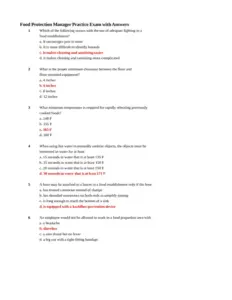
Food Protection Manager Practice Exam with Answers
1 Which of the following occurs with the use of adequate lighting in a
food establishment?
a. It encourages pest to enter
b. It is more difficult to identify hazards
c. It makes cleaning and sanitizing easier
d. It makes cleaning and sanitizing more complicated
2
What is the proper minimum clearance between the floor and
floor-mounted equipment?
a. 4 inches
b. 6 inches
c. 8 inches
d. 12 inches
3
What minimum temperature is required for rapidly reheating previously
cooked foods?
a. 140 F
b. 155 F
c. 165 F
d. 180 F
4
When using hot water to manually sanitize objects, the objects must be
immersed in water for at least
a. 15 seconds in water that is at least 135 F
b. 15 seconds in water that is at least 150 F
c. 20 seconds in water that is at least 150 F
d. 30 seconds in water that is at least 171 F
5
A hose may be attached to a faucet in a food establishment only if the hose
a. has treated connector instead of clamps
b. has threaded connectors on both ends to simplify joining
c. is long enough to reach the bottom of a sink
d. is equipped with a backflow prevention device
6
An employee would not be allowed to work in a food prepartion area with
a. a headache
b. diarrhea
c. a sore throat but no fever
d. a leg cut with a tight-fitting bandage
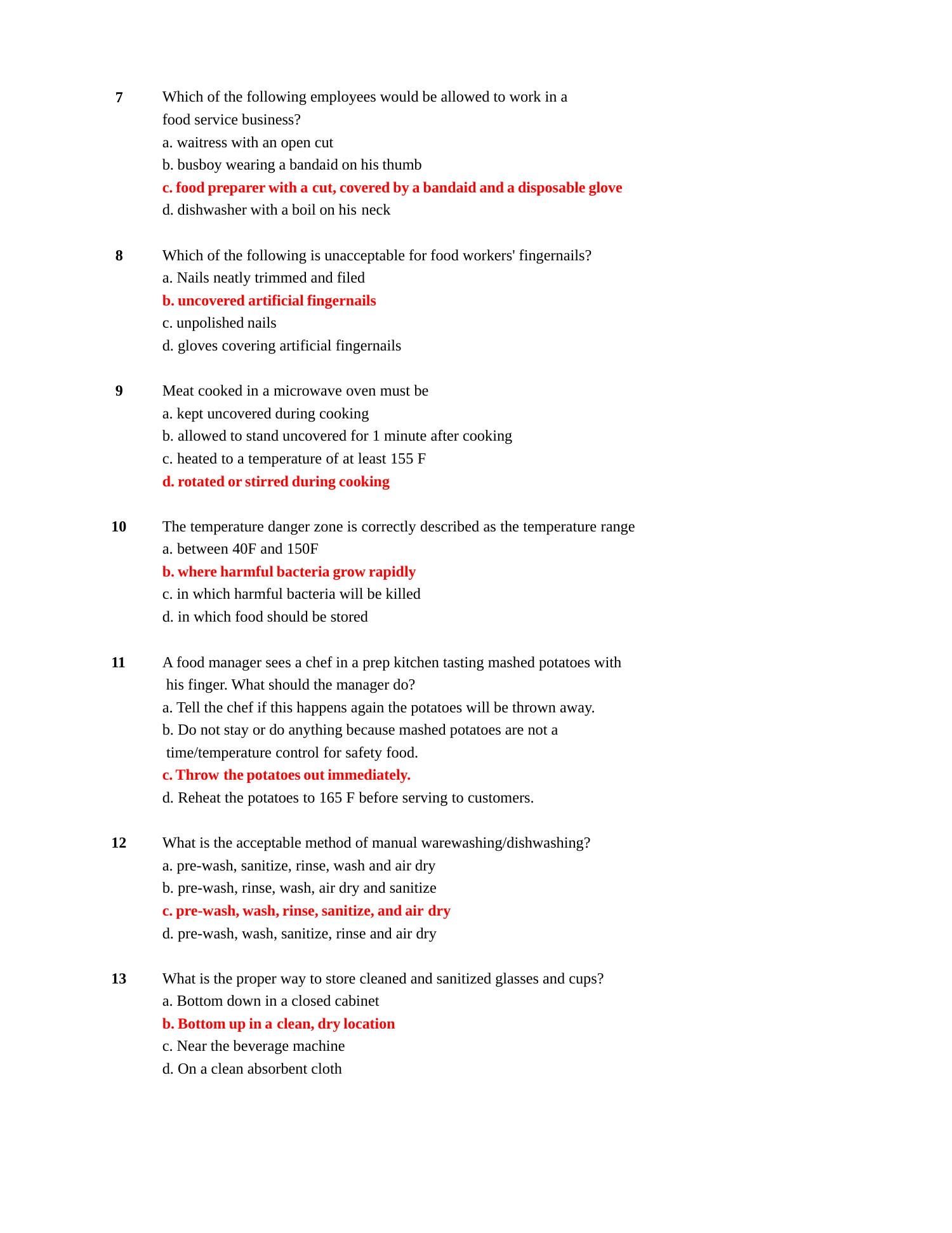
7
Which of the following employees would be allowed to work in a
food service business?
a. waitress with an open cut
b. busboy wearing a bandaid on his thumb
c. food preparer with a cut, covered by a bandaid and a disposable glove
d. dishwasher with a boil on his neck
8
Which of the following is unacceptable for food workers' fingernails?
a. Nails neatly trimmed and filed
b. uncovered artificial fingernails
c. unpolished nails
d. gloves covering artificial fingernails
9
Meat cooked in a microwave oven must be
a. kept uncovered during cooking
b. allowed to stand uncovered for 1 minute after cooking
c. heated to a temperature of at least 155 F
d. rotated or stirred during cooking
10
The temperature danger zone is correctly described as the temperature range
a. between 40F and 150F
b. where harmful bacteria grow rapidly
c. in which harmful bacteria will be killed
d. in which food should be stored
11 A food manager sees a chef in a prep kitchen tasting mashed potatoes with
his finger. What should the manager do?
a. Tell the chef if this happens again the potatoes will be thrown away.
b. Do not stay or do anything because mashed potatoes are not a
time/temperature control for safety food.
c. Throw the potatoes out immediately.
d. Reheat the potatoes to 165 F before serving to customers.
12 What is the acceptable method of manual warewashing/dishwashing?
a. pre-wash, sanitize, rinse, wash and air dry
b. pre-wash, rinse, wash, air dry and sanitize
c. pre-wash, wash, rinse, sanitize, and air dry
d. pre-wash, wash, sanitize, rinse and air dry
13
What is the proper way to store cleaned and sanitized glasses and cups?
a. Bottom down in a closed cabinet
b. Bottom up in a clean, dry location
c. Near the beverage machine
d. On a clean absorbent cloth
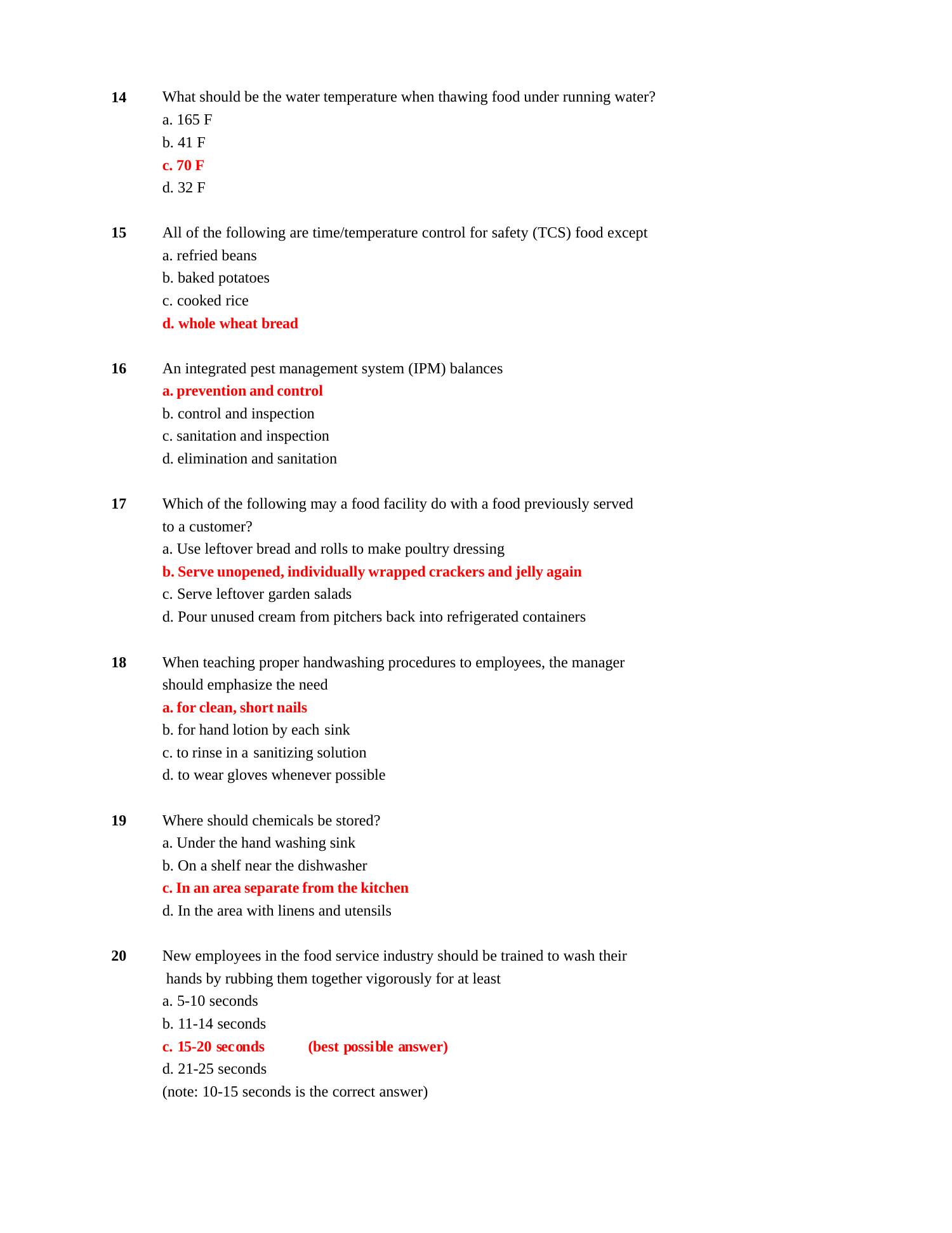
14
What should be the water temperature when thawing food under running water?
a. 165 F
b. 41 F
c. 70 F
d. 32 F
15
All of the following are time/temperature control for safety (TCS) food except
a. refried beans
b. baked potatoes
c. cooked rice
d. whole wheat bread
16
An integrated pest management system (IPM) balances
a. prevention and control
b. control and inspection
c. sanitation and inspection
d. elimination and sanitation
17
Which of the following may a food facility do with a food previously served
to a customer?
a. Use leftover bread and rolls to make poultry dressing
b. Serve unopened, individually wrapped crackers and jelly again
c. Serve leftover garden salads
d. Pour unused cream from pitchers back into refrigerated containers
18 When teaching proper handwashing procedures to employees, the manager
should emphasize the need
a. for clean, short nails
b. for hand lotion by each sink
c. to rinse in a sanitizing solution
d. to wear gloves whenever possible
19 Where should chemicals be stored?
a. Under the hand washing sink
b. On a shelf near the dishwasher
c. In an area separate from the kitchen
d. In the area with linens and utensils
20
New employees in the food service industry should be trained to wash their
hands by rubbing them together vigorously for at least
a. 5-10 seconds
b. 11-14 seconds
c. 15-20 seconds (best possible answer)
d. 21-25 seconds
(note: 10-15 seconds is the correct answer)