Preparing For The ACT Test

Preparing For The ACT Test

This document is a comprehensive study guide for the ACT Test, covering essential test-taking strategies, practice tests, and detailed information about each section of the exam. Published by ACT Education Corp, it includes a full-length practice ACT test, insights on the English, Mathematics, Reading, and Science sections, and tips for optimizing performance on test day.

282
/ 82
2025
l
2026
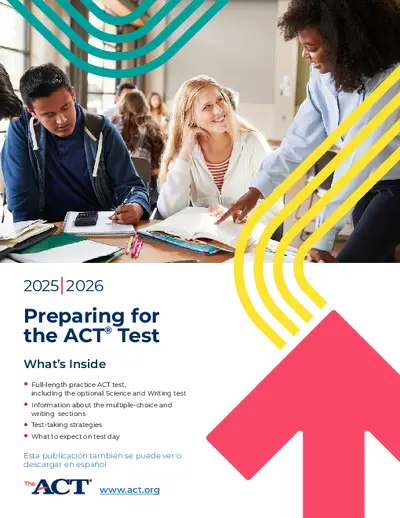
Preparing for
the A C T
®
Test
What’s Inside
y
Full-length practice A C T test,
including the optional Science and Writing test
y
Information about the multiple-choice and
writing sections
y
Test-taking strategies
y
What to expect on test day
Esta publicación también se puede ver o
descargar en español
www.act.org
© 2026 by ACT Education Corp. All rights reserved. Page 2 of 82 QU00002.CJ22893
Contents
A Message toStudents 2
Overview of theA C T 2
Test-Taking Strategies 3
Prohibited Behavior at the Test Center 6
Content of the A C T Sections 6
Taking the Practice Tests 12
Practice Multiple Choice Test 13
Practice Writing Test 60
Practice Answer Document 64
How to Score the Practice Multiple-Choice
Tests 72
Scoring the Practice Writing Test 78
Next Steps 81
A Message toStudents
This document is an important first step as you get ready for college and your
career.
The information here is intended to help you do your best on the A C T to gain
admission to colleges and universities. Included are helpful hints and test-
taking strategies, as well as a complete practice A C T, with “retired” questions
from earlier test subjects given on previous test dates at A C T test centers. Also
featured are a practice writing test, a sample answer document, answer keys,
and self-scoring instructions.
Read this document carefully and take the practice tests well before test day.
That way, you will be familiar with the test format, test subjects and what they
measure, and strategies you can use to do your best on test day.
You may also want to consider
The Official A C T
®
Self-Paced Course, Powered
by Kaplan
®
to learn test content and strategies in a virtual classroom. To view all
of our test preparation options, go to www.act.org/the-act/testprep.
Overview of theA C T
The A C T test consists of three multiple-choice
sections—English, mathematics, and reading.
Students may opt to take an optional multiple-
choice science section and/or an optional
writing section. Some colleges and universities
require or accept A C T science or writing scores,
so you may consider taking the science and
writing sections.
Test Questions Minutes per Test
English 50 (40 scored) 35
Mathematics 45 (41 scored) 50
Reading 36 (27 scored) 40
Science (optional) 40 (34 scored) 40
Writing (optional) 1 essay 40
Each of the multiple-choice sections will
include some embedded field test items
that will not be included in your score. The
results of the embedded field test items help
develop future test questions. These items are
not labeled, so you will not know which items
contribute to your score. You should try your
best on all items.
© 2026 by ACT Education Corp. All rights reserved. Page 3 of 82 QU00002.CJ22893
Test-Taking Strategies
Test Strategies for the A C T
Each multiple-choice section contains
questions with four answers from which you
are to choose the correct or best answer.
If you do not complete all your sections and
want to test again, you will need to re-register
and pay for a new test date. Once you access
test content, you cannot request a Test Date
Change.
Strategies to help you prepare for the
A C T
9
Get familiar with the content of the
sections.
Review the information in this document.
Note which content areas make up a large
proportion of the sections. The topics included
in each content area are examples of possible
topics; they do not include all possibilities.
9
Update your knowledge and skills in the
content areas.
Review content areas that you have studied but
that are not fresh in your mind. Refresh your
knowledge in the content areas that make up
large portions of the test.
9
Study content areas you are not familiar with.
If some content areas of the A C T are unfamiliar
to you, consider taking coursework in those
areas before you take the test.
Tips for Taking the Multiple-Choice
Sections
9
Pace yourself.
It is important that you have enough time to
read the passages/questions and figure out
your responses. For each section, subtract
the number of minutes you estimate you will
spend skimming the passages or reading the
information provided, then divide the total
number of remaining minutes allowed by
the number of questions to determine the
estimated time you should spend on each
question. If possible, spend less time on each
question and use the remaining time allowed
for a section to review your work and return to
the questions in that section that were most
difficult for you.
The time limits set for each section give
nearly everyone enough time to finish all the
questions.
However, you will want to pace yourself to avoid
spending too much time on one passage or
puzzling over an answer to a specific problem.
If you don’t know how to work toward an
answer to a question, it is a better strategy to
guess, flag the question, and then move on to
other questions that you know how to do. If
there is time, you can come back to the flagged
questions.
9
Read the directions carefully.
Before you begin each section, read the
directions carefully.This should occur before
you take the test so that you do not use testing
time.
y
The English, reading, and science sections
ask for the best answer. Read and consider
all of the answer choices and choose the
answer that best responds to the question.
y
The mathematics section asks for the
correct answer. You may want to work out
the answer you feel is correct and look for
it among the choices given. If your answer
is not among the choices provided, reread
the question and consider all the answer
choices.
9
Read each question carefully.
You need to understand exactly what each
question asks. Some questions will require you
to go through several steps to find the correct
or best answer, while others can be answered
more quickly.
9
Answer the easy questions first.
A good strategy is to answer the easy questions
and skip the questions you find difficult. After
answering the easy questions, go back and
answer the more difficult questions if you have
time.
9
Use logic on more difficult questions.
When you return to the more difficult
questions, try to use logic to eliminate incorrect
answers. Compare the answer choices to
each other and note how they differ. Such
differences may provide clues as to what the
question requires. Eliminate as many incorrect
answers as you can, then make an educated
guess from the remaining answers.
9
Answer every question.
Your scores in the sections will be based only
on the number of questions that you answer
correctly; there is no penalty for guessing. Try to
answer every question within the time allowed
for each section.
/ 82
End of Document
282

You May Also Like

Related of Preparing For The ACT Test