President’s Challenge Qualifying Standards for Youth Fitness

President’s Challenge Qualifying Standards for Youth Fitness

The President’s Challenge outlines the qualifying standards for youth fitness awards, including the Presidential Physical Fitness Award and the National Physical Fitness Award. It details the required performance levels for boys and girls across five fitness events, based on the 1985 School Population Fitness Survey. This guide is essential for educators and coaches aiming to assess and encourage physical fitness among students. It also includes testing guidelines, event descriptions, and scoring methods for each fitness assessment. Designed for physical education programs, it supports students in achieving their fitness goals.

Key Points

  • Outlines qualifying standards for the Presidential Physical Fitness Award and National Physical Fitness Award.
  • Details five fitness events including curl-ups, shuttle runs, and endurance runs for youth assessment.
  • Provides testing guidelines and scoring methods for accurate evaluation of student fitness.
  • Encourages regular fitness testing as part of a comprehensive physical education program.
86
/ 7
1
President’s Challenge
Qualifying standards
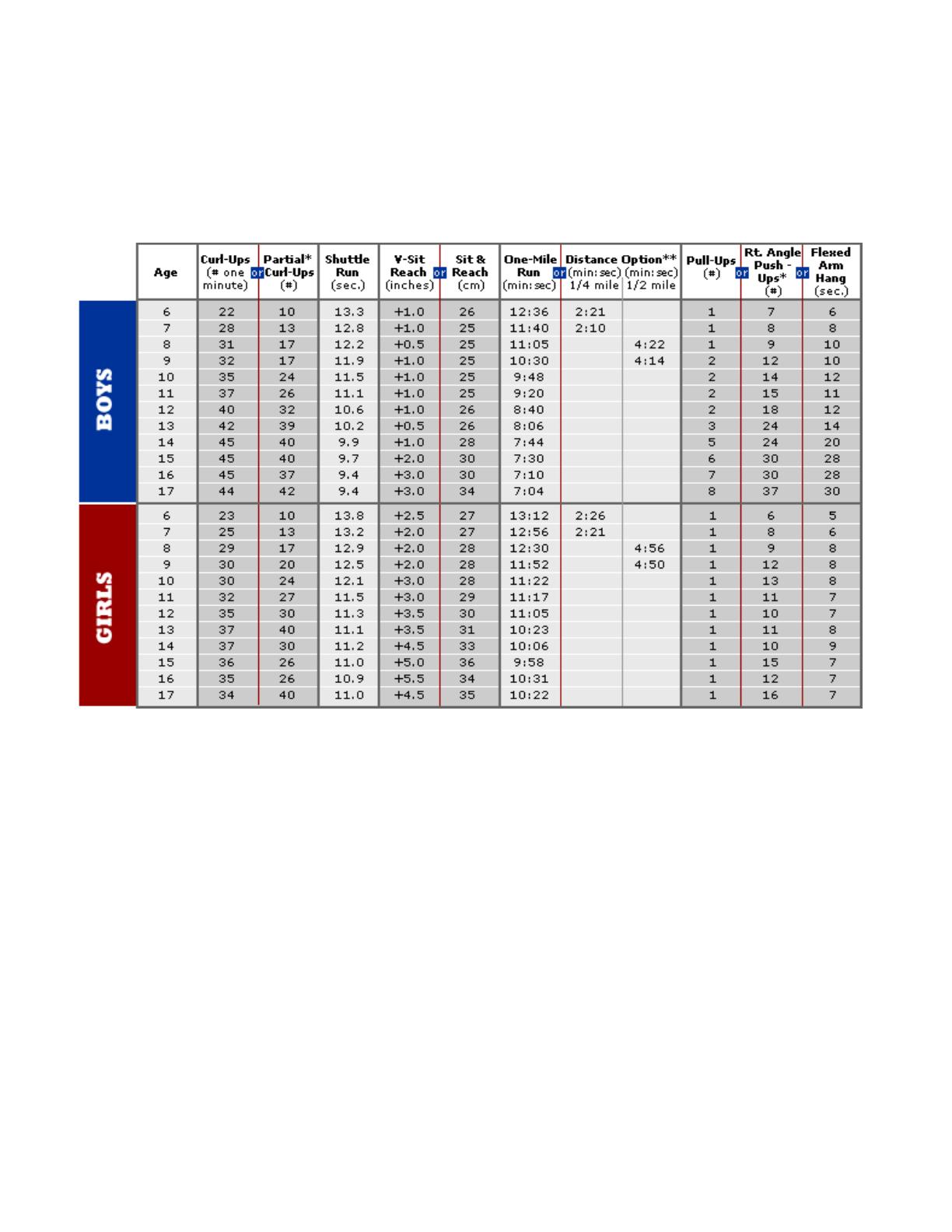
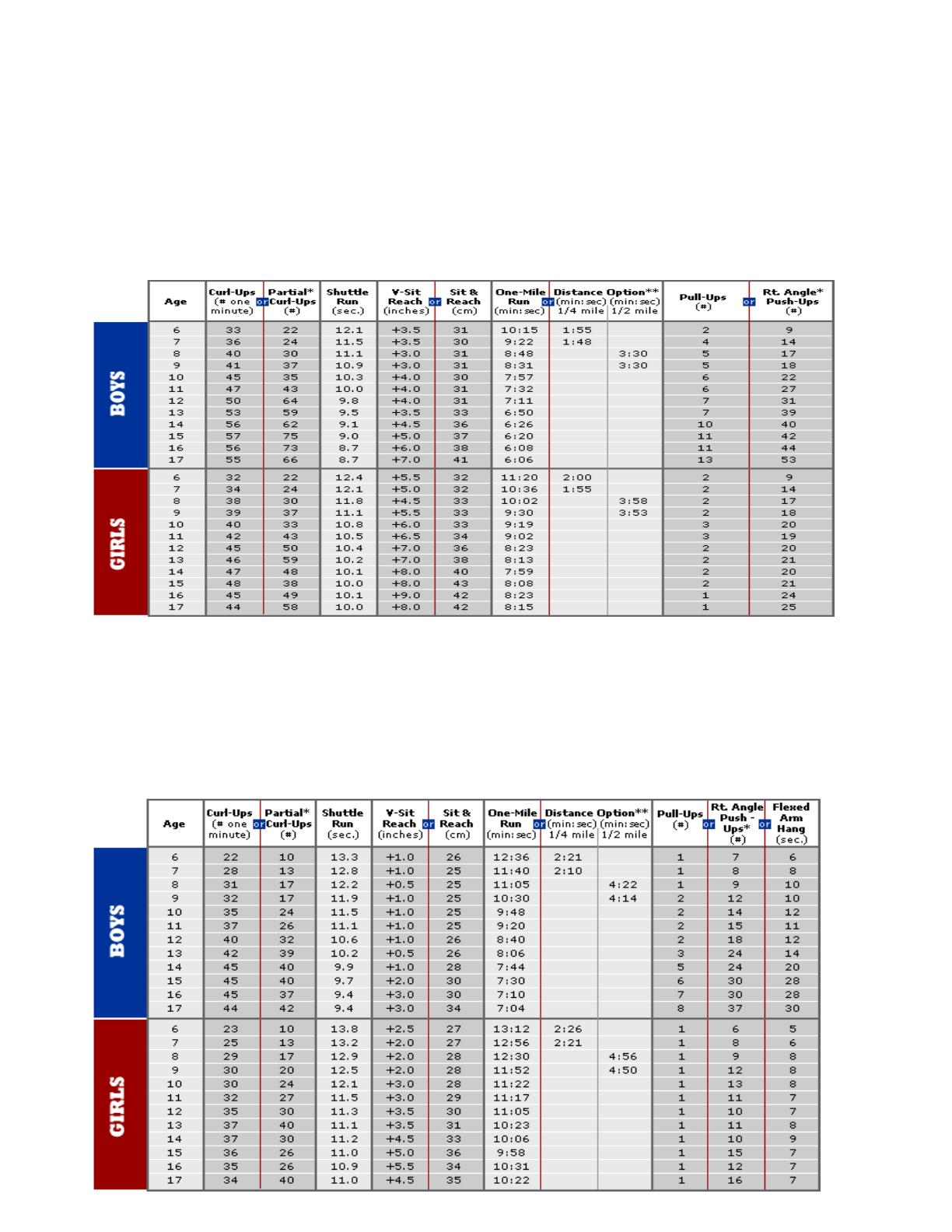
The Presidential Physical Fitness Award
Participants must at least reach these levels in all 5 events in order to qualify for the Presidential
Physical Fitness Award. These levels represent the 85th percentile based on the 1985 School
Population Fitness Survey.
The Presidential Physical Fitness Award
(This represents the 85th percentile.)
The National Physical Fitness Award
Participants must at least reach these levels in all 5 events in order to qualify for
the National Physical Fitness Award. These levels represent the 50th percentile
based on the 1985 School Population Fitness Survey.
The National Physical Fitness Award
(This represents the 50th percentile.)
2
The Participant Physical Fitness Award
Boys and Girls who attempt all five items, but whose scores fall below the 50th percentile on one
or more of them are eligible to receive the Participant Award.
The National Physical Fitness Award
(This represents the 50th percentile.)
Testing guidelines and events
The PCPFS recommends fitness testing at least twice each year, in the fall and spring. It works
best as part of a complete physical education program that supports testing with educational and
motivational information.
Before conducting The President's Challenge, or any youth fitness test, you should review each
student's medical status to identify medical, orthopedic or other health problems that should be
considered.
Before you begin, make sure all students know the correct techniques for all tests, including
proper pacing and running style. There is no limit to the number of tries students may have on
each event.
*When determining award levels, use the age of the student at the start of testing.
3
Physical Fitness Test Events
Curl-ups (or partial curl-ups)
This event measures abdominal strength and endurance.
Curl-ups test
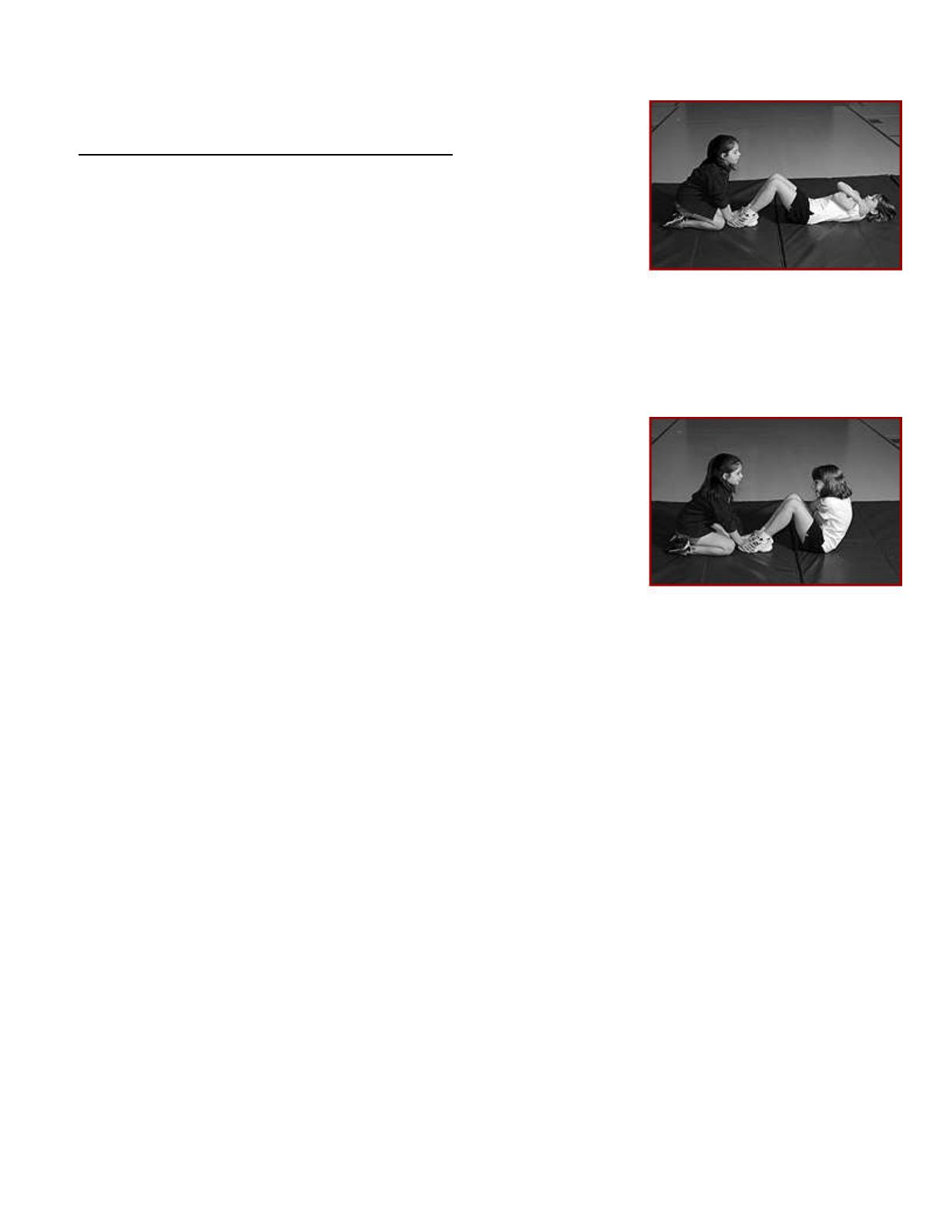
Have student lie on cushioned, clean surface with knees flexed and
feet about 12 inches from buttocks. Partner holds feet. Arms are
crossed with hands placed on opposite shoulders and elbows held close to chest. Keeping this
arm position, student raises the trunk curling up to touch elbows to thighs and then lowers the
back to the floor so that the scapulas (shoulder blades) touch the floor, for one curl-up. To start,
a timer calls out the signal "Ready? Go!" and begins timing student for one minute. The student
stops on the word "stop."
Curl-ups tip
Instruct helpers to count aloud the number of repetitions.
Curl-ups scoring
"Bouncing" off the floor is not permitted. The curl-up should be
counted only if performed correctly.
Partial curl-ups test
Have student lie on cushioned, clean surface with knees flexed and feet about 12 inches from
buttocks. Do not hold or anchor the feet. Arms are extended forward with fingers resting on the
legs and pointing toward the knees. The student's partner is behind the head with hands cupped
under the student's head. The student being tested curls up slowly sliding the fingers up the legs
until the fingertips touch the knees, then back down until the head touches the partner's hands.
The curl-ups are done to a metronome (or audio tape, clapping, drums) with one complete curl-
up every three seconds, and are continued until the student can do no more in rhythm (has not
done the last three in rhythm) or has reached the target number for the test.
Partial curl-ups tip
Make sure that the participant's arm is fully extended from the starting position.
Partial curl-ups scoring
Record only those curl-ups done with proper form and in rhythm.
Partial curl-ups rationale
Done slowly with knees bent and feet not held, the partial curl-up is a better indicator of
abdominal strength and endurance than the timed curl-ups.
/ 7
End of Document
86
You May Also Like

FAQs of President’s Challenge Qualifying Standards for Youth Fitness

What are the five fitness events in the President’s Challenge?
The President’s Challenge includes five fitness events: curl-ups (or partial curl-ups), shuttle runs, endurance run/walk, pull-ups (or right angle push-ups), and the V-sit reach (or sit and reach). Each event measures different aspects of physical fitness such as strength, endurance, speed, and flexibility. These assessments help determine eligibility for the Presidential and National Physical Fitness Awards.
How are scores recorded for the curl-ups event?
For the curl-ups event, students must perform the exercise correctly to have their repetitions counted. A partner holds the student's feet while they curl up to touch their elbows to their thighs and then lower back down until their shoulder blades touch the floor. The total number of correct curl-ups performed in one minute is recorded as the score.
What is the purpose of the endurance run/walk in the President’s Challenge?
The endurance run/walk measures heart and lung endurance, encouraging students to cover a one-mile distance as quickly as possible. Students can alternate between running and walking, but they are motivated to complete the distance in the shortest time. This event helps assess cardiovascular fitness, which is crucial for overall health.
What are the scoring criteria for the shuttle run?
In the shuttle run, students must run back and forth between two lines spaced 30 feet apart, picking up blocks placed behind one of the lines. Scores are recorded to the nearest tenth of a second, and participants must run through the finish line to ensure accurate timing. This event tests speed, agility, and quickness.
How does the V-sit reach assess flexibility?
The V-sit reach measures flexibility in the lower back and hamstrings. Students sit on the floor with their legs extended and attempt to reach forward as far as possible while keeping their feet flexed. The distance reached is recorded, with plus scores for reaching beyond the baseline and minus scores for reaching behind it.
What guidelines are recommended for conducting fitness tests?
The President’s Challenge recommends conducting fitness tests at least twice a year, ideally in fall and spring. It emphasizes the importance of reviewing each student's medical status before testing and ensuring that students understand the correct techniques for each event. Additionally, ample practice and warm-up time are encouraged to help students perform their best.
What is the significance of the Presidential Physical Fitness Award?
The Presidential Physical Fitness Award recognizes students who achieve high performance levels in physical fitness assessments. It motivates youth to engage in regular physical activity and promotes a culture of fitness and health in schools. Achieving this award can encourage lifelong habits of exercise and wellness among students.

Related of President’s Challenge Qualifying Standards for Youth Fitness