Second Tri-Service Environmental Technology Workshop, ‘Enhancing Readiness Through Environmental Quality Technology,’ 10-12 June 1997, St. Louis, Missouri, Proceedings.

Second Tri-Service Environmental Technology Workshop, 'Enhancing Readiness Through Environmental Quality Technology,' 10-12 June 1997, St. Louis, Missouri, Proceedings.

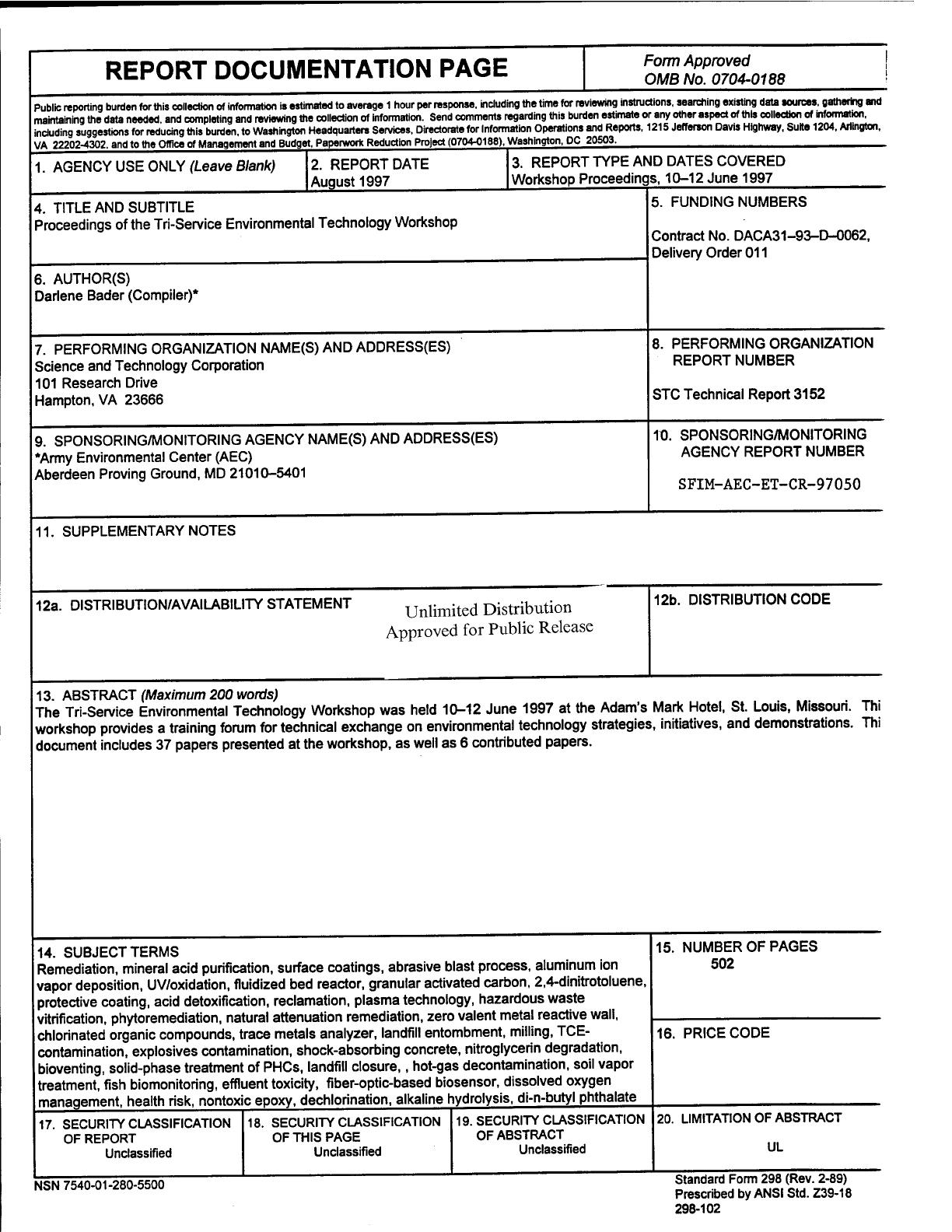
The Tri-Service Environmental Technology Workshop, held from June 10-12, 1997, in St. Louis, Missouri, focused on enhancing military readiness through environmental quality technology. This workshop featured 37 technical papers and 6 contributed papers discussing innovative environmental technology strategies, including topics such as hazardous waste remediation, bioventing, and phytoremediation. Compiled by Darlene Bader, the proceedings provide valuable insights for military and environmental professionals interested in the latest advancements in environmental technology. The document serves as a comprehensive resource for understanding the intersection of environmental quality and military operations, making it essential for researchers and practitioners in environmental science and technology fields.

Key Points

  • Includes 37 technical papers on environmental technology strategies
  • Covers topics like hazardous waste remediation and phytoremediation
  • Provides insights from military and environmental professionals
  • Documents advancements in environmental quality technology for military readiness
372
/ 464
PROCEEDINGS
^^Tri-Service
Environmental
Technology
Workshop
"Enhancing
Readiness
Through
Environmental
Quality
Technology"
y.
.-.
.,„.-
|
--""-°--"'"t«o«lw
J
v
W
«
,
I
.
.
.
Approved
tor
pursue
raieauj
PJS'3
'o&n&asi
Uxdmxmi
10-12
JUNE
1997
ST.
Louis,
MISSOURI
Mm
057
DTIC
QUALITY
MEFSCTED
3
Hosted
by:
U.S.
ARMY
ENVIRONMENTAL
CENTER
PROCEEDINGS
TRI-SERVICE
ENVIRONMENTAL
TECHNOLOGY
WORKSHOP
10-12
June
1997
St.
Louis,
Missouri
DTIC
QUAUT?
mSFS^TED
3*
Hosted
by:
U.S.
ARMY
ENVIRONMENTAL
CENTER
REPORT
DOCUMENTATION
PAGE
Form
Approved
OMB
No.
0704-0188
Public
reporting
burden
for
this
collection
of
information
is
estimated
to
average
1
hour
per
response,
including
the
time
for
reviewing
instructions,
searching
existing
data
sources,
gathering
and
maintaining
the
data
needed,
and
completing
and
reviewing
the
collection
of
information.
Send
comments
regarding
this
burden
estimate
or
any
other
aspect
of
this
collection
of
information,
including
suggestions
for
reducing
this
burden,
to
Washington
Headquarters
Services,
Directorate
for
Information
Operations
and
Reports,
1215
Jefferson
Davis
Highway,
Suite
1204,
Arlington,
VA
22202-4302.
and
to
the
Office
of
Management
and
Budget,
Paperwork
Reduction
Project
(0704-0188),
Washington,
DC
20503.
1.
AGENCY
USE
ONLY
(Leave
Blank)
2.
REPORT
DATE
August
1997
3.
REPORT
TYPE
AND
DATES
COVERED
Workshop
Proceedings,
10-12
June
1997
4.
TITLE
AND
SUBTITLE
Proceedings
of
the
Tri-Service
Environmental
Technology
Workshop
6.
AUTHOR(S)
Darlene
Bader
(Compiler)*
7.
PERFORMING
ORGANIZATION
NAME(S)
AND
ADDRESS(ES)
Science
and
Technology
Corporation
101
Research
Drive
Hampton,
VA
23666
9.
SPONSORING/MONITORING
AGENCY
NAME(S)
AND
ADDRESS(ES)
*Army
Environmental
Center
(AEC)
Aberdeen
Proving
Ground,
MD
21010-5401
5.
FUNDING
NUMBERS
Contract
No.
DACA31-93-D-0062,
Delivery
Order
011
8.
PERFORMING
ORGANIZATION
REPORT
NUMBER
STC
Technical
Report
3152
10.
SPONSORING/MONITORING
AGENCY
REPORT
NUMBER
SFIM-AEC-ET-CR-97050
11.
SUPPLEMENTARY
NOTES
12a.
DISTRIBUTION/AVAILABILITY
STATEMENT
Unlimited
Distribution
Approved
for
Public
Release
12b.
DISTRIBUTION
CODE
13.
ABSTRACT
(Maximum
200
words)
The
Tri-Service
Environmental
Technology
Workshop
was
held
10-12
June
1997
at
the
Adam's
Mark
Hotel,
St.
Louis,
Missoun.
Thi
workshop
provides
a
training
forum
for
technical
exchange
on
environmental
technology
strategies,
initiatives,
and
demonstrations.
Thi
document
includes
37
papers
presented
at
the
workshop,
as
well
as
6
contributed
papers.
14.
SUBJECT
TERMS
Remediation,
mineral
acid
purification,
surface
coatings,
abrasive
blast
process,
aluminum
ion
vapor
deposition,
UV/oxidation,
fluidized
bed
reactor,
granular
activated
carbon,
2,4-dinitrotoluene,
protective
coating,
acid
detoxification,
reclamation,
plasma
technology,
hazardous
waste
vitrification,
phytoremediation,
natural
attenuation
remediation,
zero
valent
metal
reactive
wall,
chlorinated
organic
compounds,
trace
metals
analyzer,
landfill
entombment,
milling,
TCE-
contamination,
explosives
contamination,
shock-absorbing
concrete,
nitroglycerin
degradation,
bioventing,
solid-phase
treatment
of
PHCs,
landfill
closure,,
hot-gas
decontamination,
soil
vapor
treatment,
fish
biomonitoring,
effluent
toxicity,
fiber-optic-based
biosensor,
dissolved
oxygen
management,
health
risk,
nontoxic
epoxy,
dechlorination,
alkaline
hydrolysis,
di-n-butyl
phthalate
17.
SECURITY
CLASSIFICATION
OF
REPORT
Unclassified
18.
SECURITY
CLASSIFICATION
OF
THIS
PAGE
Unclassified
19.
SECURITY
CLASSIFICATION
OF
ABSTRACT
Unclassified
15.
NUMBER
OF
PAGES
502
16.
PRICE
CODE
20.
LIMITATION
OF
ABSTRACT
UL
NSN
7540-01-280-5500
Standard
Form
298
(Rev.
2-89)
Prescribed
by
ANSI
Std.
Z39-18
298-102
/ 464
End of Document
372
You May Also Like

FAQs of Second Tri-Service Environmental Technology Workshop, ‘Enhancing Readiness Through Environmental Quality Technology,’ 10-12 June 1997, St. Louis, Missouri, Proceedings.

What are the key topics discussed in the Tri-Service Environmental Technology Workshop?
The Tri-Service Environmental Technology Workshop covered a range of key topics including hazardous waste remediation, bioventing, phytoremediation, and innovative technologies for environmental cleanup. Specific discussions included mineral acid purification, UV/oxidation processes, and the use of granular activated carbon in remediation efforts. The workshop aimed to enhance military readiness by exploring effective environmental quality technologies and strategies.
Who compiled the proceedings of the Tri-Service Environmental Technology Workshop?
The proceedings of the Tri-Service Environmental Technology Workshop were compiled by Darlene Bader. Her work brought together a diverse range of technical papers presented during the workshop, highlighting the contributions of various experts in the field of environmental technology. This compilation serves as a valuable resource for understanding the advancements discussed at the workshop.
What is the significance of the Tri-Service Environmental Technology Workshop for military operations?
The Tri-Service Environmental Technology Workshop is significant for military operations as it focuses on enhancing readiness through improved environmental quality technologies. By addressing environmental challenges and exploring innovative solutions, the workshop aims to ensure that military operations can proceed without compromising environmental standards. The insights gained from the workshop are crucial for developing effective strategies to manage environmental impacts associated with military activities.
What types of papers were presented at the workshop?
At the Tri-Service Environmental Technology Workshop, a total of 37 technical papers and 6 contributed papers were presented. These papers encompassed a variety of topics related to environmental technology, including remediation techniques, environmental monitoring, and innovative cleanup technologies. The diversity of topics reflects the workshop's goal of fostering technical exchange and collaboration among military and environmental professionals.

Related of Second Tri-Service Environmental Technology Workshop, ‘Enhancing Readiness Through Environmental Quality Technology,’ 10-12 June 1997, St. Louis, Missouri, Proceedings.