The Act Test Is Evolving

The Act Test Is Evolving

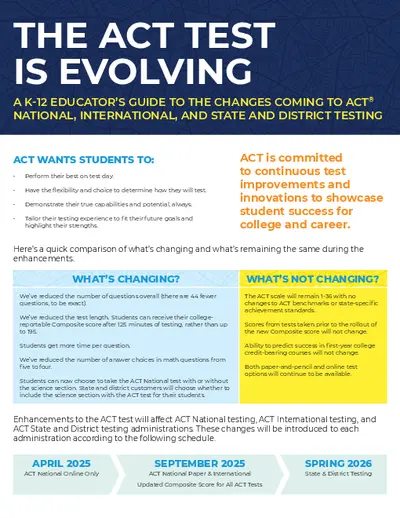
The ACT test is evolving with significant changes set to roll out in 2025, impacting both national and international testing formats. Key updates include a reduction in the number of questions and test length, allowing students to receive their Composite score after just 125 minutes. Students will have the option to take the ACT without the science section, tailoring their testing experience to their strengths. These enhancements aim to better reflect student capabilities and improve the overall testing experience for college readiness. Educators and students alike can benefit from understanding these changes to prepare effectively for upcoming exams.

Key Points

  • Reduces total questions by 44, enhancing focus on key skills.
  • Shortens test duration to 125 minutes for quicker score reporting.
  • Allows students to opt out of the science section for a customized experience.
  • Maintains a Composite score scale of 1-36, ensuring consistency in scoring.
132
/ 2
THE ACT TEST
IS EVOLVING
A K-12 EDUCATOR’S GUIDE TO THE CHANGES COMING TO ACT
®
NATIONAL, INTERNATIONAL, AND STATE AND DISTRICT TESTING
APRIL 2025 SEPTEMBER 2025 SPRING 2026
Enhancements to the ACT test will affect ACT National testing, ACT International testing, and
ACT State and District testing administrations. These changes will be introduced to each
administration according to the following schedule.
ACT is committed
to continuous test
improvements and
innovations to showcase
student success for
college and career.
ACT WANTS STUDENTS TO:
Perform their best on test day.
Have the flexibility and choice to determine how they will test.
Demonstrate their true capabilities and potential, always.
Tailor their testing experience to fit their future goals and
highlight their strengths.
Here’s a quick comparison of what’s changing and what’s remaining the same during the
enhancements.
ACT National Online Only ACT National Paper & International
Updated Composite Score for All ACT Tests
State & District Testing
WHATS CHANGING? WHATS NOT CHANGING?
We’ve reduced the number of questions overall (there are 44 fewer
questions, to be exact).
We’ve reduced the test length. Students can receive their college-
reportable Composite score after 125 minutes of testing, rather than up
to 195.
Students get more time per question.
We’ve reduced the number of answer choices in math questions from
five to four.
Students can now choose to take the ACT National test with or without
the science section. State and district customers will choose whether to
include the science section with the ACT test for their students.
The ACT scale will remain 1-36 with no
changes to ACT benchmarks or state-specific
achievement standards.
Scores from tests taken prior to the rollout of
the new Composite score will not change.
Ability to predict success in first-year college
credit-bearing courses will not change.
Both paper-and-pencil and online test
options will continue to be available.
MR038185
SCORES REPORTED ON THE ACT STARTING APRIL 2025
IN SEPTEMBER 2025:
WILL ACT STILL PROVIDE A SUPERSCORE? HOW WILL IT WORK?
Beginning with the April 2025 National online test, the ACT Composite score will be
based on performance on the English, math, and reading sections. Students will
still have the option to take all five sections previously offered, including science and
writing, allowing for a more tailored testing experience. Those who opt to take the
science section will also receive a STEM score, and those who choose to take the
writing section will also receive an ELA score (all section scores will still be provided).
The new ACT Composite score calculation will be used for all students (all National, International,
and State and District contract students).
This change ensures that higher education institutions receive consistent Composite scores from
September 2025 onward.
Students who take the science section will receive individual science section scores and a STEM
score (if they completed math).
ACT will not change how we send information to higher education institutions.
What is an ACT Superscore? A Superscore is the average of a student’s best scores from each
section from multiple test attempts.
Starting in April 2025, students choosing to take the National online test will have their ACT
Superscore calculated using their English, math, and reading scores.
For all other students, this transition to the English/math/reading calculation will take place in
September 2025.
A student’s Superscore can be calculated from section scores from test events before and after the
transition to the new Composite. If a student takes a test after September 2025, their Superscore
will be based on their English, math, and reading performance (if no tests are taken after September
2025, the last calculated Superscore, based on English, math, reading, and science, will continue
to be available). ACT will still report the highest score for each section with the test date, but the
Composite score will now be based on a simplified calculation of English, math, and reading scores.
For full details and the supporting evidence,
visit act.org/
enhancementsK12
©2025 by ACT Education Corp. All rights reserved.
WHEN STUDENTS TAKE: THEY WILL RECEIVE:
The ACT Test (English, Math, and Reading sections) Composite Score
The ACT Test with Writing Composite and ELA Scores
The ACT Test with Science Composite and STEM Scores
The ACT Test with Science and Writing Composite, STEM, and ELA Scores
/ 2
End of Document
132
You May Also Like

FAQs of The Act Test Is Evolving

What are the main changes to the ACT test in 2025?
The ACT test will see several key changes starting in 2025, including a reduction in the total number of questions by 44 and a shortened test duration of 125 minutes. Students will now have the flexibility to choose whether to include the science section in their test, allowing for a more personalized assessment of their skills. Additionally, the number of answer choices in math questions will decrease from five to four, making it easier for students to focus on their responses. These changes are designed to better reflect student capabilities and improve their testing experience.
How will the Composite score be calculated after the changes?
Beginning in April 2025, the ACT Composite score will be calculated based on performance in the English, math, and reading sections. Students will still have the option to take the science and writing sections, which will provide additional scores such as STEM and ELA. This new calculation method ensures that higher education institutions receive consistent Composite scores, facilitating a clearer understanding of student performance. The transition to this new scoring system will apply to all students, enhancing the overall clarity and effectiveness of the ACT.
What is an ACT Superscore and how will it work?
An ACT Superscore is the average of a student's best section scores from multiple test attempts. Starting with the April 2025 National online test, the Superscore will be calculated using scores from the English, math, and reading sections. For students who take the science section, individual science scores and a STEM score will also be provided. This approach allows students to present their highest achievements across different test dates, making it a valuable tool for college admissions.
Will the ACT still report scores from previous tests after the changes?
Yes, the ACT will continue to report scores from tests taken prior to the rollout of the new Composite score system. Students will still have access to their highest section scores from previous attempts, even after the transition to the new scoring method. This ensures that students can leverage their best performances when applying to colleges, maintaining a comprehensive record of their achievements.


Related of The Act Test Is Evolving